Glow Peptides · Research Journal
CJC-1295 With and Without DAC: What the Difference Is
Glow Peptides Research Team · 2026-09-15
For research use only. Not for human or veterinary use, diagnostic use, or in any therapeutic application.
Two molecules, not two grades
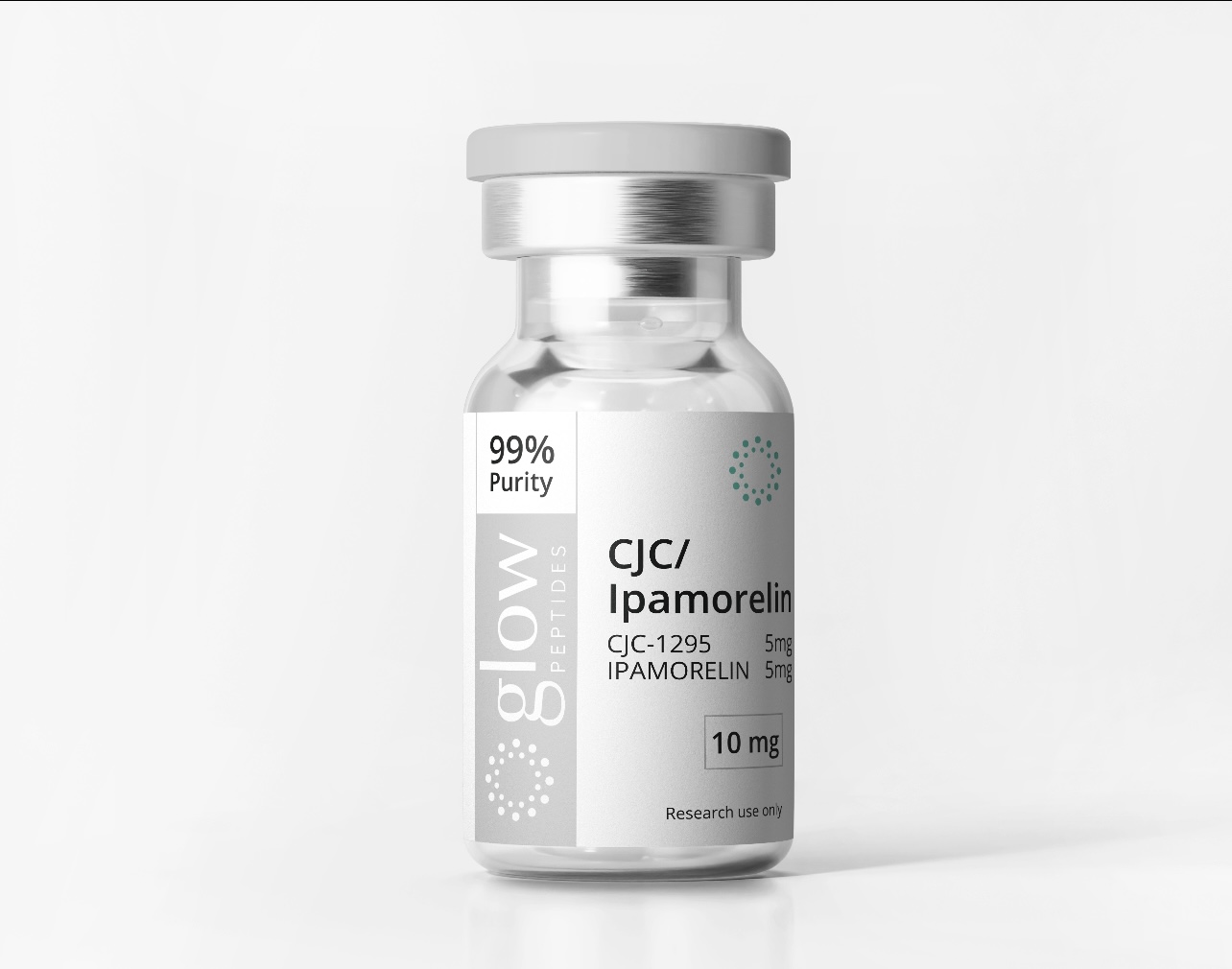
CJC-1295 with DAC and CJC-1295 without DAC are two chemically distinct compounds, not two grades of one product. DAC stands for drug affinity complex, a chemical group bonded to the peptide chain. Because the two molecules differ in composition, they differ in molecular mass, and mass spectrometry on a certificate of analysis is what confirms which one is in a vial. Glow Peptides supplies CJC/Ipamorelin as a research peptide at 10 mg in a 3 mL vial, with a lot-specific certificate of analysis behind every released batch.
- DAC stands for drug affinity complex, and in CJC-1295 it refers to a chemical modification bonded to the peptide, not to a different concentration or a different grade of the same material.
- PubChem records CJC-1295 under CID 91971820, with the molecular formula C165H269N47O46 and a molecular weight of 3,647.2 g/mol.
- PubChem describes that record as "a maleimido derivative of hGRF(1-29)". The maleimido group is the drug affinity complex, so CID 91971820 and its 3,647.2 g/mol describe the with-DAC form. No verified mass for the non-DAC form is stated on this page.
- CJC-1295 with DAC and CJC-1295 without DAC are chemically distinct, so they differ in mass, and mass spectrometry is the analytical method that tells them apart.
- Glow Peptides supplies CJC/Ipamorelin at 10 mg in a 3 mL vial at ≥99.2% (HPLC), and lot 260410-HP-CP10-03 has its own certificate of analysis page.
What CJC-1295 is, compositionally
CJC-1295 is a synthetic analog of growth hormone-releasing hormone. That is a statement about how the molecule is built, not about what it is for, and everything that follows treats the compound purely as a chemical entity with a formula, a mass and a documented identity.
The public chemical record is the place to start, because it is the reference a laboratory checks a certificate against. PubChem, the chemical database maintained by the National Center for Biotechnology Information, lists CJC-1295 under Compound Identifier 91971820. Three fields on that record do the work:
- Molecular formula: C165H269N47O46. This is an atom count. It says how many carbon, hydrogen, nitrogen and oxygen atoms the molecule contains, and nothing else.
- Molecular weight: 3,647.2 g/mol. This is the mass that follows from that atom count. It is the number an analytical laboratory expects to observe when it runs the compound on a mass spectrometer.
- Description: "a maleimido derivative of hGRF(1-29)". PubChem's own wording. Read it as two halves. The second half, hGRF(1-29), names the parent peptide sequence the compound is derived from. The first half, maleimido derivative, names the modification made to that parent sequence.
That description is the whole article in miniature. CJC-1295, as PubChem records it, is not simply a peptide sequence. It is a peptide sequence plus a specified chemical modification. Once that is understood, the with-DAC and without-DAC question stops being a labeling detail and becomes a question about which molecule is actually in the vial.
It also settles which of the two versions the PubChem record is describing, and that point is worth making explicitly rather than leaving a reader to join it up. The maleimido group named in the description is the drug affinity complex. A record for a maleimido derivative of hGRF(1-29) is therefore a record for the modified molecule, which is to say the with-DAC form. The formula C165H269N47O46 and the molecular weight of 3,647.2 g/mol belong to that form, and they should not be quoted against a vial labeled without DAC. No molecular weight for the non-DAC form appears anywhere on this page, because none was found in the chemical database consulted, and the point of a page about identity confirmation is defeated the moment it publishes an unverified mass.
What DAC means and what it adds to the molecule
DAC stands for drug affinity complex. The term names a chemical group that is bonded to the peptide, and the reason it matters here is structural: the group is part of the molecule, not an additive suspended alongside it, not a carrier, and not a stabilizer mixed into the vial. It is covalently joined to the peptide chain, which means the finished substance is a single compound with a single formula rather than a mixture of two things.
The maleimido term in the PubChem description is the chemistry that makes that joining possible. A maleimido group is a reactive chemical handle, and a maleimido derivative is a molecule that carries one. That reactive group is what allows a defined chemical complex to be attached to the peptide at a defined point rather than loosely associated with it.
The compositional consequence stands on its own and is fully verifiable: adding a chemical group to a peptide adds atoms to the molecule, and adding atoms changes the formula and the mass. Everything a buyer can independently confirm about which version is in a vial follows from that single fact.
Why this is an identity question and not a strength question
The most common misreading of this whole topic is that with-DAC and without-DAC describe two versions of one product, in the way that two strengths of the same material describe one product at different concentrations. They do not. They describe two different molecules, and that changes which analytical question has to be asked.
The two situations are handled differently in a laboratory. Two strengths of one compound share a formula and a molecular weight, and are distinguished by quantity. Two different compounds share neither, and are distinguished by identity testing. CJC-1295 with DAC and CJC-1295 without DAC fall into the second category.
What is being compared — Two strengths of one compound — CJC-1295 with DAC and without DAC
Molecular formula — Identical — Different
Molecular weight — Identical — Different
How they are told apart — By the stated quantity in the vial — By identity testing, including mass spectrometry
Certificate treatment — One compound, different strength entries — Two compounds, separate certificate records
What a wrong label means — A quantity error — A different substance from the one named
That last row is the reason this is an identity question rather than a preference question. If a vial is mislabeled between two strengths of the same compound, the material inside is still the compound named on the label. If a vial is mislabeled between the with-DAC and without-DAC forms, the material inside is a different substance from the one named on the label, and no amount of reading the label more carefully will reveal that. Only analytical documentation will.
How mass spectrometry tells them apart
Mass spectrometry measures the mass of the molecules in a sample. Because the two versions of CJC-1295 are chemically distinct, they carry different masses, and a mass spectrometry result is therefore the analytical evidence of which one has been supplied. The method answers the identity question: is this the compound the label names.
The verified reference point is the one PubChem publishes, and it is a reference point for one of the two forms rather than for both. CID 91971820 is described by PubChem as a maleimido derivative of hGRF(1-29), the maleimido group is the drug affinity complex, and the record therefore describes the with-DAC form. Against the formula C165H269N47O46 it carries a recorded molecular weight of 3,647.2 g/mol. A mass spectrometry result for a lot of that compound is compared against that expected value, and identity is confirmed when the observed mass matches.
Reference field — CJC-1295 with DAC, as recorded by PubChem — CJC-1295 without DAC
PubChem CID — 91971820 — No PubChem record was returned when checked
Molecular formula — C165H269N47O46 — Not published in the source checked
Molecular weight — 3,647.2 g/mol — Not stated here. See the note below
PubChem description — "a maleimido derivative of hGRF(1-29)" — Not applicable
The gap in that table is deliberate. No molecular weight is given for the non-DAC form, because no verified figure for it was found in the chemical database consulted for this article, and publishing an unverified mass would defeat the purpose of a page about identity confirmation. What can be said is that the two forms are chemically distinct and that mass spectrometry distinguishes them by mass. A laboratory compares its result against the reference value for the specific compound it is testing, and that reference value should come from the chemical record rather than from a vendor description. The corollary matters as much: the 3,647.2 g/mol figure is not a general figure for anything named CJC-1295, and quoting it against a non-DAC vial would be comparing a result to the wrong reference.
Glow Peptides sets out how mass spectrometry and chromatography are used together in its explainer on HPLC and mass spectrometry purity testing, which covers what each method reports and why identity and purity are two separate questions.
How purity is reported, and why it is a separate question from identity
Purity and identity are answered by different methods and should never be read as one number. Identity asks what the substance is. Purity asks what proportion of the material in the vial is that substance rather than anything else.
Purity for peptide material is reported by high performance liquid chromatography, usually written HPLC. The technique separates the components of a sample as they pass through a column, and the detector records each component as a peak. The area under the peak corresponding to the target compound, expressed as a percentage of the total peak area, is the purity figure that appears on a certificate.
This is why a purity figure alone cannot tell a buyer which version of CJC-1295 is in a vial. An HPLC result describes how much of the sample is the main component. It does not name that component. That naming is the job of identity testing, and a certificate reporting both is answering both questions.
Glow Peptides states purity for its single compounds as ≥99.2% (HPLC). The CJC/Ipamorelin product is listed at 10 mg with a stated purity of ≥99.2% (HPLC), supplied in a 3 mL vial. The product listing states that specification, and the certificate page for each released lot carries its own purity line for the batch that was tested, which is the point: the number should be traceable to a document rather than resting on the catalog page alone.
What the certificate shows, field by field
Every certificate of analysis page published by Glow Peptides carries the same set of fields, in the same order, for every product. Knowing what each one is for turns the certificate from a trust badge into a document a buyer can actually read.
Certificate field — What it records
Product name — The compound or blend the certificate covers
Bottle Lot — The lot code printed on the vial, which ties the vial to this record
Strength — The stated milligram content for that lot
Date Received — The date the material was received for testing
Form — The physical presentation, for example a 3 mL vial
Purity — The purity result and the method used, for example ≥99.2% (HPLC)
Released status — Whether that lot has been released
COA Verified — Confirmation that the certificate itself has been verified
Certificate PDF — A link to the official certificate issued by the testing laboratory
QR verification code — The lot number, matching the code on the vial
The official PDF linked from that page carries more than the summary fields do. It names the laboratory rather than describing it in the abstract: Freedom Diagnostics, United States. It carries an accession number and a search code, which allow a lot to be looked up at the laboratory independently of the supplier rather than only through the page the supplier publishes. It states the method, all chemical analysis performed by HPLC with UV detection coupled with mass spectrometry, with purity determined by HPLC-UV and identity by LC-MS. And it records appearance as a documented field, a white lyophilized powder for CJC/Ipamorelin against a blue lyophilized powder for the copper-containing products in the same range.
Endotoxin testing appears on the Glow Peptides certificates checked, reported in accordance with USP <85> Bacterial Endotoxins Test and performed in duplicate, with both replicates passing. On the CJC/Ipamorelin certificate it is a Limulus Amebocyte Lysate assay at a stated sensitivity of ≤0.05 EU/mL. That is a third question again, separate from both identity and purity, and it is reported for the individual lot rather than as a general statement about the product line.
The Product name field is the one a buyer would look to for the with-DAC or without-DAC question, because it names the compound the laboratory tested. It does not always answer it, and that should be said plainly rather than glossed. The Glow Peptides certificate for CJC/Ipamorelin names the compound "CJC-1295" with no DAC designation either way. The product name on that record therefore does not settle which form is supplied. Where a supplier stocks both versions they are two separate compounds and so two separate certificate records, each with its own lot code, strength entry and purity result, and a certificate naming one version is not evidence about the other. A buyer who needs certainty about which form is in a vial should ask the supplier directly which form is supplied, rather than inferring it from a product name that does not carry the distinction.
Glow Peptides publishes a walkthrough of these fields in its guide to reading a certificate of analysis, and sets out its testing approach on the quality page.
How to match a vial to its certificate, using the lot code
The lot code is what connects a physical vial to a specific test record. A certificate that does not name the lot in front of you is a certificate for someone else's material, however impressive it looks.
It is worth being exact about what a lot code is, because it is often credited with more than it does. A lot number is an identifier. It ties a vial to its certificate, and that is the whole of its function. It does not decode into a date, a facility, a strength or a formulation, and nothing should be read off it in place of opening the record it points to. The Glow Peptides bottle lot for its CJC/Ipamorelin product is 260410-HP-CP10-03, the rendering carried on the official certificate for that lot, and its single job is to resolve one vial to one document.
The check itself is short. Read the lot code on the vial, open the certificate page for that lot, and confirm that the Bottle Lot field matches the vial, that the Product name is the compound expected, that the Strength and Form match what was ordered, and that the purity figure and method are stated. Then open the linked laboratory certificate PDF and confirm it carries the same lot and the laboratory's name. Glow Peptides states that every vial ships with its own QR code, which pulls up that exact lot's independent United States laboratory certificate, purity, identity and test date.
What Glow Peptides supplies, and where the records are
Glow Peptides lists one product in this range: CJC/Ipamorelin, supplied at 10 mg with a stated purity of ≥99.2% (HPLC) in a 3 mL vial. The catalog statement and the certificate record are meant to be read together rather than separately.
The corresponding certificate is published as a live page. The certificate record for CJC/Ipamorelin lot 260410-HP-CP10-03 shows the product name, the bottle lot, a strength of 10 mg, a date received of 9 April 2026, the form, the released status, the verification status and the link to the official certificate issued by Freedom Diagnostics, an independent laboratory in the United States. A second CJC/Ipamorelin certificate record is published in the same index for a different lot of the same product, which is what per-lot documentation looks like in practice: one certificate per lot, not one certificate per product line reused indefinitely.
That is the practical value of lot traceability. A single certificate held up as proof for every vial a company has ever shipped proves something about one batch and nothing about the vial in hand. A certificate index with a separate record per lot allows the check described above to be completed against the specific vial received.
Handling, storage and research-use-only labeling
Two record-keeping points close the loop on identity. The certificate captures the state of the material as it was received and tested, including its form, its appearance as a white lyophilized powder, the date received and the accession number the laboratory filed it under, and those fields belong in the lot file alongside the vial rather than being read once and discarded. And where two chemically distinct compounds share most of a name, as the with-DAC and without-DAC forms of CJC-1295 do, the lot code and the certificate are what keep them separated in a records system. Filing both under the compound name alone loses exactly the distinction this article is about.
Labeling sits in the same frame. Research-use-only labeling is a status, not decoration. Glow Peptides certificates carry the statement directly, recording that the material is intended for research and laboratory use only and is not supplied for human or veterinary use, or for diagnostic, therapeutic or clinical applications.
The two documents do different jobs. A research-use-only label states the terms on which material is supplied. A certificate of analysis states what the material is and how pure it was found to be. Neither substitutes for the other.
Frequently asked questions
What does DAC stand for in CJC-1295?
DAC stands for drug affinity complex. In CJC-1295 it refers to a chemical group bonded to the peptide chain rather than to a different concentration, a different strength or a different grade of the same material. Because the group is part of the molecule itself, the version carrying it has a different chemical composition from the version that does not, and the two are recorded as separate compounds.
Is CJC-1295 with DAC a different compound from CJC-1295 without DAC?
Yes. CJC-1295 with DAC and CJC-1295 without DAC are chemically distinct compounds rather than two grades of one product. They differ in composition, which means they differ in molecular formula and molecular mass. In practice that means two separate lot records and two separate certificates of analysis, because a certificate names the specific compound that was tested and cannot cover both versions at once.
Do the two versions have different molecular masses?
Yes. Because the two versions differ chemically, they differ in mass, and that mass difference is what allows an analytical laboratory to distinguish them. PubChem records CJC-1295 under CID 91971820 with the molecular formula C165H269N47O46 and a molecular weight of 3,647.2 g/mol, and describes that record as a maleimido derivative of hGRF(1-29). The maleimido group is the drug affinity complex, so those figures describe the with-DAC form. No verified molecular weight for the non-DAC version is published here, because none was confirmed in the chemical record consulted.
How can a laboratory confirm which version is in a vial?
By identity testing rather than by reading the label. Mass spectrometry measures the mass of the molecules in a sample, and because the two versions of CJC-1295 carry different masses, the observed mass is compared against the expected value for the compound named. High performance liquid chromatography answers a separate question, reporting how much of the sample is the main component rather than naming that component.
Does the certificate of analysis state which version was tested?
Not always, and it is better to say so than to imply otherwise. The product name field names the compound the laboratory tested, alongside the bottle lot, strength, form, date received, appearance, purity result and method, released status and a link to the laboratory certificate. On the Glow Peptides CJC/Ipamorelin certificate, lot 260410-HP-CP10-03, that field names the compound "CJC-1295" with no DAC designation either way, so the product name alone does not settle which form is supplied. A buyer wanting certainty on that point should ask the supplier which form is supplied.
Sources
- PubChem, National Library of Medicine. CJC-1295, CID 91971820. https://pubchem.ncbi.nlm.nih.gov/compound/CJC-1295