
A Certificate of Analysis records a laboratory's findings for an identified sample. Its usefulness depends on matching that sample to the supplied material and reading the methods, results and limitations together.
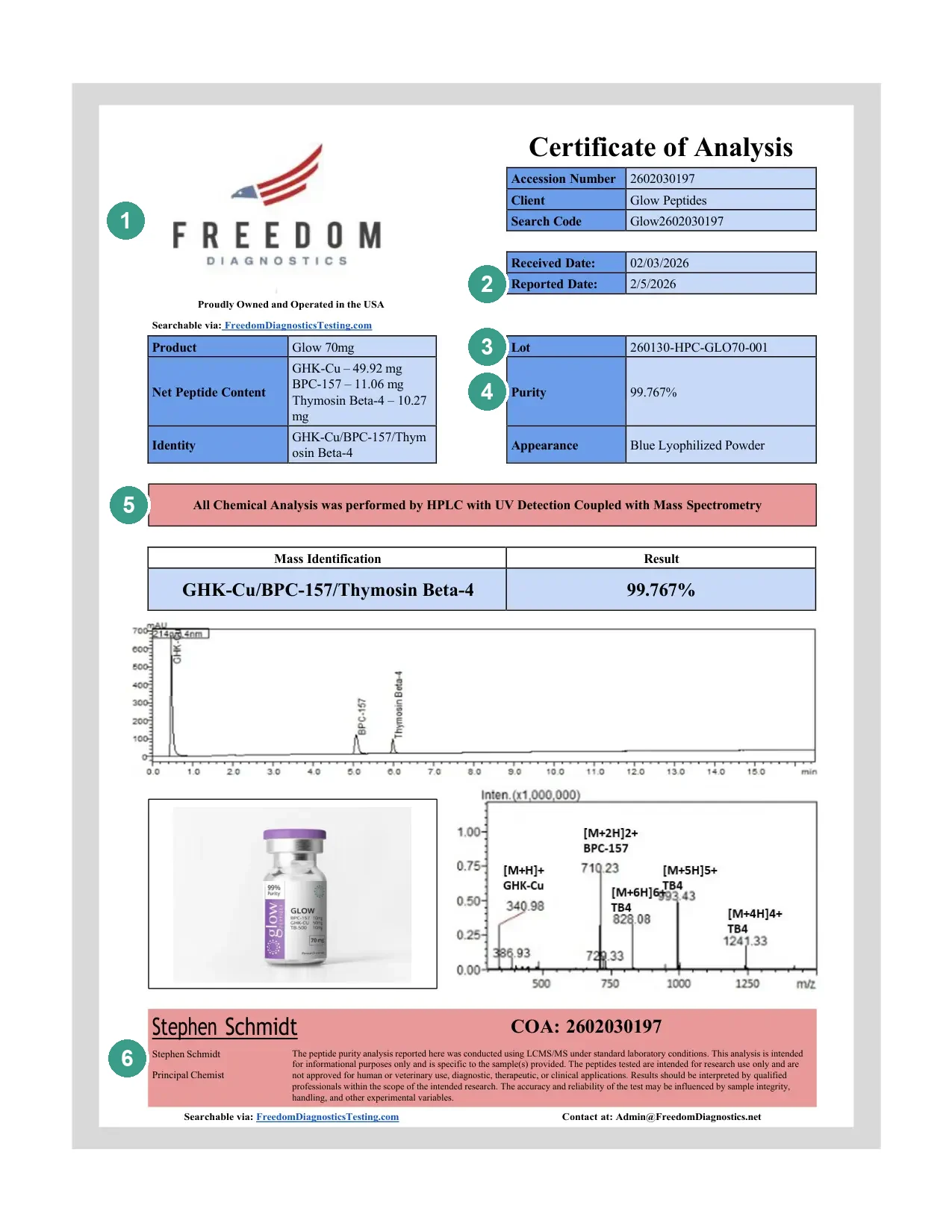
- The issuing laboratory — who performed the analysis.
- The reported date — when the sample was analysed.
- The lot number — this is the field that must match the lot printed on your vial.
- The reported purity result, to be read with the method that produced it.
- The methods actually used for this report, stated on the document itself.
- The signature, scope and stated limitations — what the report does and does not establish.
HPLC purity
Read the chromatographic method and how the laboratory defines the reported percentage. A chromatographic percentage is not automatically a mass fraction, an identity determination, or proof that every component of a blend was separately measured. Record the reported value with its units and limitations instead of comparing unlike percentages.
Mass-spectrometry identity
Mass-spectrometry findings may support identification within the method's demonstrated scope. Read the actual conclusion; a displayed mass alone does not establish every structural or quality attribute. FDA's ICH Q2(R2) guidance separates identification, impurity and assay objectives. It is a methodological reference, not approval of Glow or evidence that a particular lot underwent a test.
Lot number & traceability
A COA is tied to a specific lot. The lot on your vial should match the lot on the certificate and its test date. That linkage is what makes a COA meaningful rather than generic marketing.
Verify any Glow Peptides lot
Use the Quality & COA directory to find available documentation. A listed document does not establish analytical approval; documentation can be missing or held for a source conflict. Do not replace a missing report with another lot's certificate or resolve a contradiction by editing a PDF text layer.
Apply the method to a blend or supplier
The GLOW and KLOW composition comparison shows why the declared component list and the tested sample must be matched separately. After the lot audit, Use the vendor evaluation checklist to review documentation, policies and unresolved questions before a procurement decision.
Frequently asked questions
Does a catalog purity specification establish a lot result?
No. Read the matched report for its measured findings, methods and units. A catalog specification is not a test result.
What can an independent laboratory report establish?
The findings reported about the identified sample within the stated methods and limitations. It does not establish unmeasured attributes or the status of other lots.
Can I see a COA before buying?
Available records can be inspected in the Quality and COA directory without a purchase. Missing or held documentation remains unresolved.