Glow Peptides · Research Journal
Peptide Blend Purity: What 99% Pure Means
Glow Peptides Research Team · 2026-10-12
For research use only. Not for human or veterinary use, diagnostic use, or in any therapeutic application.
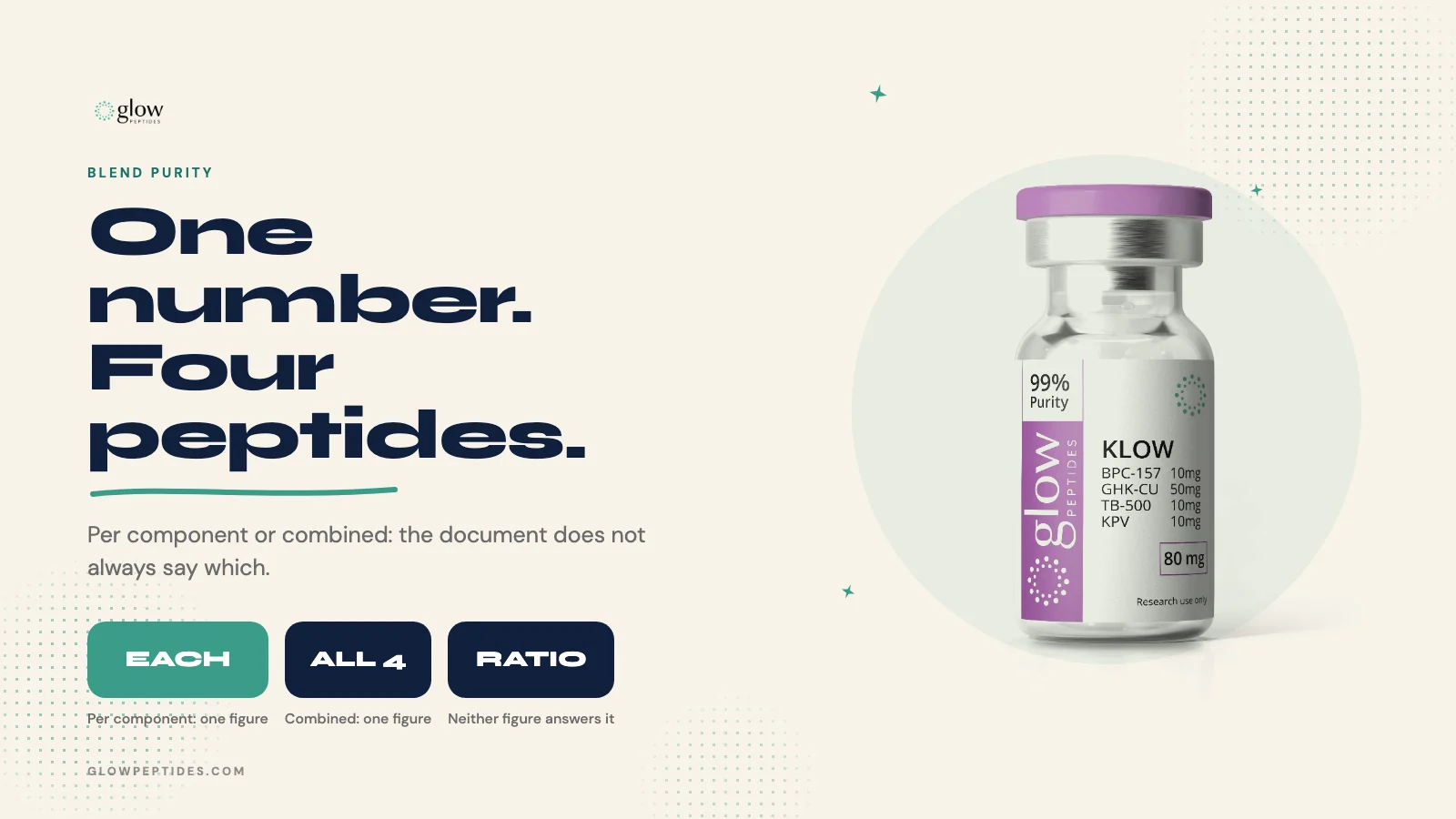
A single purity percentage on a vial holding four peptides can mean two completely different things, and the document does not always say which. It can mean that each material was held to a threshold on its own before they were combined, or it can mean that all four peaks together were measured against everything else in the chromatogram. Those are different measurements answering different questions. This page sets out how purity is reported for a co-lyophilized preparation such as the KLOW peptide blend, what each reporting style establishes, and the one question purity does not answer at all.
The short version
- On a single-compound vial, purity is unambiguous. One target peak against everything else.
- On a four-component vial it is not, because the other three materials are supposed to be there. They are not impurities.
- Two reporting styles exist. Per component, one figure for each material. Combined, one figure for all four peaks against the rest.
- Neither answers the ratio question. A vial can be extremely pure and still hold the four materials in the wrong proportions.
- Purity, content and ratio are three separate things. Most confusion here is one being read as another.
- A specification is not a measurement. The catalog figure is a floor; the lot document is a finding.
Why a single peptide blend purity figure cannot do the job
Chromatographic purity is, in essence, an area comparison. The instrument separates what is in the sample, and the result expresses the target as a proportion of everything detected.
On a vial holding one material that is a clean question. There is one peak you want and everything else is something you do not, so a single percentage describes the situation completely.
Put four materials in one vial and the question stops being clean, because three of the four things that would have been "everything else" are now intended contents. A figure reported against the mixture as a whole is not measuring the same thing as a figure reported against one compound. Both can legitimately be written as a percentage, and a reader who does not know which one they are looking at cannot tell them apart.
That is the whole problem, and almost nothing published in this category addresses it.
The two reporting styles, and what each one establishes
| Reporting style | What is being compared | What it establishes | What it does not |
|---|---|---|---|
| Per component | Each target peak against the non-target material associated with it | That each material individually met a threshold | The proportions between the four. Four clean materials can still be combined wrongly |
| Combined | All four target peaks together against everything else detected | How much foreign material is present in total | Whether any individual component was below threshold. A weak component can be masked by three strong ones |
The practical difference is which failure each one can hide.
A combined figure can hide a single weak component. If three materials are excellent and one is poor, the four peaks summed against the remainder can still look high, because the poor component's own shortfall is a small fraction of the total area. The number is not wrong; it is answering a question about the vial rather than about the component.
A per component figure cannot hide that, which is why it is the more informative of the two. What it still cannot tell you is the ratio.
Four materials at 99 percent do not give you a vial you can reason about
Suppose each of four materials is independently 99 percent pure before blending. Every component has cleared its threshold, and a per-component certificate would report four figures at or above 99. None of that tells you how much of each material is in the container. The same four materials at the same four purities could be combined in equal parts or in a heavily lopsided split, and the purity figures would be identical in both cases. Purity is a statement about what fraction of a material is not the target. It is silent on how much of that material is present.
The ratio question, which purity does not answer at all
This is the part most worth carrying away, because it is where the reasoning usually goes wrong.
Three separate properties get collapsed into one on a multi-component vial:
Purity is the fraction of a material that is the intended compound rather than something else. It is a quality statement about a substance.
Content is how much material is in the container, in milligrams. On these preparations the catalog code carries a nominal total rather than a per-component figure, which is covered in reading a peptide lot number.
Ratio is how that content is divided between the four materials. It is neither a purity figure nor a total, and it is the one property that a co-lyophilized vial has and a single-compound vial does not.
A container can score well on the first, state the second clearly, and still be wrong on the third. Nothing in a purity percentage constrains the ratio, and nothing in a total content figure does either. If the proportions matter for what you are doing, the only thing that can tell you is a lot document reporting each component's quantity individually.
What a complete analytical record looks like
There is a useful external yardstick here, and it is worth being precise about its status: it does not apply to research materials, and that is exactly why it is useful as a comparison rather than as a requirement.
21 CFR 211.194 sets out what laboratory records must contain under current good manufacturing practice for finished pharmaceuticals. Research reference materials are not finished pharmaceuticals and Part 211 does not govern them. But the regulation is a published statement of what a complete record looks like when somebody has been made to define it, and it lists eight things.
| Element | What the regulation requires |
|---|---|
| Sample description | The source, quantity, lot number or other distinctive code, date taken and date received for testing |
| Method statement | Each method used, and where the data establishing its accuracy and reliability sits |
| Amount tested | The weight or measure of sample used for each test, where appropriate |
| Complete data | All data from the test, including the graphs, charts and spectra from the instrument |
| Calculations | Every calculation, with units, conversion factors and equivalency factors |
| Results against standards | The results, and how they compare with established standards of identity, strength, quality and purity |
| Who performed it | Initials or signature of the person who ran each test, and the dates |
| Second-person review | Initials or signature of a second person confirming the record was reviewed for accuracy, completeness and compliance with established standards |
Two items on that list are the ones to hold a blend certificate against. "Complete data, including the graphs, charts and spectra" is the difference between a document that reports a number and a document that shows the chromatogram the number came from. And "how the results compare with established standards" is the difference between a figure floating on a page and a figure stated against a specification.
What to look for on a lot document for a blend
The general discipline does not change: a lot number matching the vial in front of you, the laboratory named rather than described, the method stated alongside any figure, a report date belonging to that batch, and an identifier that lets the report be looked up rather than confirmed by the seller. The field-by-field walkthrough is in how to read a peptide certificate of analysis.
Four things are specific to a multi-component lot.
Whether the purity figure is per component or combined. If the document does not say, that is the first thing to establish, because the two mean different things and a single unlabeled percentage is ambiguous rather than reassuring.
An identity result for each named component. Four materials, four identities. The masses to match are about 1,419.5 for BPC-157, about 4,963 for the component this catalog lists as TB-500, and 342.43 for KPV, with the GHK-Cu figure depending on which species is specified. The 4,963 figure is the full thymosin beta-4 chain, which is the formula on the TB-500, GLOW and Wolverine product pages and how the certificates identify it; the same name is also used for a seven-residue fragment of about 889.0, a different molecule.
Whether quantities are reported per component. This is the ratio question and it is answered nowhere else.
Whether the chromatogram is shown, not just described. A number without the trace it came from cannot be checked.
One point of good practice on this catalog is worth naming because it is unusually direct. The individual lot record pages state plainly, in the page's own words, that "No laboratory, report identifier, analytical method or result is asserted for this lot by this feed", and that the linked document itself must be read before any result is attributed to the lot. That is the correct posture: a directory entry is a pointer, and the document is the evidence. The record for KLOW lot 260320HPKL80 carries that language and links the certificate itself.
Published lot records are listed on the quality page. Availability varies by compound and by batch, so check the specific lot rather than assuming coverage, and read the document rather than the summary. What a purity percentage means on a single compound, before any of this complexity is added, is covered in how purity is verified on a single compound.
The other multi-component preparations
The same reasoning applies across the range, and the compositional differences between them are set out in GLOW 70 and KLOW 80, covering the three-material and four-material preparations side by side.
What this page deliberately does not cover
Pages on this subject tend to move quickly to which blend is better, what each component may support and what proportions to use. Those subjects are absent here on purpose, and saying so is more useful than leaving the gap unexplained.
Glow Peptides supplies cataloged materials for laboratory research only. The materials are not drugs, supplements, cosmetics or medical devices, and they are not intended for human or veterinary use. This page gives no dosing, administration, reconstitution, combination or protocol guidance and states no expected outcomes; those questions are outside what a supplier of research materials should answer. What is in scope, and what this page covers, is purity, analytical methods and documentation.
Frequently asked questions
How is purity reported when one vial holds four peptides?
In one of two ways. Per component, meaning one figure for each material measured against the non-target content associated with it. Or combined, meaning all four target peaks measured together against everything else detected. The two answer different questions, and a single unlabeled percentage on a four-component vial does not say which one it is.
Why can a purity figure not be read the same way on a blend as on a single compound?
Because chromatographic purity is an area comparison between the target and everything else. On a single-compound vial everything else is unintended. On a four-component vial, three of the four things that would count as everything else are intended contents and are not impurities. The comparison therefore measures something different, even though both results are written as a percentage.
Which reporting style is more informative?
Per component, because a combined figure can hide a single weak material. If three components are excellent and one is poor, the four peaks summed against the remainder can still read high, since the weak component's shortfall is a small share of the total area. A per-component figure exposes that. Neither style, however, tells you the proportions between the four.
Does a high purity figure mean the components are in the right proportions?
No, and this is the most common mistake. Purity states what fraction of a material is the intended compound. It says nothing about how much of that material is in the container. Four materials could each be 99 percent pure and be combined in equal parts or in a heavily lopsided split, and the purity figures would be identical either way. Only per-component quantities answer the ratio question.
What should a complete analytical record contain?
21 CFR 211.194 lists eight elements for laboratory records under good manufacturing practice: sample description, method statement, amount tested, all data including instrument graphs and spectra, all calculations, results compared against established standards, the initials or signature of who ran the test, and a second person's review. Part 211 governs finished pharmaceuticals, not research materials, so this is a benchmark rather than a requirement.
Why does this page not say which blend is better?
Because Glow Peptides supplies cataloged materials for laboratory research only. The products are not drugs, supplements, cosmetics or medical devices, and they are not intended for human or veterinary use. The page gives no dosing, combination or protocol guidance and does not compare merits; those are outside what a research materials supplier should provide. What is covered is purity, analytical methods and documentation.
Sources
- Code of Federal Regulations, Title 21, Section 211.194, "Laboratory records." Read in full at eCFR 24 and 29 September 2026, content current as of 25 September 2026. Source 43 FR 45077, 29 September 1978, as amended at 55 FR 11577, 65 FR 18889, 70 FR 40880 and 70 FR 67651. Part 211 applies to current good manufacturing practice for finished pharmaceuticals and does not govern research reference materials; it is cited here as a published definition of a complete laboratory record.
- PubChem, National Library of Medicine, National Institutes of Health. Component records read 24 September 2026: BPC-157 CID 9941957, C62H98N16O22, about 1,419.5; thymosin beta-4 CID 45382195, C212H350N56O78S, about 4,963, the component this catalog lists as TB-500; the seven-residue TB-500 CID 62707662, about 889.0; KPV CID 125672, C16H30N4O4, about 342.43, held under the title "Msh (11-13)".
- Composition and the lot record wording were read from the live KLOW product page and the published lot document directory, 24 September 2026. No analytical result is attributed to any specific lot in this page.
For research use only. Not for human or veterinary use, diagnostic use, or any therapeutic application.