Glow Peptides · Research Journal
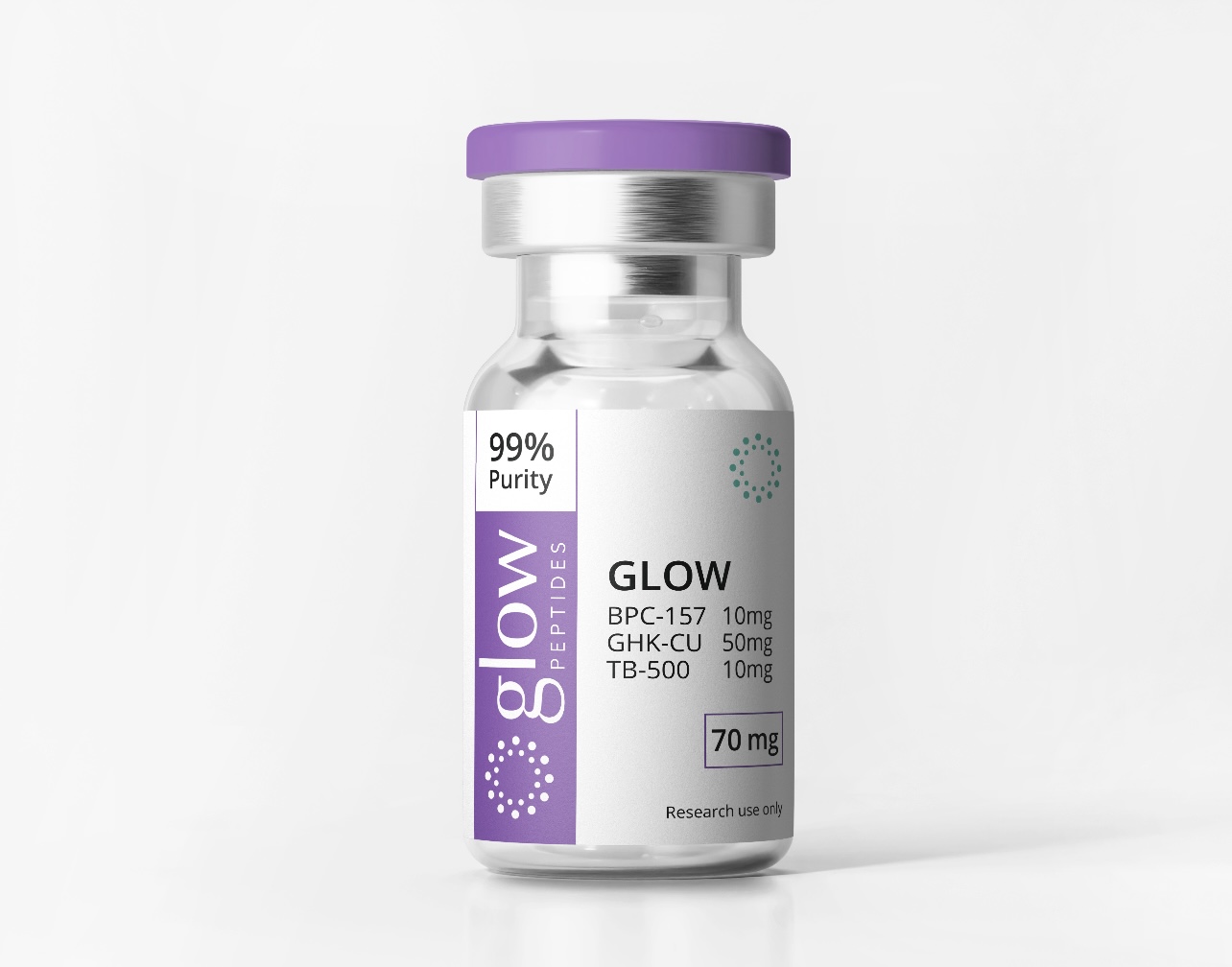
What Is GLOW Peptide? Reading the GL70 Vial
Glow Peptides Research Team · 2026-10-06
For research use only. Not for human or veterinary use, diagnostic use, or in any therapeutic application.
GLOW is this catalog's name for three peptides supplied together in one vial: BPC-157, TB-500 and GHK-Cu, freeze-dried into a single cake and sealed. The name on its own settles very little, because the market attaches the same four letters to different products, so the reliable way to read the GLOW three-peptide research vial is through the two strings that travel with it: the catalog code GL70 and the lot number. This page checks both against the current lot, names what each component resolves to in the public record, and sets out what the paperwork for a three-component vial has to show.
The short version
- In this catalog, GLOW means three peptides co-lyophilized in one sealed vial: BPC-157, TB-500 and GHK-Cu, under catalog code GL70.
- The 70 in GL70 checks out against the current lot record. The lot record for 260402HP-GL70 states a strength of 70 mg, the total across the three components.
- That total is not a split. Nothing in the code or the name says how much of each component is present.
- The name is not a standard. Other things are sold as GLOW elsewhere, with other recipes and other amounts. Only the code and the lot record pin down what this vial is.
- GLOW differs from KLOW by exactly one component. KLOW adds KPV; GLOW does not contain it.
- Purity is specified per component, because the other two materials in the vial are intended contents, not impurities.
What is GLOW peptide? One name, three meanings
Three different things answer to the phrase. It is the name of this supplier. It is the name of this supplier's three-component vial. And it is a label that appears across the wider market on blends and services whose contents vary with whoever is selling them. A question about GLOW is only half asked until it says which of those it means.
This page is about the second one: the catalog item. For that item the name is just the front label. The identifying work is done by GL70, the catalog code, and by the lot number printed on the vial, which is the string that leads to this batch's own documentation. Everything below follows those two strings rather than the name.
What the catalog lists
The product page lists the composition as GLOW · BPC-157 + TB-500 + GHK-Cu: a lyophilized powder in a sealed research vial. Co-lyophilized means the three were freeze-dried together into one cake, so there is no stage at which anyone can inspect them separately. Whatever is known about the contents has to come off a document, which is why the documentation trail carries more weight on a blend than it does on a single compound.
The purity specification on the page is stated per component, by HPLC. On a three-material vial that phrasing matters: measured against the mixture as a whole, the other two intended components would sit in the result as though they were contamination, which they are not. Per component says each material is held to the floor on its own. A catalog specification is still a promise rather than a finding, and the finding for a given batch lives in that batch's certificate.
What GL70 encodes, checked against the current lot
The code is a letter block for the material and a number. On this vial the number lines up with the nominal total peptide content in milligrams across all three components, and that is not an inference from the code alone: the lot record for 260402HP-GL70 states a strength of 70 mg for a 3 mL vial, and the product page lists the same concentration. Code, page and record agree.
70 mg is a total, and a total answers one question only
It does not say how the 70 mg divides across BPC-157, TB-500 and GHK-Cu. No split is encoded in the code, printed in the name, or implied by the total. The 70 mg is also a declared nominal value rather than a measurement, so component quantities reported on an individual lot certificate will not necessarily sum to it. Splits for this blend circulate in posts and summaries, and this catalog's own records pages treat any quoted split as unconfirmed until a specific lot's label and certificate state it. The same caution belongs here: where the proportions matter to your work, the only document that can answer is the certificate for the lot in your hand.
There is a second reason the split matters more than the total, and it is arithmetic rather than policy. The three components are very different sizes: BPC-157's record sits at about 1,419.5 while the copper-bound tripeptide records sit near 400, roughly three and a half times lighter. Equal milligrams of two materials that far apart contain very different numbers of molecules, so even a perfectly even mass split would not mean an even molecular one. The point is qualitative, and it is one more reason the per-component figures on a certificate carry information nothing else on the label does.
One limit on reading codes generally: the number-tracks-the-total pattern holds on this vial and on the KLOW vial, but a catalog code is one supplier's internal shorthand, not an industry convention, and encapsulated formats in the same family carry their numbers on a different basis. Read strength off the lot record, not off the code.
The three components in the public record
| Component | Identity |
|---|---|
| BPC-157 | One record under its own name: PubChem CID 9941957, C62H98N16O22, mass about 1,419.5 |
| GHK-Cu | More than one public record, with different formulas, charges and masses. See the note below before matching any figure |
| TB-500 | Listed by the catalog as a synthetic thymosin beta-4 fragment. More than one convention is in use for this name and the figures differ by thousands of mass units, so identity for a given vial is read off its lot certificate, not off a catalog page or an article |
GHK-Cu: name one record before quoting one number
The free tripeptide, glycyl-L-histidyl-L-lysine, is CID 73587 at about 340.38. The copper-bound form has several records of its own, among them prezatide copper, CID 71587328, C14H23CuN6O4+ at about 402.92, and copper tripeptide, CID 139035031, C14H21CuN6O4− at about 400.90, plus a dimer record titled GHK-Cu at about 744.3. Every one of those numbers is correct for its own record, which is exactly why a bare GHK-Cu figure proves nothing until the record behind it is named. A document pairing a copper formula with the copper-free 340.38 has crossed two records, and one of its two figures belongs to something else.
GLOW and KLOW differ by one component
KLOW is the neighboring blend in the same catalog and it lists the same three materials plus KPV. That single addition is the whole compositional difference, and it is why nothing in this piece mentions KPV again: GLOW does not contain it. The two blends, their components and their totals are set side by side in GLOW 70 and KLOW 80 compared.
Walking the current lot record
The lot record is the page the lot number leads to, and reading one is quick because it carries little on purpose. For 260402HP-GL70 it states the product, the lot string, the strength of 70 mg, the form of a 3 mL vial, a received date and an evidence line reading Certificate available, and it links the certificate of analysis as a separate PDF. It also states its own limit in plain terms: no laboratory, report identifier, method or result is asserted on the record page itself.
That limit is the useful part. The record is a pointer, and the certificate it links is the evidence. The two answer different questions, so a reader who stops at the record has the batch identified and nothing yet established about what a laboratory found. The published lot records sit in the lot document directory, and the directory makes the same point its own way: document availability does not establish analytical approval, and each lot page explains the recorded evidence and any limitations.
What a three-component certificate has to show
Everything that applies to any research certificate applies here: a lot number matching the vial, the laboratory named, the method stated beside each figure, a report date belonging to the batch. The blend adds three requirements. Three identity results, one per named component, each reconcilable against a named public record. Purity per component, since one combined figure cannot show whether an individual material cleared the floor. And quantities per component, because that is the only place the split behind the 70 mg total can come from. The field-by-field walkthrough of a certificate is in how to read a peptide certificate of analysis.
One name, many uses: GLOW in the wider market
The four letters travel widely. Blends sold elsewhere under the same name list their own recipes and amounts, services use it for mixes of their own design, and summaries repeat figures with no lot attached to them. None of that is a complaint about anyone; it is what happens to any good product name in a market with no official register of names. The practical consequence is the one this page opened with: the name identifies nothing by itself. A claim about GLOW is checkable only once it is tied to a specific catalog's code and a specific lot's documents.
Check a claim the systematic way
Match the claim to the record type that could support it, then open that record. The worked method, with lookup tables and a claim-check worksheet, is in the GLOW composition and lot records guide.
What this page deliberately does not cover
Most pages answering this question move straight to what the blend may do, who should use it and what to expect. Those subjects are absent here on purpose, and saying so is more useful than leaving the gap unexplained.
Glow Peptides supplies cataloged materials for laboratory research only. The materials are not drugs, supplements, cosmetics or medical devices, and they are not intended for human or veterinary use. This page gives no dosing, administration, reconstitution, duration, combination or protocol guidance, states no expected outcomes and makes no claim about what these materials do; those questions are outside what a supplier of research materials should answer. What is in scope, and what this page covers, is composition, strength, purity, analytical methods, handling, storage and documentation.
Frequently asked questions
What is GLOW peptide?
In this catalog, GLOW is the name for three peptides supplied together in one sealed vial: BPC-157, TB-500 and GHK-Cu, freeze-dried into a single cake. The vial carries catalog code GL70, and the current lot record states a strength of 70 mg as the total across the three components. The same four letters are used elsewhere in the market for other blends and services, so the code and the lot number, not the name, are what identify this product.
What does GL70 mean?
It is the catalog code: a letter block for the material and a number. On this vial the number lines up with the nominal total peptide content in milligrams across all three components, which the lot record for 260402HP-GL70 confirms at 70 mg for a 3 mL vial. The code does not say how that total divides between the components, and a catalog code is one supplier's internal shorthand rather than an industry standard, so strength is always read off the lot record rather than the code.
What is the difference between GLOW and KLOW?
One component. GLOW lists BPC-157, TB-500 and GHK-Cu. KLOW lists the same three plus KPV, under its own catalog code. The difference is between two catalog declarations rather than two tested materials, and it says nothing about proportions or about the form of any shared component. Each blend's lot documents only its own batches.
Why does GHK-Cu show more than one mass?
Because the abbreviation reaches more than one public record. The copper-free tripeptide is CID 73587 at about 340.38. The copper-bound form has several records, including prezatide copper, CID 71587328, at about 402.92 with a positive charge, copper tripeptide, CID 139035031, at about 400.90 with a negative one, and a dimer record titled GHK-Cu at about 744.3. Each figure is right for its own record, so a GHK-Cu number only means something once the record behind it is named.
Is GLOW the same thing everywhere the name appears?
No. The name is a market convention rather than a registered standard, and products sold under it elsewhere list their own recipes and their own amounts. Figures that circulate for the blend in posts and summaries are not evidence for any particular vial. What pins a vial down is its catalog code and its lot number, and the only documents that speak for its contents are that lot's record and certificate.
What should the certificate for a three-component vial show?
The general requirements first: a lot number matching the vial, the laboratory named rather than described, the method stated beside each figure, and a report date belonging to the batch. Then the three blend-specific ones: an identity result for each named component, purity reported per component rather than one combined figure, and quantities per component, which is the only place the split behind the 70 mg total can come from.
Sources
- PubChem, National Library of Medicine, National Institutes of Health. Compound records read 2 October 2026: BPC-157 CID 9941957; glycyl-L-histidyl-L-lysine CID 73587; prezatide copper CID 71587328; copper tripeptide CID 139035031; and the dimer record titled GHK-Cu, CID 133697840. Formulas, masses and charges taken directly from those records.
- Glow Peptides live product page for GLOW, read 2 October 2026, for the composition listing, the sealed-vial format, the 70 mg concentration and the per-component wording of the purity specification. The catalog code GL70 is carried in the current lot string and the page's product markup.
- Glow Peptides lot record for 260402HP-GL70, read 1 and 2 October 2026: strength 70 mg, form vial 3 mL, evidence line Certificate available, with the certificate linked as a separate document and the record's own statement that no laboratory, report identifier, method or result is asserted on it.
- Glow Peptides lot document directory, read 2 October 2026, for its statement that document availability does not establish analytical approval and that each lot page explains the recorded evidence and any limitations.
- The treatment of TB-500 naming conventions and of circulating milligram splits follows the catalog's own records pages, which log both as matters the lot documents settle. No split figure is quoted in this piece from any source.
For research use only. Not for human or veterinary use, diagnostic use, or any therapeutic application.