Glow Peptides · Research Journal
What a Peptide Stack Means on the Label
Glow Peptides Research Team · 2026-10-07
For research use only. Not for human or veterinary use, diagnostic use, or in any therapeutic application.
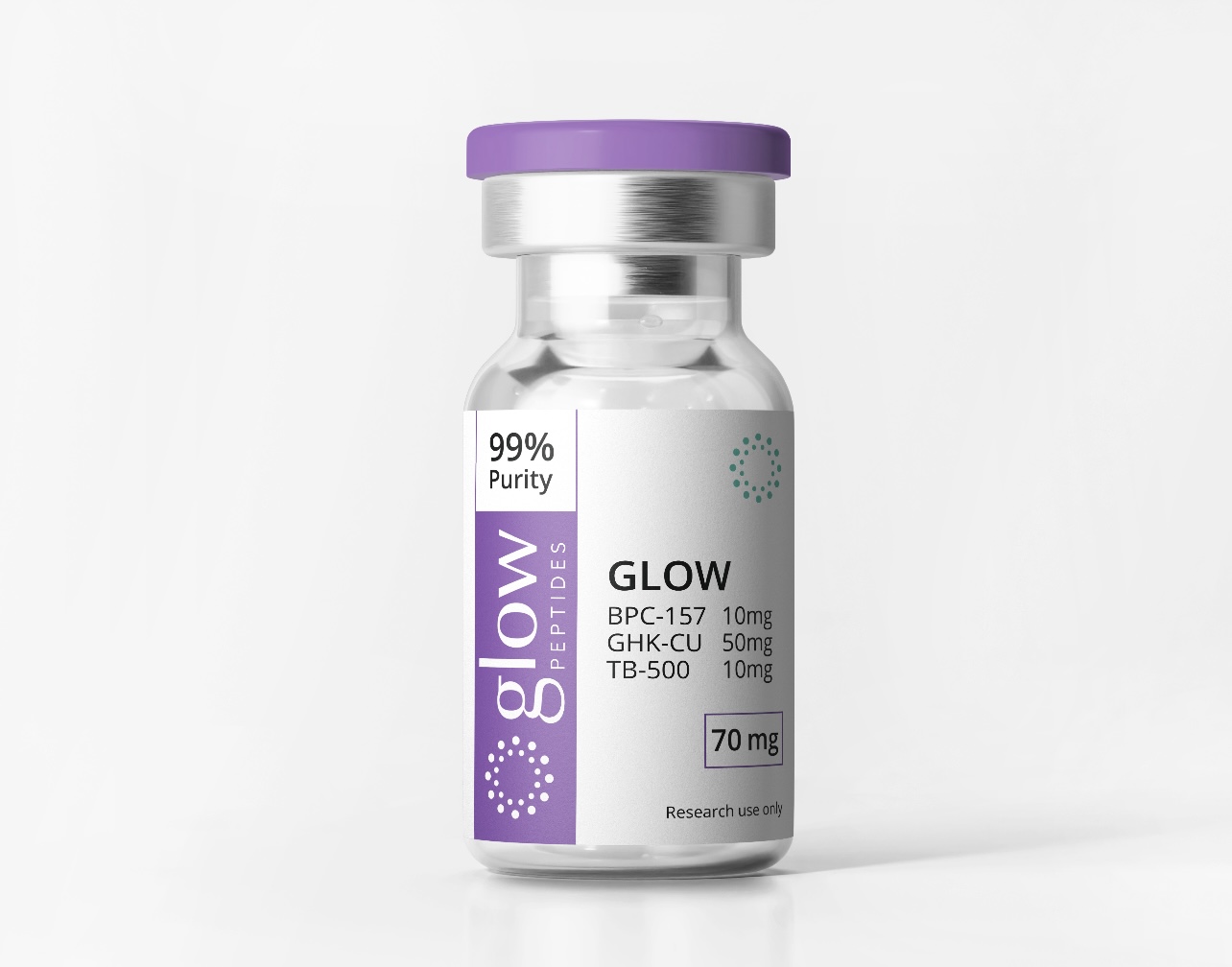
"Stack" is market shorthand, not a label term: it does not appear anywhere on the vial. What the market calls the GLOW peptide stack is one vial holding three research peptides co-lyophilized, BPC-157, TB-500 and GHK-Cu, under catalog code GL70. The word stands in for a container holding more than one material, and the label uses different words entirely: the product name, a nominal amount for each component, a total, and a lot number, none of which contains the word stack. This page sets out what the label does carry, what is actually in a container of the GLOW blend, catalog code GL70, and why one total figure printed on a vial holding three or four materials is not the figure most people read it as.
The short version
- The word "stack" is not on the label. The label carries the product name, a nominal amount for each component, a total in milligrams and a lot number. The catalog code, GL70 or KL80, identifies the product on its lot record and inside the lot number.
- GLOW is three materials co-lyophilized in one vial: BPC-157, TB-500 and GHK-Cu. Catalog code GL70.
- KLOW is four: the same three plus KPV. Catalog code KL80.
- The number in the code is a nominal total across all components, not the amount of any one of them, and not a measurement. KL80 is a nominal total across four materials, printed on the label as 10, 50, 10 and 10 mg, not 80 mg of each.
- The purity specification is stated per component, not on the mixture.
- A catalog specification is not a measured lot result. Those are two different kinds of statement.
What a peptide stack label actually carries
The front of a KLOW vial in this catalog prints the product name, a nominal amount against each of the four component names, a boxed total of 80 mg, a purity statement and the words "research use only". Nowhere on it is the word stack. The product pages state that lot expiry and release status are printed on the label as well.
Two further strings identify what the vial is and which batch it came from. The catalog code is a short letter block for the material followed by a number: GL70 for GLOW, KL80 for KLOW, WV20 for the BPC-157 and TB-500 combination. It identifies the product on its lot record, it is stable across every batch, and that is exactly why it cannot identify a batch. The lot number changes with every production run and is the only string that resolves to a certificate; on the GLOW, KLOW and Wolverine vial lots it carries the catalog code inside it. The full decomposition of both strings is set out in reading a peptide lot number.
So when somebody searches for a stack and arrives at a label, there is a translation step nobody has written down: the thing they are holding is described by a product name, a set of nominal amounts and a code, and the code encodes a material and a total content figure. Everything below is that translation.
What is in each container
The correct term for how these are put together is co-lyophilized: the components are freeze-dried together into a single cake in a single sealed vial, rather than supplied as separate vials to be handled individually.
| Listed as | Catalog code | Components | Count |
|---|---|---|---|
| GLOW | GL70 | BPC-157, TB-500, GHK-Cu | 3 |
| KLOW | KL80 | KPV, GHK-Cu, BPC-157, TB-500 | 4 |
| BPC-157 & TB-500 (Wolverine) | WV20 | BPC-157, TB-500 | 2 |
The single compositional difference between GLOW and KLOW is KPV. That one addition is what the K in KLOW records, and the two preparations are compared component by component in the GLOW 70 vs KLOW 80 comparison.
The individual components have their own identities, and those are worth having to hand because they are what an identity result on a certificate has to match.
| Component | PubChem CID | Molecular formula | Molecular weight |
|---|---|---|---|
| BPC-157 | 9941957 | C62H98N16O22 | About 1,419.5 |
| TB-500, as listed in this catalog | 45382195 | C212H350N56O78S | About 4,963 |
| KPV | 125672 | C16H30N4O4 | About 342.43 |
Two of those rows carry naming traps that are worth stating plainly.
The name TB-500 covers two different molecules, and this catalog's figures point to the larger one. The product pages give the component's formula as C212H350N56O78S at about 4,963, which is the full 43-residue thymosin beta-4 chain, PubChem CID 45382195, and the published certificates identify it as Thymosin Beta-4 with a charge-state series that reconstructs to about 4,963. The same name is also used across the market for a thymosin beta-4 fragment: strictly a seven-residue peptide, Ac-LKKTETQ, PubChem CID 62707662, at about 889.0, one short stretch of the same protein. On a certificate for this catalog, the identity mass to expect against TB-500 is the 4,963 one, and a figure near 889 would mean the vial held the short fragment instead.
PubChem's canonical title for the KPV record is "Msh (11-13)", because the tripeptide corresponds to residues 11 to 13 of a longer hormone. Searching the database for "KPV" as a bare abbreviation does not reliably return it, and will return an unrelated organic acid instead. The CID is the thing that resolves; the abbreviation is not.
One total figure, three or four materials
This is the part that is most often read wrong, and the arithmetic is simple once it is stated.
On a vial, the digits in a catalog code give a nominal total peptide content in milligrams. GL70 is 70. KL80 is 80. On a single-compound vial that figure is close to unambiguous, because there is only one material for it to describe. On a co-lyophilized vial it is a nominal sum, and the individual lot document is what reports the components.
KL80 is not 80 mg of each
KL80 is a nominal total across four materials. It is not 80 mg of KPV plus 80 mg of GHK-Cu plus 80 mg of BPC-157 plus 80 mg of TB-500, which would be 320 mg. Two things follow, and the second is the one people miss. The split between components is not encoded in the code; it is printed on the label as nominal figures, 10 mg BPC-157, 50 mg GHK-Cu, 10 mg TB-500 and 10 mg KPV on KLOW. And every one of those figures, the split and the total, is a catalog value rather than a measurement, so the component masses reported on an individual lot document will not necessarily match them or sum to 80. Where the measured per-component amount matters, the lot record is the only thing that carries it.
The Wolverine preparation follows the same pattern with two components: the catalog code is WV20, 20 mg is the nominal total across both, and the lot document reports each component separately. The nominal figures and the measured ones are answers to different questions printed in different places, and only the second kind is a result.
The capsule formats break the rule rather than bending it, and this is the trap. On a capsule code the digits are inherited from the vial family and do not describe the capsule at all. KL80-C does not hold 80 mg per capsule; its lot record reports 3.5 mg. GH50-C does not hold 50; its lot record reports 2. So on an encapsulated product the code identifies the product line and the lot record is the only place the per-capsule figure appears. The capsule composition is stated on the capsule's own page and is not necessarily the vial's component list, so read that page rather than assuming. A bottle holds a count of capsules, which is a number of units.
One abbreviation, two different molecules
GHK-Cu deserves its own note, because the abbreviation covers two chemically distinct things and they do not weigh the same.
GHK on its own is the free tripeptide glycyl-L-histidyl-L-lysine, PubChem CID 73587, C14H24N6O4, about 340.38. GHK-Cu is that tripeptide complexed with copper, and PubChem holds a copper tripeptide record, CID 139035031, at C14H21CuN6O4−, about 400.90. The copper is not a trace additive; it is part of the species, and the complex is recorded as an anion rather than a neutral molecule. The gap between the two records is about 60.5 units, and it is worth being precise about what that is: copper weighs about 63.5, and the complex also loses three hydrogens on chelation, so the difference is copper less those hydrogens rather than the mass of copper itself.
The practical consequence on a label is that "GHK-Cu" and "GHK" are not interchangeable in a component list, and a mass quoted against one does not describe the other. One reading note for certificates: under the acidic conditions of a reversed-phase run and electrospray ionization the copper can be displaced from the complex, so a report may record the copper-free tripeptide ion, near 341, against the GHK-Cu name. That identifies the tripeptide; it does not by itself measure the copper. The 400.90 figure belongs with PubChem's copper tripeptide record, CID 139035031, and the 340.38 figure with the copper-free tripeptide, CID 73587.
What "per component" means on a purity specification
The catalog specification for these preparations is stated per component, by HPLC. The phrase "per component" is load-bearing and it is the reason a blend specification is not the same kind of statement as a single-compound one.
A purity figure on a single-compound vial describes one peak against everything else in the chromatogram. On a co-lyophilized vial holding four materials, all four are supposed to be there, so a figure describing the mixture as a whole answers a different question: the other three components are not impurities. Stating the specification per component says that each material is held to the threshold individually, before they are combined.
The second half of that sentence matters as much as the first. A catalog specification is not a measured lot result. A specification is a floor the supplier undertakes to clear on a released lot. A lot result is what an analysis found in one sample of one batch on one date. The product pages for these preparations state that distinction directly, and it is the difference between a promise and a measurement. What a purity percentage does and does not capture is set out in how a purity percentage is verified.
Reading a certificate for a co-lyophilized vial
The general discipline is unchanged: a lot number that matches the vial in front of you, the issuing laboratory named rather than described, the analytical method stated alongside any purity figure, a report date belonging to that batch, and an accession number that lets the report be looked up at the laboratory rather than confirmed by the seller. The field-by-field walkthrough is in the guide on how to read a peptide certificate of analysis.
Three things are specific to a multi-component lot.
An identity result for each named component, not one for the vial. On KLOW that means four, and the masses to match against are roughly 1,419 for BPC-157, 4,963 for the component listed as TB-500, 342 for KPV, and the GHK-Cu figure appropriate to whichever species is specified.
Purity reported per component. One combined figure on a four-material vial does not establish that any individual material cleared the threshold.
The catalog code repeated inside the lot number, on the vial lots. If the label says KL80 and the lot number says 260320HPKL80, the two agree and the redundancy has done its job. This check applies to the vial lots and not to the capsule lots, whose lot strings embed the per-capsule strength instead of the catalog code, so a capsule bottle failing the check is not evidence of anything.
Published lot records for this catalog are listed on the quality page, each at its own address. The certificate for KLOW lot 260320HPKL80 is worth opening as a worked example: it names the four components and reports one combined purity figure for the preparation, so the per-component question is put to the laboratory report itself. Lot document availability varies by compound and by batch, so check the specific lot rather than assuming coverage.
The compositional difference
KPV is the single material that separates the two preparations, and what it is on its own is set out in what KPV is, including why the database files it under a different name.
What this page deliberately does not cover
Most pages returned for this query move quickly to what a stack may do, what to combine, how often, in what order and what to expect. Those subjects are absent here on purpose, and saying so is more useful than leaving the gap unexplained.
Glow Peptides supplies cataloged materials for laboratory research only. The materials are not drugs, supplements, cosmetics or medical devices, and they are not intended for human or veterinary use. This page gives no dosing, administration, reconstitution, combination, frequency or protocol guidance and states no expected outcomes; those questions are outside what a supplier of research materials should answer. What is in scope, and what this page covers, is composition, nominal content, the purity specification, analytical methods and documentation.
Frequently asked questions
What does "stack" mean on a research peptide label?
Nothing, because it does not appear on the label. Stack is market shorthand for a container holding more than one material. The label carries the product name, a nominal amount for each component, a total in milligrams and a lot number. The catalog code, GL70 or KL80, identifies the product on its lot record and gives the nominal total; the lot number identifies one production run and is the only string that resolves to a certificate.
What is in the GLOW blend?
Three materials, co-lyophilized into a single sealed vial: BPC-157, TB-500 and GHK-Cu. Its catalog code is GL70, where the digits give a nominal 70 mg of total peptide content across all three components rather than 70 mg of any one of them. KLOW is the same three materials plus KPV, giving four components under catalog code KL80.
Does KL80 mean 80 mg of each component?
No. KL80 is a nominal total across the four materials in the container. Reading it as 80 mg of each would imply 320 mg in the vial. The split is printed on the label as nominal figures, 10, 50, 10 and 10 mg on KLOW, and those are catalog values rather than measurements, so the component masses on an individual lot document will not necessarily match them or sum to 80. The lot record is the only place that carries the measured figures.
Why is GHK-Cu sometimes listed with two different molecular weights?
Because the abbreviation covers two different species. GHK on its own is the free tripeptide glycyl-L-histidyl-L-lysine, PubChem CID 73587, at about 340.38. GHK-Cu is that tripeptide complexed with copper, and PubChem's copper tripeptide record, CID 139035031, is about 400.90. The gap between the two records is about 60.5 units, which is copper at about 63.5 less the three hydrogens the complex loses on chelation, so a figure quoted against one does not describe the other.
What does a purity specification "per component" mean?
It means each material in the vial is held to the threshold individually, rather than the mixture being assessed as a whole. On a co-lyophilized preparation the other components are supposed to be present, so they are not impurities and a single combined figure answers a different question. It is also a specification rather than a measurement: a floor the supplier undertakes to clear, not what an analysis found in your batch.
Why does this page not cover what to combine or how often?
Because Glow Peptides supplies cataloged materials for laboratory research only. The products are not drugs, supplements, cosmetics or medical devices, and they are not intended for human or veterinary use. The page gives no dosing, combination or frequency guidance and states no expected outcomes; those are outside what a research materials supplier should provide, so they are deliberately absent rather than accidentally missing. What is covered is composition, nominal content, the purity specification, analytical methods and documentation.
Sources
- PubChem, National Library of Medicine, National Institutes of Health. Compound records read 24 and 29 September 2026: BPC-157 CID 9941957; thymosin beta-4 CID 45382195 (the component this catalog lists as TB-500); the seven-residue TB-500 CID 62707662; KPV CID 125672, held under the title "Msh (11-13)"; glycyl-L-histidyl-L-lysine CID 73587; copper tripeptide CID 139035031. Molecular formulas and molecular weights taken directly from those records.
- UniProt. Thymosin beta-4, accession P62328, consulted for the 43-residue mature chain that this catalog's TB-500 figures correspond to.
- Composition, catalog codes and the purity specification wording were read from the live GLOW and KLOW product pages and the published lot document directory, 24 September 2026.
For research use only. Not for human or veterinary use, diagnostic use, or any therapeutic application.