Glow Peptides · Research Journal
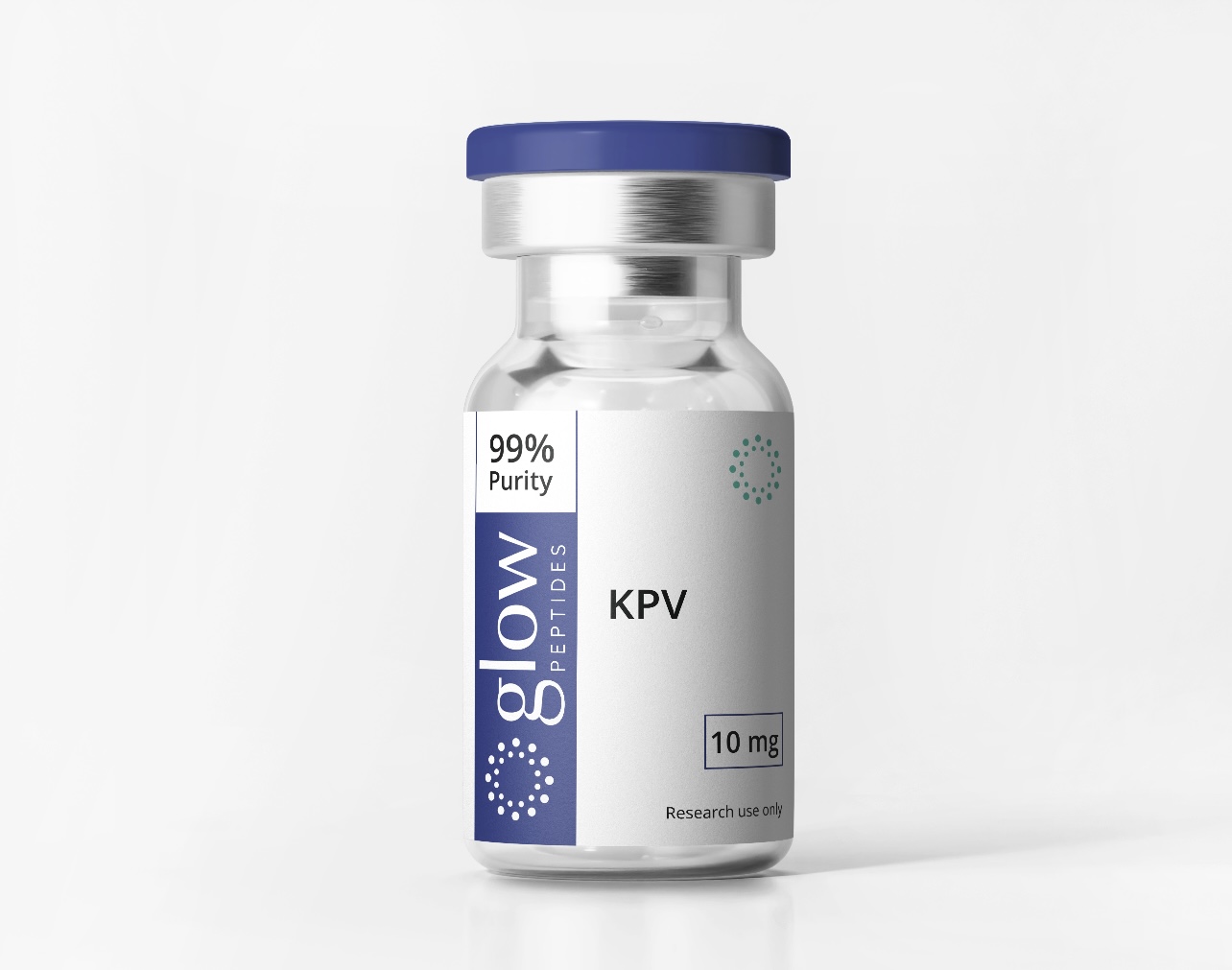
What Is KPV Peptide? Lys-Pro-Val, Residues 11 to 13
Glow Peptides Research Team · 2026-09-22
For research use only. Not for human or veterinary use, diagnostic use, or in any therapeutic application.
KPV is a tripeptide: three amino acids, lysine, proline and valine, joined in that order. It is one of the shortest peptides in this catalog, and it corresponds to the last three residues of a thirteen-residue hormone called alpha-melanocyte-stimulating hormone. Almost every description of it stops at "C-terminal fragment of alpha-MSH" and goes no further. This page goes further: which residues, what the formula and mass are, the one structural difference between research-grade KPV and the tail of the hormone it is named after, and what being three residues long changes about how it is analyzed.
What KPV is
KPV is named after its own sequence. The letters are the single-letter codes for its three amino acids: K for lysine, P for proline, V for valine. Written in the three-letter convention it is Lys-Pro-Val. Its molecular formula is C16H30N4O4 and its molecular weight is 342.43. PubChem holds it under CID 125672, where its title is recorded as MSH (11-13), which is the clearest short statement of what it is: residues 11 to 13 of alpha-MSH.
The short version
- KPV is Lys-Pro-Val, a tripeptide. C16H30N4O4, molecular weight 342.43, PubChem CID 125672.
- It is residues 11, 12 and 13 of alpha-melanocyte-stimulating hormone, which is thirteen residues long.
- Alpha-MSH carries a C-terminal amide on that valine. The free KPV tripeptide does not: it is the free acid.
- That difference is one mass unit, 342.4 against 341.5, and it is a real specification question.
- Three residues is short enough to change the analysis. No aromatic side chain, very little retention, and a mass near the noise floor of some methods.
Three residues, and which three
A tripeptide is three amino acids joined by two peptide bonds. In KPV those are lysine to proline, and proline to valine.
Each of the three brings something worth noting on a specification sheet. Lysine carries a basic side chain that is positively charged at ordinary pH, which is what gives the molecule its charge behavior. Proline is the only standard amino acid whose side chain loops back onto its own backbone nitrogen, which constrains the shape of the chain at that point and makes proline-containing bonds behave differently from the rest. Valine is small and hydrophobic, and its carboxyl group is the free end of the molecule.
None of the three is aromatic. That single fact has a direct consequence for how the compound is detected, which is covered below.
Where it comes from: alpha-MSH residues 11 to 13
Alpha-melanocyte-stimulating hormone is a thirteen-residue peptide, cut from the much larger precursor protein proopiomelanocortin. Read from the UniProt reference entry for human proopiomelanocortin, alpha-MSH is residues 138 to 150 of that precursor, and its sequence is:
| Position in alpha-MSH | Residue | In KPV? |
|---|---|---|
| 1 to 10 | Ser-Tyr-Ser-Met-Glu-His-Phe-Arg-Trp-Gly | No |
| 11 | Lys | Yes |
| 12 | Pro | Yes |
| 13 | Val | Yes |
So "C-terminal fragment of alpha-MSH" is accurate, and the precise version is that KPV is the final three of thirteen. PubChem's own title for the compound, MSH (11-13), says exactly this.
Worth noting for completeness: UniProt also records an N-acetylserine at the first position, annotated as belonging to corticotropin, which begins at the same residue. Either way it sits at the opposite end from KPV and has nothing to do with the tripeptide.
The one structural difference, and it is at the end of the molecule
Here is the detail that gets left out everywhere, and it is the difference between describing KPV loosely and specifying it.
In alpha-MSH, the C-terminal valine is amidated. UniProt records the modification explicitly as "valine amide" at that position. The hormone does not end in a free carboxyl group; it ends in an amide, which is a common modification on secreted peptide hormones.
The KPV tripeptide cataloged in PubChem as CID 125672, with formula C16H30N4O4 and a molecular weight of 342.43, is the free acid. Its valine ends in a carboxyl group, not an amide.
The arithmetic is small and completely determinate. Replacing a terminal hydroxyl with an amino group swaps one oxygen for one nitrogen and one hydrogen, a net change of 0.98 mass units:
| Form | C-terminus | Molecular formula | Molecular weight |
|---|---|---|---|
| KPV free acid | Carboxyl | C16H30N4O4 | 342.43 |
| KPV amide | Amide | C16H31N5O3 | 341.5 |
Why one mass unit is not a rounding error here
On a 5,000-dalton peptide a one-unit difference is a hard call. On a 342-dalton molecule it is not: mass spectrometry separates 342 from 341 without difficulty. So the expected mass on an identity line is a real specification, and 342.4 and 341.5 describe two different materials. A certificate that reports one without stating which form was specified has left the question open rather than answered it.
Being three residues long changes the analysis
Most of what is written about verifying research peptides assumes a chain of twenty, forty or more residues. A tripeptide breaks several of those assumptions, and the differences are worth knowing before reading a certificate for one.
There is no aromatic residue to detect. Peptides containing tryptophan or tyrosine can be detected by UV absorbance at 280 nanometers, where those two side chains absorb. Phenylalanine is aromatic but contributes almost nothing at that wavelength. Lysine, proline and valine have no aromatic ring between them at all. Detection therefore falls back on the peptide backbone itself, in the region around 214 to 220 nanometers, where the amide bond absorbs. That is a less selective window, because a great many things absorb there, which puts more weight on the separation doing its job.
It barely retains on a reversed-phase column. Reversed-phase HPLC separates by hydrophobicity, and a three-residue peptide carrying a charged lysine has very little to hold on with. Short, polar peptides tend to elute early, near the point where everything unretained comes off together. That is exactly the part of a chromatogram where salts, residual reagents and anything else unretained also appear, so the separation has to be set up for the problem rather than borrowed from a longer peptide.
The impurity profile is small but close. A three-residue synthesis has few opportunities to go wrong, which is a genuine advantage. The failures that do occur are close in structure to the target: a deletion leaves a dipeptide, and the amide and free acid forms differ by one unit. Closely related impurities elute near the target rather than far from it, so a clean result is one where the main peak accounts for nearly all the area, not one where the trace looks empty.
Net peptide content still matters. Purity describes what proportion of the peptide material is the intended compound. Net peptide content describes how much of the vial is peptide at all, once water and counterions are accounted for. On a small, basic peptide supplied as a salt, the counterion is a meaningful fraction of the weight, so the two figures can differ more than people expect. That distinction is unpacked in what a purity percentage means and what it misses, and the techniques themselves in how HPLC and mass spectrometry verify peptide purity.
Specification summary
| Property | Value |
|---|---|
| Sequence | Lys-Pro-Val |
| Single-letter code | K P V |
| Residue count | 3 |
| Relationship to alpha-MSH | Residues 11 to 13 of the 13-residue hormone |
| C-terminus of the cataloged compound | Free acid, not amide |
| Molecular formula | C16H30N4O4 |
| Molecular weight | 342.43 |
| PubChem CID | 125672, recorded as MSH (11-13) |
| Aromatic residues | None, so no 280 nm absorbance |
| Expected mass on an MS identity line | About 342.4 for the free acid |
| In this catalog | Lyophilized vial and capsules; also a component of the KLOW blend |
Reading a certificate for a KPV lot
The general principles hold, and two fields deserve particular attention on a compound this small. The identity mass should be matching about 342.4, and the certificate should make clear which C-terminal form was specified. The purity method should state its detection wavelength, because a method relying on 280 nanometer absorbance has nothing to detect on this molecule.
Everything else is the usual discipline: a lot number that matches the vial in front of you, the issuing laboratory named rather than described, a report date belonging to that batch, and an accession number that lets the report be looked up at the laboratory instead of confirmed by the seller. The field-by-field walkthrough is in how to read a peptide certificate of analysis. Published lot records for this catalog are on the quality page, and lot document availability varies by compound and by batch, so check the specific lot rather than assuming coverage.
What this page deliberately does not cover
Most pages returned for this question move quickly to what KPV is used for, what it may support, how much to take and how to take it. Those subjects are absent here on purpose.
Glow Peptides supplies cataloged materials for laboratory research only. Nothing here is a drug, a supplement, a cosmetic or a medical device, and nothing here is intended for human or veterinary use. Dosing, administration, reconstitution and protocol questions are outside what a supplier of research materials should answer. What is in scope, and what this page covers, is composition, structure, strength, purity, analytical method, handling and documentation. The single-compound reference page is at KPV.
Frequently asked questions
What is KPV peptide?
KPV is a tripeptide, three amino acids joined in sequence: lysine, proline and valine, written Lys-Pro-Val. The name is simply the single-letter code for its own sequence. Its molecular formula is C16H30N4O4 and its molecular weight is 342.43, and PubChem holds it under CID 125672 with the title MSH (11-13). That title states its origin precisely: it corresponds to residues 11, 12 and 13 of alpha-melanocyte-stimulating hormone, a peptide hormone that is thirteen residues long in total. KPV is therefore the final three residues of that hormone.
Which residues of alpha-MSH does KPV correspond to?
Residues 11 to 13, which are the last three. Alpha-MSH is thirteen residues long, cut from the precursor protein proopiomelanocortin, and its sequence is Ser-Tyr-Ser-Met-Glu-His-Phe-Arg-Trp-Gly-Lys-Pro-Val. The final three are lysine, proline and valine, which is KPV. PubChem's own title for the compound, MSH (11-13), records the same thing. Most descriptions say only "C-terminal fragment of alpha-MSH" without giving the positions, which is accurate but less useful than the numbers.
Is KPV the same as the end of alpha-MSH?
Almost, and the difference is at the very end of the molecule. In alpha-MSH the C-terminal valine is amidated, which UniProt records explicitly as a valine amide modification. The KPV tripeptide cataloged in PubChem as CID 125672, formula C16H30N4O4 at 342.43, is the free acid: its valine ends in a carboxyl group rather than an amide. The two forms differ by 0.98 mass units, 342.4 against 341.5. On a molecule of this size that is easily resolved by mass spectrometry, so which form a lot is has a definite answer and belongs on the certificate.
Does being only three residues long change how KPV is tested?
Yes, in three ways. There is no aromatic residue in lysine, proline or valine, so the 280 nanometer absorbance used to detect tryptophan and tyrosine has nothing to read, and detection falls back on the peptide backbone around 214 to 220 nanometers. A short, charged peptide also retains poorly on a reversed-phase column and tends to elute early, near where unretained material comes off, so the separation has to be designed for the problem rather than borrowed from a longer peptide. And the counterion is a larger share of the weight on a small basic peptide, which makes net peptide content diverge from purity more than people expect.
Why does this page not cover what KPV is used for?
Because Glow Peptides supplies cataloged materials for laboratory research only. The products are not drugs, supplements, cosmetics or medical devices, and they are not intended for human or veterinary use. Dosing, administration, reconstitution and protocol guidance are outside what a research materials supplier should provide, so they are deliberately absent rather than accidentally missing. What is covered here is composition, structure, strength, purity, analytical method, handling and documentation.
Sources
- PubChem, National Library of Medicine. KPV, CID 125672, recorded as MSH (11-13). Molecular formula and weight read 21 September 2026.
- UniProt. Human proopiomelanocortin, accession P01189. Alpha-MSH is annotated as residues 138 to 150 of the precursor, giving the 13-residue hormone, with a valine amide modification at position 13. UniProt also records an N-acetylserine at precursor position 138, annotated as belonging to corticotropin, which begins at the same position. Read 21 September 2026.
- Molecular weight of the amide form computed from the sequence using standard average residue masses, and the free acid figure reconciled against the PubChem record.
For research use only. Not for human or veterinary use, diagnostic use, or any therapeutic application.