Glow Peptides · Research Journal
What Is FOXO4-DRI? The Name Decoded
Glow Peptides Research Team · 2026-10-07
For research use only. Not for human or veterinary use, diagnostic use, or in any therapeutic application.
FOXO4-DRI is one of the few research peptides whose name, read correctly, tells you almost everything about the molecule. FOXO4 names the human protein it copies a piece of. The rest of the name, D-retro-inverso, describes two deliberate changes made to that piece: mirror-image amino acids, built in reverse order, which together put the side chains back into nearly the arrangement the original had. The public record behind the name is a 46-residue synthetic peptide with a mass of about 5,358, and this page decodes the name part by part, shows the recognizable pieces hiding inside it, and explains what the decoded name means when you read the lot certificate behind the FOXO4-DRI research vial.
The short version
- One molecule, two database records that agree. PubChem holds FOXO4-DRI as CID 167312269 and CID 168431240: both C228H388N86O64, both about 5,358, both under CAS registry number 2460055-10-9.
- The chain is 46 amino acid residues, with every chiral residue in the D-form, the mirror image of the L-form that natural proteins are built from. The four glycines in the chain have no mirror image to take.
- Read the sequence backwards and it comes apart into three recognizable pieces: a ten-residue cell-penetration domain, a three-proline linker, and a 33-residue stretch copied letter for letter from positions 92 to 124 of the human FOXO4 protein. Ten plus three plus 33 is 46, the whole chain accounted for.
- The name is a design description, not a brand. D-retro-inverso is a standard peptide-chemistry construction, and FOXO4-DRI is simply that construction applied to one piece of one protein.
- The name still does not identify a vial. As with every compound in this catalog, the definition lives in the public record and the identity of a specific lot lives on that lot's certificate.
What is FOXO4-DRI, in the public record?
Start with the database rather than the market. PubChem holds the compound under two records, CID 167312269 and CID 168431240, and unlike some names in this territory the two records describe the same molecule: molecular formula C228H388N86O64, a mass of about 5,358, and the same CAS registry number, 2460055-10-9, on both. One of the two carries a trifluoroacetate salt form name among its synonyms, which is a statement about how the powder is supplied rather than about the peptide itself. In a market where one name can sit on two different molecules, a name whose records reconcile at a glance is the easy case, and it is worth saying so.
At about 5,358 this is a large molecule by research-peptide standards: a chain of 46 amino acid residues, several times the size of the short fragments that dominate this catalog, and large enough that the public sequence is the right way to understand it. That sequence is where the name starts paying out.
Decoding the name, part by part
D-retro-inverso is not a marketing flourish. It is an exact, standard piece of peptide-chemistry vocabulary, and each element states something precise about how the peptide relates to the natural protein sequence it is based on.
| Name part | What it states |
|---|---|
| FOXO4 | The human protein the copied stretch comes from: Forkhead box protein O4, a 505-residue transcription factor held under UniProt entry P98177 |
| D | Every chiral amino acid in the chain is the D-form, the mirror image of the natural L-form; glycine, which has no mirror image, appears four times |
| Retro | The sequence runs in reverse order relative to the natural stretch it copies |
| Inverso | Says the mirror-image flip applies to the molecule as a whole; it restates at chain level what the D already says residue by residue |
The two changes are made together for a reason that is pure geometry. Mirroring the chiral residues flips where the side chains point; reversing the order of the chain flips them back. A D-retro-inverso peptide therefore presents its side chains, the parts of a peptide that do the recognizing and the binding, in nearly the same spatial arrangement as the natural sequence, while its backbone, the part that enzymes recognize when they cut peptides apart, is the mirror image of anything a protein-degrading enzyme evolved to work on. That resistance to enzymatic breakdown in laboratory settings is the standard stated rationale for building research peptides this way, and it is the whole reason the construction has its own name.
Why the sequence is written in lowercase letters
Peptide sequences use single capital letters for the standard L-amino acids, and the common convention for D-residues is the same letters in lowercase. The published FOXO4-DRI sequence is written entirely in lowercase, ltlrkepaseiaqsileaysqngwanrrsggkrppprrrqrrkkrg, and that typography is not a style choice. It is the D of the name written into the sequence itself.
Read the sequence backwards: a carrier plus a piece of FOXO4
Because the chain is a retro construction, the natural reading of what it contains runs back to front. Reverse the 46 letters and the chain comes apart into three pieces, each checkable against a public record.
| Piece, reading the reversed chain | Length | What it is |
|---|---|---|
| GRKKRRQRRR | 10 | A basic cell-penetration domain, the arginine-rich carrier motif widely used in research to move cargo across cell membranes in laboratory models |
| PPP | 3 | A three-proline linker joining carrier to cargo |
| RKGGSRRNAWGNQSYAELISQAIESAPEKRLTL | 33 | A letter-for-letter copy of positions 92 to 124 of human FOXO4, the 505-residue protein under UniProt entry P98177 |
Ten plus three plus 33 is 46: the whole chain is accounted for, carrier plus linker plus cargo, with nothing left over. The arithmetic checks out at the atomic level too. Building the formula up residue by residue from the published 46-letter sequence gives C228H388N86O64 at a computed mass of 5,358.1, matching the formula both PubChem records report and agreeing with their stated mass of about 5,358. The sequence, the formula and the mass are three statements of the same molecule, and they agree.
Two composition details are worth holding onto because they surface on documents. First, ten of the 46 residues are arginine, most of them concentrated in the carrier piece; that density of basic residues is what the carrier motif is. Second, the chain contains one tryptophan and one tyrosine, the two amino acids that absorb ultraviolet light at 280 nanometers. Several peptides in this territory contain neither; this one contains both, so it has a 280-nanometer handle, one more line on an analytical report that should reconcile with the sequence.
The protein behind the name
The cargo piece is a copy of part of Forkhead box protein O4, a human transcription factor of 505 residues held under UniProt entry P98177 and written FOXO4 after its gene. In the published literature, the peptide is studied in cellular-senescence and p53-pathway research: it was designed to interfere with the interaction between the FOXO4 protein and p53, another human protein, in laboratory models, which is the description the supplier's own FOXO4-DRI research guide gives for the material's research context. The peptide entered the literature in 2017, in a study in the journal Cell, and the design described there is the one the name still spells out: a mirror-image, reversed copy of a FOXO4 stretch, carried into cells by the arginine-rich domain.
The relationship between peptide and protein resembles the fragment-and-parent pairs elsewhere in this catalog, with one twist. FOXO4-DRI is not a fragment of FOXO4 in the ordinary sense, because no stretch of the natural protein consists of D-residues in reversed order. It is a mirrored, reversed, carrier-equipped copy of one 33-residue stretch. A 46-residue synthetic peptide at about 5,358 and a 505-residue natural protein are different molecules at a glance, and the name, decoded, says precisely how they relate.
What this means when you read a certificate
For most compounds, the identity question on a lot certificate is whether the reported mass matches the record. The decoded name sharpens what that check does and does not cover here. The general discipline is unchanged, a lot number matching the vial, the laboratory named, the method beside the figure, and it is walked field by field in how to read a peptide certificate of analysis. Specific to this name, three points earn their place:
The identity mass should reconcile with about 5,358. There is no second molecule sharing this name in the public record, so a figure far from that is not a convention question, it is a different material. The salt form stated on the document matters here as on any lyophilized, or freeze-dried, peptide, since a trifluoroacetate figure sits above the bare-peptide figure, even where a database record carries the peptide formula under a salt label.
A mass figure alone does not report chirality. A D-residue weighs exactly what its L mirror image weighs, so the mass that confirms the composition cannot, by itself, distinguish the D-built chain the name promises from an L-built chain of the same letters. Chirality is established by the synthesis, from D building blocks, and where a laboratory reports on it at all it takes chiral methods beyond a routine identity mass. That is not a defect in any document; it is a limit of what one number can say, and worth knowing when the molecule's defining feature is its mirror-image construction.
The D construction is a synthesis story. Chains like this are assembled one residue at a time from protected building blocks, the same solid-phase process behind the rest of the catalog, covered in how research peptides are synthesized and purified. Building with D-residues changes which building blocks go into the coupling cycles, not the nature of the process, and at 46 residues this is among the longer single chains a catalog like this one carries.
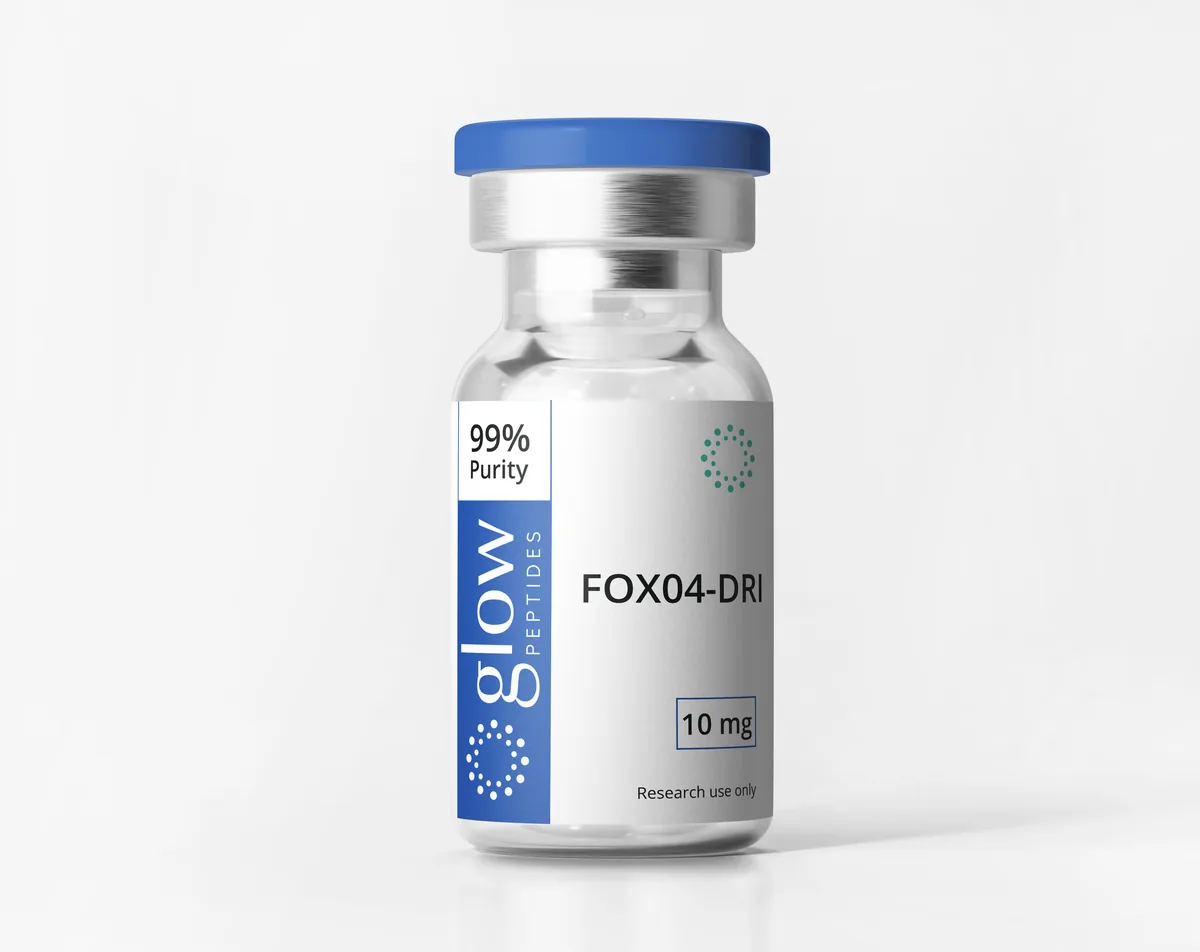
Published lot records for this catalog sit in the lot document directory, each linking its certificate. In this catalog the lyophilized vial carries catalog code FX10 at a stated strength of 10 mg, described as a D-retro-inverso FOXO4 sequence peptide, with the purity figure stated as a catalog specification rather than a measured lot result; the certificate for a given lot is where that lot's own figures are reported, and the catalog page itself defers molecular data to the lot report, which is the right order of authority.
The pattern across the catalog
Every compound here answers to the same two documents: a public record for the definition and a lot certificate for the vial. FOXO4-DRI is the compound where the definition is unusually legible, because the name itself is the datasheet, provided you know the vocabulary it is written in.
What this page deliberately does not cover
Most of what ranks for this question is built on material that falls outside the scope of a research-use page, and none of it is written here. Saying so plainly is more useful than leaving the gap unexplained.
Glow Peptides supplies cataloged materials for laboratory research only. The materials are not drugs, supplements, cosmetics or medical devices, and they are not intended for human or veterinary use. This page gives no dosing, administration, reconstitution, duration, combination or protocol guidance, states no expected outcomes and makes no claim about what these materials do; those questions are outside what a supplier of research materials should answer. What is in scope, and what this page covers, is composition, strength, purity, analytical methods, handling, storage and documentation.
Frequently asked questions
What is FOXO4-DRI?
FOXO4-DRI is a synthetic peptide of 46 amino acid residues, held on PubChem under CID 167312269 and CID 168431240 with the formula C228H388N86O64, a mass of about 5,358 and CAS number 2460055-10-9. Every chiral residue is the D-form of its amino acid and the sequence runs in reverse order relative to the natural stretch it copies, which is what D-retro-inverso means. The copied stretch is positions 92 to 124 of human FOXO4, a 505-residue transcription factor, joined by a three-proline linker to an arginine-rich cell-penetration domain.
What does DRI stand for in FOXO4-DRI?
D-retro-inverso, a standard peptide-chemistry construction. D says the chain is built from mirror-image D-amino acids rather than the natural L-forms, on every residue that has a mirror image to take. Retro says the sequence runs in reverse order. Inverso states the chirality inversion for the molecule as a whole. Made together, the two changes present the side chains in nearly the natural arrangement while the backbone is the mirror image of what protein-degrading enzymes recognize, which is the standard stated rationale for building research peptides this way.
What sequence is FOXO4-DRI?
The published sequence is 46 residues, written in lowercase, the convention for D-residues: ltlrkepaseiaqsileaysqngwanrrsggkrppprrrqrrkkrg. Read in reverse it comes apart into a ten-residue arginine-rich cell-penetration domain, a three-proline linker and a 33-residue stretch that matches positions 92 to 124 of human FOXO4 letter for letter. Building the formula up from these 46 residues gives C228H388N86O64 at about 5,358, matching the formula and stated mass on the PubChem records.
Is FOXO4-DRI the same as the FOXO4 protein?
No. FOXO4 is a natural human transcription factor of 505 residues, held under UniProt entry P98177. FOXO4-DRI is a 46-residue synthetic peptide at about 5,358 that carries a mirrored, reversed copy of one 33-residue stretch of that protein, plus a carrier domain and a linker. No stretch of the natural protein consists of D-residues in reversed order, so the peptide is a designed derivative of one piece of FOXO4, not a fragment of it in the ordinary sense and not the protein itself.
Why is the FOXO4-DRI sequence written in lowercase letters?
Single capital letters are the convention for the standard L-amino acids, and lowercase letters are the common convention for their D-forms. The FOXO4-DRI sequence is written entirely in lowercase: every chiral residue is the D-form, the mirror image of the natural form, while the four glycines have no mirror image, so for them the case carries no information. The typography is the D of the name written into the sequence, not a stylistic choice.
How do I check what a FOXO4-DRI vial contains?
Read the lot certificate rather than the label. The identity mass should reconcile with about 5,358, allowing for the stated salt form, since the public records agree on one molecule under this name. Note that a mass figure alone does not report chirality, because a D-residue weighs exactly what its L mirror image weighs; the D construction is established by the synthesis and, where reported at all, by chiral methods beyond a routine identity mass. The lot number on the document should match the vial, and the laboratory and method should be named beside each figure.
Sources
- PubChem, National Library of Medicine, National Institutes of Health. Records read 5 October 2026: CID 167312269, titled Foxo4-dri and carrying the synonym FOXO4-DRI TFA salt form, and CID 168431240, carried under its full systematic peptide name with FOXO4-DRI among its synonyms, a systematic rendering that leaves some carrier-region residues without stereo-prefixes and writes two prolines as DL; the D construction described in this article is that of the published lowercase sequence. Both records carry the formula C228H388N86O64, a mass of about 5,358 and CAS registry number 2460055-10-9.
- UniProt, entry P98177, Forkhead box protein O4, human, gene FOXO4. Sequence retrieved 5 October 2026: 505 residues, with the 33-letter stretch RKGGSRRNAWGNQSYAELISQAIESAPEKRLTL located at positions 92 to 124 by direct search of the retrieved sequence.
- The published 46-residue FOXO4-DRI sequence as carried in the public record. Its molecular formula and mass were recomputed residue by residue for this article, giving C228H388N86O64 at 5,358.1, matching the formula on both PubChem records and agreeing with their stated mass, and its reversal into the ten-residue carrier domain, the three-proline linker and the 33-residue FOXO4 stretch was verified by direct string comparison against the UniProt sequence above, 5 October 2026.
- Baar MP et al., Cell, volume 169, 23 March 2017, PubMed identifier 28340339, verified against the PubMed record 5 October 2026. Cited solely as the publication that introduced the peptide's design; no finding from the study is reported on this page.
- Glow Peptides live product page and research guide for FOXO4-DRI, read 5 October 2026, for the catalog code FX10, the 10 mg stated strength and the catalog's description of the material. No formula or mass is quoted from any catalog page in this article; identity figures here come from the public records above, and the identity of any specific lot is a matter for that lot's certificate.
For research use only. Not for human or veterinary use, diagnostic use, or any therapeutic application.