Glow Peptides · Research Journal
BPC-157 and TB-500: What Is in the Wolverine Blend
Glow Peptides Research Team · 2026-09-24
For research use only. Not for human or veterinary use, diagnostic use, or in any therapeutic application.
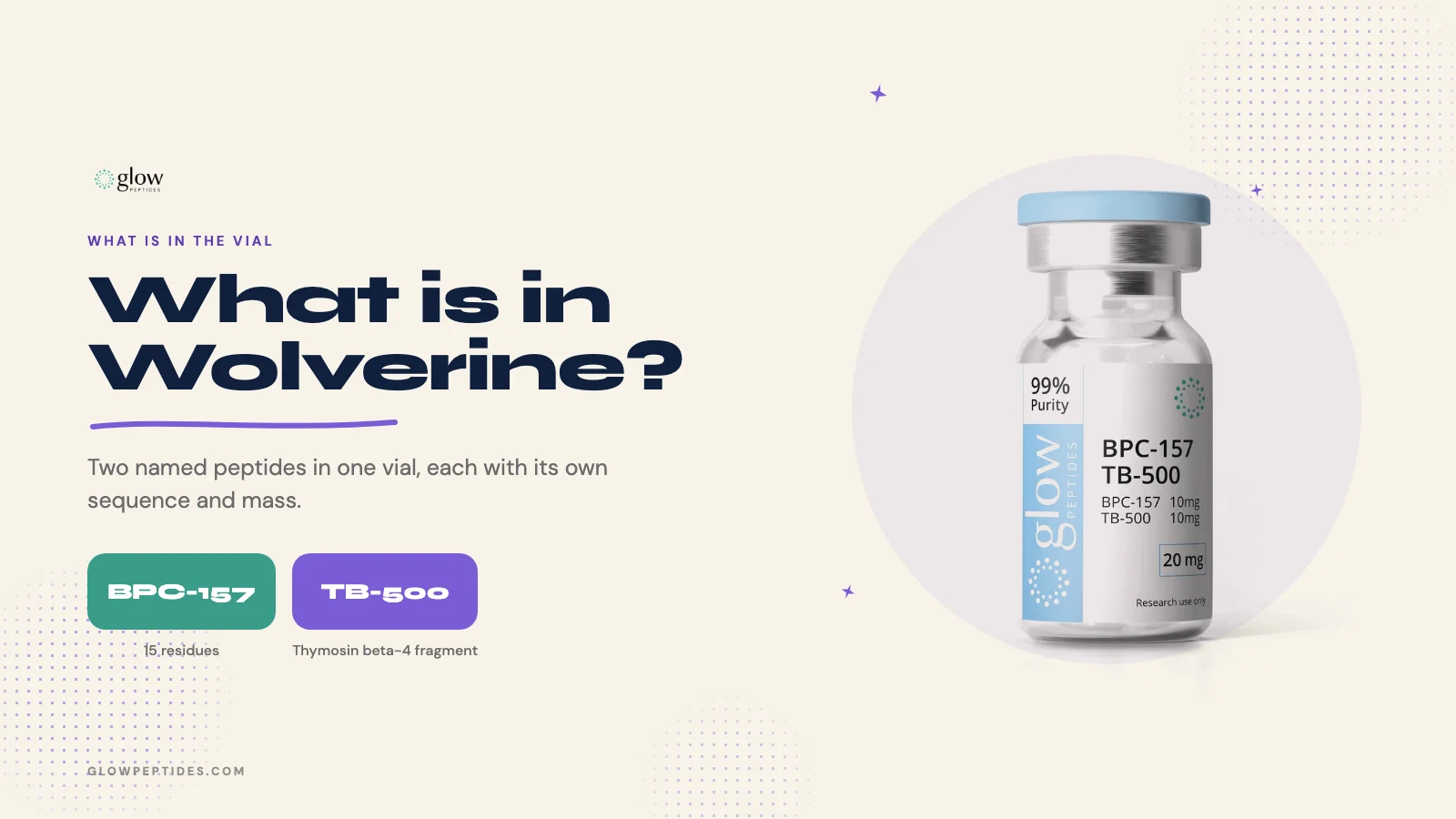
The Wolverine blend contains two separate peptides: BPC-157, a fifteen-residue peptide of about 1,419.5, and TB-500, a seven-residue peptide of about 889.0. The most common statement made about the second one is wrong. TB-500 is named after a forty-three-residue protein and is routinely described as a synthetic version of it, which it is not. This page sets out what is actually in a vial of the BPC-157 and TB-500 blend: both sequences, both formulas, both masses, where the shorter one actually sits inside the protein it borrows its name from, and what having two peptides in one vial changes about analyzing a lot.
The two components
The short version
- BPC-157. 15 residues, GEPPPGKPADDAGLV. C62H98N16O22, about 1,419.5. PubChem CID 9941957.
- TB-500. 7 residues, Ac-LKKTETQ. C38H68N10O14, about 889.0. PubChem CID 62707662.
- TB-500 is not thymosin beta-4. Thymosin beta-4 is a 43-residue protein of about 4,963. Thymosin beta-4 is 5.58 times its mass.
- LKKTETQ is residues 17 to 23 of thymosin beta-4. It is one seven-residue stretch out of forty-three.
- Neither peptide contains an aromatic residue, so neither absorbs at 280 nanometers. Detection is backbone-only for both.
- They do not share a net charge. BPC-157 runs clearly negative; TB-500 sits close to neutral. That is part of why a blend method is not a single-compound method run twice.
TB-500 is not thymosin beta-4, and the difference is large
This is the correction worth making first, because it is commonly stated the other way round, and because the size of the difference is larger than the language usually suggests.
Thymosin beta-4 is a protein. UniProt holds it under accession P62328, where the entry length is 44 residues with the initiating methionine annotated as removed, giving a mature chain of 43 residues. PubChem holds it as CID 45382195 with a molecular weight of about 4,963.
TB-500 is a seven-residue peptide. Its sequence is Ac-Leu-Lys-Lys-Thr-Glu-Thr-Gln, written Ac-LKKTETQ, with an acetyl group capping the N-terminus. Its molecular formula is C38H68N10O14 and its molecular weight is about 889.0.
Divide one by the other and thymosin beta-4 is 5.58 times the mass of TB-500. These are not two versions of one thing. One is a short peptide; the other is a protein roughly six times its size.
| TB-500 | Thymosin beta-4 | |
|---|---|---|
| Residue count | 7 | 43 (mature chain) |
| Molecular weight | About 889.0 | About 4,963 |
| Molecular formula | C38H68N10O14 | C212H350N56O78S |
| Sequence | Ac-LKKTETQ | 43 residues, N-terminally acetylated, beginning Ac-SDKPDMAEIEKFDKSKLKKTETQ... |
| Contains sulfur | No | Yes, one methionine |
| Database identifier | PubChem CID 62707662 | UniProt P62328, PubChem CID 45382195 |
Where LKKTETQ actually sits
The seven residues of TB-500 do appear inside thymosin beta-4. They are mature residues 17 to 23, verified against the UniProt sequence. So the relationship is real but narrow: TB-500 reproduces one seven-residue window out of forty-three, roughly sixteen percent of the chain, and reproduces none of the rest.
Two things follow from that, and both are compositional facts rather than claims about activity.
It is a fragment, not an analog, and not a synthetic version. The distinction matters and it is the same one that applies elsewhere in this catalog. A synthetic version of a protein would reproduce the whole sequence. An analog would reproduce it with substitutions. A fragment reproduces an exact excerpt and nothing else. TB-500 is a fragment, with one modification: the N-terminal acetyl group, which is not present at that position in the parent protein because position 17 sits in the middle of a chain rather than at its start.
The acetyl group is a real part of the molecule. The acetyl contributes about 42 mass units. Without it, the same seven residues would weigh about 847 rather than 889. A certificate reporting roughly 847 is describing the unacetylated heptapeptide, which is a different compound from the one named on the vial.
One protein, two differently named fragments
TB-500 is not the only named peptide carved out of thymosin beta-4. UniProt annotates a second one inside the same 43-residue chain: AcSDKP, the four residues at mature positions 1 to 4, which has its own name and its own literature. So one protein sits behind at least two separately named and separately sold short peptides. That is a useful thing to know when reading source material, because a paper on the parent protein, a paper on residues 1 to 4 and a paper on residues 17 to 23 are three different subjects.
What is in BPC-157
BPC-157 is a fifteen-residue peptide. PubChem holds it as CID 9941957 with molecular formula C62H98N16O22 and a molecular weight of about 1,419.5. A recalculation from the sequence gives 1,419.55, which agrees.
| Position | 1 | 2 | 3 | 4 | 5 | 6 | 7 | 8 | 9 | 10 | 11 | 12 | 13 | 14 | 15 |
|---|---|---|---|---|---|---|---|---|---|---|---|---|---|---|---|
| Residue | Gly | Glu | Pro | Pro | Pro | Gly | Lys | Pro | Ala | Asp | Asp | Ala | Gly | Leu | Val |
| Code | G | E | P | P | P | G | K | P | A | D | D | A | G | L | V |
Three features of that composition do real work.
Four prolines out of fifteen, three of them consecutive. Prolines sit at positions 3, 4, 5 and 8. That is twenty-seven percent proline, which is high, and the run of three at positions 3 to 5 is the notable part. Proline is the one residue whose backbone nitrogen is inside a ring, which means the peptide bond in front of it can sit in either a cis or a trans arrangement and can interconvert slowly. On a chromatogram that produces broader peaks, and sometimes split or shouldered peaks, from a single pure species. It is a real analytical complication and it is specific to proline-rich sequences.
No aromatic residues. There is no tryptophan, no tyrosine, no phenylalanine and no histidine anywhere in the fifteen residues. So BPC-157 does not absorb at 280 nanometers and detection has to be done on the peptide backbone near 214 to 220 nanometers.
No sulfur. The molecular formula contains no S. There is no cysteine, so no disulfide bond is possible, and no methionine, so there is nothing to oxidize to a sulfoxide.
Why a two-peptide vial is harder to analyze than either peptide alone
This is the part that is specific to a blend, and it is where the two components' compositions interact.
Neither component gives a 280 nanometer handle. Both sequences are entirely free of aromatic residues. On a single-compound vial that costs you a confirmatory wavelength. On a blend it costs you something more useful, because two peaks that both appear only at 214 nanometers cannot be told apart by their absorbance ratio. Everything has to come from retention time and from the mass.
The two do not share a net charge. BPC-157 runs clearly negative: three acidic side chains, glutamate at 2 and the two aspartates at 10 and 11, against a single lysine at 7, plus a free C-terminal carboxyl.
TB-500 lands close to neutral, and the reason is worth working through because it is easy to get wrong. It has two lysines, which are positive. Against them it has a glutamate at position 5 and a free C-terminal carboxyl on the glutamine, both negative. Its N-terminus is capped by the acetyl group, so unlike a normal peptide it contributes no positive charge there at all. Two positives against two negatives puts it near zero at neutral pH, not on the positive side.
So the pair does not split neatly into an anion and a cation, but it does not behave as one charge class either, and a mobile phase and column chemistry tuned to retain BPC-157 well is not automatically right for a near-neutral heptapeptide. That is part of why a blend method has to be developed as a blend method rather than borrowed from either component.
They differ by about 530 mass units, which helps. 1,419.5 against 889.0 is a wide separation, so mass spectrometry distinguishes the two components without difficulty. The mass dimension is the strong one here; the chromatographic dimension is the awkward one.
Purity means something different on a blend. A single figure on a two-component product does not answer the question that matters, which is whether both components are present at the stated ratio and whether each is individually clean. Two peptides each at high purity can still be blended in the wrong proportion, and a single combined purity number would not show it. What a purity percentage does and does not capture is unpacked in what a purity percentage means and what it misses, and the techniques themselves in how HPLC and mass spectrometry verify peptide purity.
Specification summary
| Property | BPC-157 | TB-500 |
|---|---|---|
| Residue count | 15 | 7 |
| Sequence | Gly-Glu-Pro-Pro-Pro-Gly-Lys-Pro-Ala-Asp-Asp-Ala-Gly-Leu-Val | Ac-Leu-Lys-Lys-Thr-Glu-Thr-Gln |
| Single-letter code | GEPPPGKPADDAGLV | Ac-LKKTETQ |
| Molecular formula | C62H98N16O22 | C38H68N10O14 |
| Molecular weight | About 1,419.5 | About 889.0 |
| PubChem CID | 9941957 | 62707662 |
| N-terminus | Free amine on Gly | Acetylated, contributes about 42 |
| C-terminus | Free acid on Val | Free acid on Gln |
| Cysteines, disulfides | None | None |
| Sulfur in formula | None | None |
| Aromatic residues | None. No 280 nm absorbance | None. No 280 nm absorbance |
| Detection wavelength | Backbone, near 214 to 220 nm | Backbone, near 214 to 220 nm |
| Net charge at neutral pH | Clearly negative. Glu 2, Asp 10, Asp 11 and the C-terminus against Lys 7 | Close to neutral. Lys 2 and Lys 3 against Glu 5 and the C-terminus, with the N-terminus capped |
| Notable analytical feature | Four prolines, three consecutive. Broad or split peaks possible | Unacetylated form weighs about 847, a 42 unit difference |
| Named after | Not applicable | Thymosin beta-4, residues 17 to 23 of 43 |
| In this catalog | Single vial and in the blend | Single vial and in the blend |
Reading a certificate for a blend lot
The general discipline is unchanged: a lot number that matches the vial in front of you, the issuing laboratory named rather than described, the analytical method stated alongside the purity figure, a report date belonging to that batch, and an accession number that lets the report be looked up at the laboratory rather than confirmed by the seller. The field-by-field walkthrough is in how to read a peptide certificate of analysis.
Four things are specific to a two-component lot.
Two identity masses, not one. The report should show a mass matching about 1,419 and a mass matching about 889. One mass on a two-peptide product leaves the other component unverified.
Check the 889 figure specifically. A result near 847 is the unacetylated heptapeptide rather than TB-500. The 42 unit gap is the acetyl group, and it is large enough that it cannot be mistaken for measurement error or rounding.
Purity reported per component. Two separate figures say more than one combined figure, and the ratio between the two peaks is its own piece of information.
The detection wavelength should be in the 214 to 220 nanometer range. Neither component has an aromatic residue, so a certificate reporting 280 nanometer detection for this blend is describing a measurement that cannot work as stated for either peptide in the vial.
Published lot records for this catalog are listed on the quality page, each with its own certificate. Lot document availability varies by compound and by batch, so check the specific lot rather than assuming coverage.
What this page deliberately does not cover
Most pages returned for this query move quickly to what the blend may do, what the components may support, how they may work together, how much to take and how to take it. Those subjects are absent here on purpose, and saying so is more useful than leaving the gap unexplained.
Glow Peptides supplies cataloged materials for laboratory research only. Nothing here is a drug, a supplement, a cosmetic or a medical device, and nothing here is intended for human or veterinary use. Dosing, administration, reconstitution, combination and protocol questions are outside what a supplier of research materials should answer. What is in scope, and what this page covers, is composition, structure, strength, purity, analytical method, handling and documentation.
Frequently asked questions
What is in a BPC-157 and TB-500 blend?
Two separate peptides. BPC-157 is a fifteen-residue peptide with the sequence GEPPPGKPADDAGLV, molecular formula C62H98N16O22 and a molecular weight of about 1,419.5, held as PubChem CID 9941957. TB-500 is a seven-residue peptide with the sequence Ac-LKKTETQ, molecular formula C38H68N10O14 and a molecular weight of about 889.0, held as PubChem CID 62707662. The two differ in mass by roughly 530 units, which makes them straightforward to distinguish by mass spectrometry.
Is TB-500 the same as thymosin beta-4?
No, and the difference is large. Thymosin beta-4 is a protein of 43 residues in its mature form, held under UniProt accession P62328, with a molecular weight of about 4,963. TB-500 is a seven-residue peptide of about 889.0. Thymosin beta-4 is 5.58 times the mass of TB-500. TB-500 reproduces one seven-residue window of the protein, at mature residues 17 to 23, and none of the other thirty-six residues. It is a fragment, not a synthetic version of the whole protein and not an analog of it.
Which residues of thymosin beta-4 does TB-500 correspond to?
Mature residues 17 to 23, verified against the UniProt P62328 sequence. That is seven residues out of forty-three, roughly sixteen percent of the chain. TB-500 also carries an N-terminal acetyl group, which the parent protein does not have at that position, because position 17 sits in the middle of the chain rather than at its start. The acetyl adds about 42 mass units, which is why TB-500 weighs about 889 while the same seven residues without it would weigh about 847.
Why does BPC-157 have four prolines and does it matter?
Prolines sit at positions 3, 4, 5 and 8 of the fifteen residues, with three of them consecutive. It matters analytically. Proline is the one amino acid whose backbone nitrogen sits inside a ring, so the peptide bond preceding it can adopt either a cis or a trans arrangement and can interconvert slowly. On a chromatogram that can produce broader peaks, and sometimes split or shouldered peaks, from a single pure species. A proline-rich sequence is a known reason for a peak shape that looks like an impurity but is not one.
Can either peptide in the blend be detected at 280 nanometers?
Neither one. Absorbance at 280 nanometers comes from aromatic side chains, in practice from tryptophan and tyrosine. BPC-157 contains no tryptophan, tyrosine, phenylalanine or histidine, and neither does TB-500. Both sequences are entirely free of aromatic residues, so both have to be detected on the peptide backbone near 214 to 220 nanometers. On a blend that costs more than it would on a single compound, because two peaks that only appear at one wavelength cannot be told apart by their absorbance ratio.
What should a certificate of analysis show for a two-peptide vial?
Two identity masses rather than one: a mass matching about 1,419 for BPC-157 and a mass matching about 889 for TB-500. Purity reported per component rather than as a single combined figure, because two individually clean peptides can still be blended in the wrong proportion and a single number would not reveal it. A detection wavelength in the 214 to 220 nanometer range, since neither peptide absorbs at 280. And on the TB-500 figure specifically, a result near 847 rather than 889 indicates the unacetylated heptapeptide, a 42 unit gap too large to be rounding.
Why does this page not cover what the blend does, or dosing?
Because Glow Peptides supplies cataloged materials for laboratory research only. The products are not drugs, supplements, cosmetics or medical devices, and they are not intended for human or veterinary use. Dosing, administration, reconstitution, combination and protocol guidance are outside what a research materials supplier should provide, so they are deliberately absent rather than accidentally missing. What is covered here is composition, structure, strength, purity, analytical method, handling and documentation.
Sources
- PubChem, National Library of Medicine. BPC-157, CID 9941957. Read 22 September 2026.
- PubChem, National Library of Medicine. TB-500, CID 62707662. Read 22 September 2026.
- PubChem, National Library of Medicine. Thymosin beta-4, CID 45382195. Read 22 September 2026.
- UniProt. Thymosin beta-4, accession P62328. Mature chain length, the position of the LKKTETQ stretch at residues 17 to 23, and the annotation of AcSDKP at residues 1 to 4. Read 22 September 2026.
- Both molecular weights independently recomputed from their sequences using standard average residue masses, with water added for the chain termini and 42.0367 added for the N-terminal acetyl group on TB-500. Both recomputed figures agree with the database values.
For research use only. Not for human or veterinary use, diagnostic use, or any therapeutic application.