Glow Peptides · Research Journal
Is Tesofensine a Peptide? The Real Answer
Glow Peptides Research Team · 2026-11-23
For research use only. Not for human or veterinary use, diagnostic use, or in any therapeutic application.
Is tesofensine a peptide? No. Tesofensine is a small synthetic molecule with the formula C17H23Cl2NO and a mass of about 328.3, built on a two-ring nitrogen skeleton with a dichlorophenyl group attached. It contains no amino acids and no peptide bond, and its formula has too few nitrogen atoms to hold even the shortest possible peptide. It appears beside peptides because research suppliers often catalog small molecules and peptides together. This page shows how the structure settles the question, what the name NS-2330 refers to, and how the tesofensine research material in this catalog is identified on its lot certificate, where two chlorine atoms leave a signature no peptide in the range carries.
Key facts
- Not a peptide. Tesofensine has no amino acid units and no peptide bond. It is a small molecule.
- Formula and mass: C17H23Cl2NO, mass about 328.3, monoisotopic mass 327.1157. PubChem CID 11370864.
- Other names: NS-2330 is the development code. CAS registry number 195875-84-4. Tesofensine is its International Nonproprietary Name.
- Skeleton: an 8-azabicyclo[3.2.1]octane ring system, the same two-ring frame chemists call a tropane, carrying a 3,4-dichlorophenyl group and an ethoxymethyl group.
- Identity signature: two chlorine atoms produce a cluster of mass peaks two units apart, at roughly 100 : 64 : 10. A peptide made only of standard amino acids has no chlorine and no such cluster.
- Regulatory record: no application for tesofensine was returned from the FDA drug approval database when searched on 26 October 2026.
What makes a molecule a peptide
The definition is narrower than the way the word is used in catalogs. The National Library of Medicine defines peptides as compounds composed of amino acids joined together by peptide bonds between adjacent amino acids, in linear, branched or ring-shaped structures.
Two parts of that definition do the work. The building blocks have to be amino acids, and the links between them have to be peptide bonds, the amide bond formed when the carbonyl carbon of one amino acid joins the nitrogen of the next.
Being made by a laboratory, being studied alongside peptides or being sold in the same catalog does not make a compound a peptide. Neither does a long or technical-sounding name. The question is answered by the structure, and the structure is public.
The same test was applied to another compound in this catalog in whether NAD+ is a peptide, where the answer also turns on which building blocks are present and how they are joined. Tesofensine gets to its answer faster, because its formula rules out a peptide before the structure is even drawn.
Tesofensine's structure, read from its name
PubChem gives tesofensine the systematic name (1R,2R,3S,5S)-3-(3,4-dichlorophenyl)-2-(ethoxymethyl)-8-methyl-8-azabicyclo[3.2.1]octane. Read from the end backward, that name describes the whole molecule.
- 8-azabicyclo[3.2.1]octane is a two-ring system of seven carbons and one nitrogen, with the nitrogen bridging the two rings at position 8. With a methyl group on that nitrogen, this frame is the tropane skeleton.
- 8-methyl is that methyl group on the bridging nitrogen. It makes the nitrogen a tertiary amine, the only nitrogen in the molecule.
- 2-(ethoxymethyl) is a CH2-O-CH2CH3 chain at position 2. Its oxygen is an ether oxygen, the only oxygen in the molecule.
- 3-(3,4-dichlorophenyl) is a benzene ring carrying two chlorine atoms next to each other, attached at position 3.
- (1R,2R,3S,5S) fixes the three-dimensional arrangement at four stereocenters. A different arrangement at any of them would be a different stereoisomer with the same formula.
Nothing in that list is an amino acid. There is no carboxylic acid group, no amide group and no chain of repeating units.
PubChem records zero hydrogen-bond donors for the molecule. That is a useful cross-check, because a peptide backbone normally carries an N-H group at its peptide bonds and an amino group at its start, and tesofensine has neither.
Is tesofensine a peptide? What the formula alone shows
There is a quicker check that needs no structure at all, only the formula. The smallest possible peptide is a dipeptide, two amino acids joined by one peptide bond. The smallest dipeptide of all is glycylglycine, two glycines joined together, and PubChem gives its formula as C4H8N2O3.
That formula sets a floor. Every amino acid contains a nitrogen atom, so any peptide, however it is capped or modified, needs at least two nitrogen atoms, one from each amino acid unit.
Glycylglycine also shows what a peptide's oxygen count looks like: one oxygen in the peptide bond's carbonyl and two in the free acid at the end. A longer peptide only needs more of both.
| Compound | Formula | Nitrogen atoms | Oxygen atoms | Peptide bonds present |
|---|---|---|---|---|
| Glycylglycine, the smallest dipeptide | C4H8N2O3 | 2 | 3 | 1 |
| Tesofensine | C17H23Cl2NO | 1 | 1 | 0 |
Tesofensine has seventeen carbons, more than four times as many as glycylglycine, but only one nitrogen and one oxygen. With a single nitrogen it cannot contain two amino acid units, so it cannot contain a peptide bond between them.
The formula alone settles the question. The structure then confirms it: that one nitrogen is the ring nitrogen, and that one oxygen is an ether oxygen.
The names on documents: tesofensine, NS-2330 and the registry numbers
The same molecule turns up under several labels, and a certificate, a database or a paper may use any of them. They all point to one compound.
| Identifier | Value | What it is |
|---|---|---|
| Name | Tesofensine | International Nonproprietary Name |
| Development code | NS-2330 (also written NS2330) | The code used before the name was assigned |
| CAS registry number | 195875-84-4 | Chemical Abstracts Service identifier |
| UNII | BLH9UKX9V1 | FDA substance identifier |
| PubChem CID | 11370864 | Compound record used for the figures on this page |
A document that gives any of these identifiers is describing the same substance. A document that gives a different formula or mass under the same name is describing something else, or contains an error, and that is worth resolving before the material is logged into a research inventory.
Tesofensine is also not a salt in its PubChem record. The figures here are for the neutral compound. If a document lists a salt form, its stated mass will be higher by the mass of the acid that forms the salt, and the identity check should be made against the matching record.
The chlorine signature in the mass spectrum
Mass spectrometry is how a certificate confirms identity, and tesofensine gives that method an unusually clear target. The reason is chlorine.
Natural chlorine is a mixture of two stable isotopes. The Commission on Isotopic Abundances and Atomic Weights gives chlorine-35 a mass of 34.9689 and an abundance between 0.755 and 0.761 of all chlorine atoms, and chlorine-37 a mass of 36.9659 and an abundance between 0.239 and 0.245.
Chlorine-37 is two mass units heavier. So a molecule containing chlorine does not show up in a mass spectrum as one peak but as a cluster.
With two chlorine atoms, each molecule can carry two chlorine-35 atoms, one of each, or two chlorine-37 atoms. Those three combinations sit two mass units apart. Taking chlorine-35 at 0.758 and chlorine-37 at 0.242, the expected heights come out at roughly 100 : 64 : 10.
| Chlorine atoms in the ion | Approximate m/z of [M+H]+ | Relative height |
|---|---|---|
| Two chlorine-35 | 328.12 | 100 |
| One chlorine-35, one chlorine-37 | 330.12 | about 64 |
| Two chlorine-37 | 332.12 | about 10 |
This is what makes the identity check dependable. A spectrum showing a single peak near 328 with nothing two units above it would not fit tesofensine, whatever the label says.
A spectrum showing the cluster at the right masses and roughly the right proportions fits only a molecule of that mass carrying two chlorines. Peptides built from the standard amino acids contain no chlorine at all, so no peptide in this catalog produces this pattern.
What the lot certificate shows
The published certificate for a tesofensine lot lists identity confirmed by LC-MS/MS, a molecular weight of 328 g/mol, and purity by reversed-phase HPLC at 214 nm. Its mass spectrum labels the protonated ion at 328.2 and shows a second peak two mass units higher, which is the chlorine pattern described above. The lot number, issuing laboratory, verification code, issue date and measured purity are read from the certificate itself, not from this page.
What a certificate for tesofensine should show
Three checks follow from the structure, and each one can be made by reading the document rather than by running anything.
The stated mass should read about 328. A figure near 328.3, or the monoisotopic 327.1, matches the neutral compound.
A figure well away from that, under the same name, needs explaining before anything else. Mass fields on certificates are typed by people, so a typing slip is possible, but the spectrum should agree with the correct figure even when the field does not.
The spectrum should show the chlorine cluster. A protonated ion near 328.1 with a companion near 330.1 is the expected pattern. This is the check that is hardest to fake by relabeling, because it depends on the atoms actually present.
Purity is a separate question from identity. An HPLC percentage states what share of the detected material appears as the main peak under that method.
It does not on its own say what the main peak is, which is why the identity line on a certificate is read first. The general method for working through any certificate in this catalog, field by field, is set out in how to read a certificate of analysis.
A fourth point is about stereochemistry. Tesofensine's name specifies four stereocenters. A standard reversed-phase purity run is not designed to separate mirror-image forms, and a mass spectrum cannot tell any stereoisomers apart because they have identical masses.
Confirming the configuration takes a dedicated chiral method. A certificate that does not mention one is not wrong; it simply has not addressed that question.
Why a small molecule sits in a peptide catalog
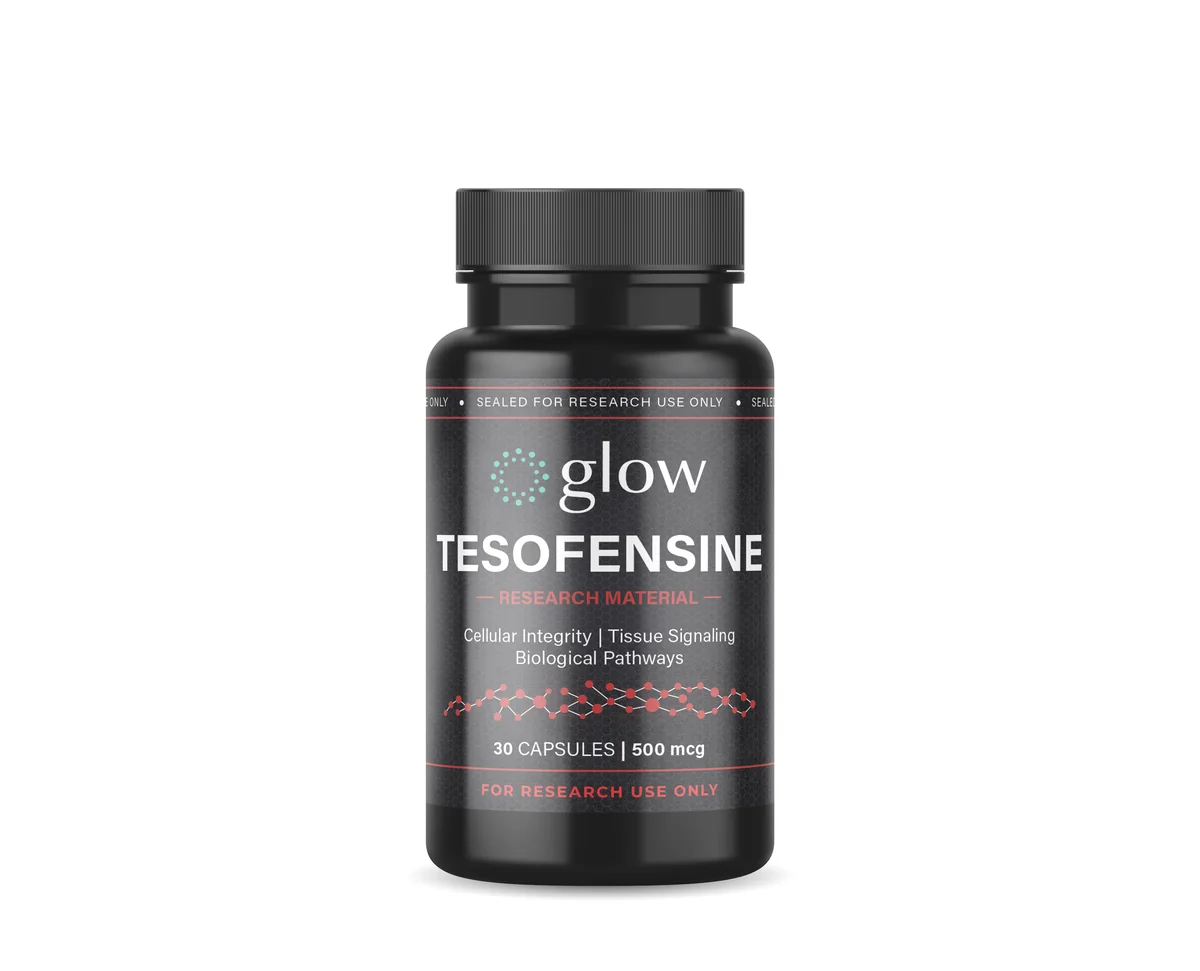
Research suppliers catalog what researchers ask them for, and that has never been limited to peptides. This catalog lists several small molecules alongside its peptides, each with its own compound record. The tesofensine reference guide describes it in the same terms used here: a small molecule, not a peptide, supplied as a reference material for laboratory use.
The practical consequence is that the vocabulary that suits peptides does not all carry over. Sequence, residue count and peptide content have no meaning for tesofensine.
Formula, mass, stereochemistry and the chlorine pattern do. Reading a tesofensine document with the right vocabulary is most of what it takes to read it well.
The product page lists tesofensine in the catalog's encapsulated research materials range, with a supplier purity specification of at least 99.2%, stated there as a specification rather than as a measured lot result. The measured result for a given lot is the one on that lot's certificate, and where a catalog field and the public record differ on a figure, the record and the certificate govern.
What this page deliberately does not cover
Most of what is written about tesofensine elsewhere falls outside the scope of a page from a supplier of research materials, and none of it is written here. That leaves the structure, the names, the mass and the documents, which are the parts a laboratory needs to establish what is in a container before any work begins.
Glow Peptides supplies cataloged materials for laboratory research only. The materials are not drugs, supplements or medical devices, and they are not intended for human or veterinary use.
Frequently asked questions
Is tesofensine the same as tesamorelin?
No. The names look alike but the compounds are unrelated. Tesamorelin is a peptide: a 44-residue analog of growth hormone releasing hormone with a mass of about 5,136, PubChem CID 16137828. Tesofensine is a small molecule of about 328.3 with no amino acids at all, PubChem CID 11370864. The two differ in mass by a factor of more than fifteen, so a mass spectrum separates them at once.
Why do the mass figure and the main mass peak both read about 328?
It is a coincidence of two different numbers. The stated mass, about 328.3, averages over every natural mix of isotopes. The main peak in the spectrum is something else: the lightest version of the molecule, with two chlorine-35 atoms, at 327.116, plus one proton at 1.007, which lands at 328.12. For tesofensine the two figures happen to sit close together, but they are not the same measurement.
What should be recorded when a tesofensine lot arrives in a lab?
The name exactly as labeled, the CAS registry number 195875-84-4, the lot number, the certificate's verification code and issue date, and the mass figure the certificate reports, checked against 328.3. Glow Peptides' tesofensine guide recommends keeping the material sealed in a cool, dry place away from light and humidity. A mismatch between label, certificate and record is worth resolving before the material is used.
Does tesofensine have an FDA approval?
The useful contrast is with two molecules in this catalog whose approved products appear in that database. Tesamorelin's record carries application BLA 022505 and PT-141's carries an NDA, so for those two a public page exists that a label can be reconciled against; the approval belongs to the approved product, never to a research material. For tesofensine no such page came back from the public database, which means there is no brand name, no application number and no approval date to quote, and any listing that implies otherwise is borrowing standing the record does not show. Searches of that database work best under the exact nonproprietary spelling, tesofensine.
Sources
- PubChem, tesofensine, CID 11370864, National Library of Medicine. Read 26 October 2026 for the formula, mass, monoisotopic mass, systematic name, hydrogen-bond donor count and synonyms (NS-2330, CAS 195875-84-4, UNII BLH9UKX9V1).
- PubChem, glycylglycine, CID 11163, read 26 October 2026, for the formula C4H8N2O3. PubChem record for tesamorelin, CID 16137828 (C221H366N72O67S, 5,136), read the same day for the comparison in the questions below.
- NLM Medical Subject Headings, "Peptides", read 26 October 2026, for the definition of a peptide.
- Commission on Isotopic Abundances and Atomic Weights, chlorine, read 26 October 2026, for the masses and abundance ranges of chlorine-35 and chlorine-37.
- FDA, Drugs@FDA. Searched for tesofensine through the openFDA drug application endpoint on 26 October 2026; no application returned.
- Glow Peptides, the published certificate of analysis linked from this page, and the live tesofensine product page, both read 26 October 2026. Isotope cluster masses and heights computed from the PubChem and CIAAW figures above.
For research use only. Not for human or veterinary use, diagnostic use, or any therapeutic application.