Glow Peptides · Research Journal
Is NAD+ a Peptide? No, and the Formula Proves It
Glow Peptides Research Team · 2026-09-22
For research use only. Not for human or veterinary use, diagnostic use, or in any therapeutic application.
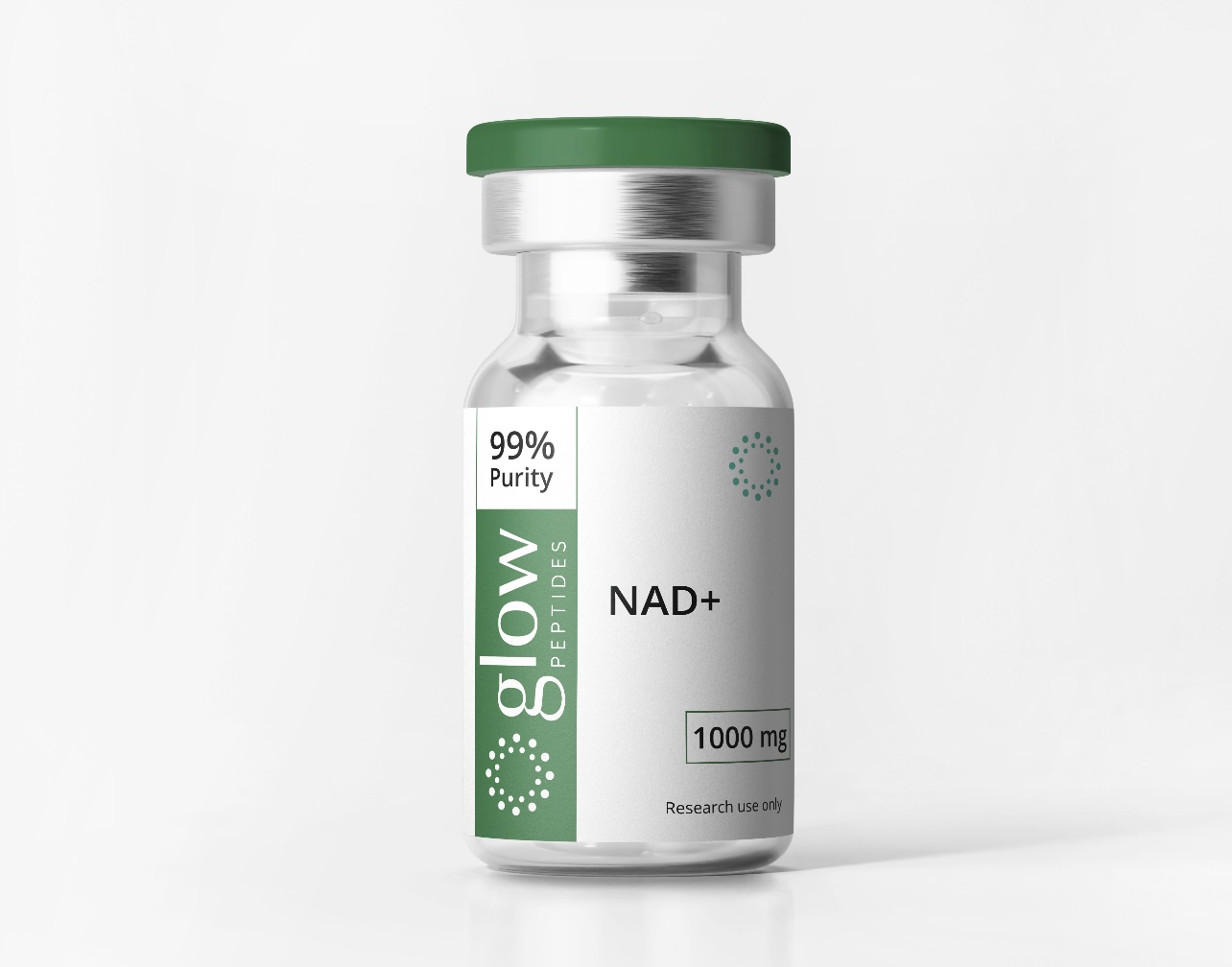
No. NAD+ is not a peptide, and it is not a borderline case or a matter of definition. A peptide is a chain of amino acids joined by amide bonds. NAD+ contains no amino acids and no peptide bonds at all. It is a dinucleotide, which is a different class of molecule entirely. It is stocked alongside peptides, including here, because the people buying research peptides also buy it, and that shelf position is the whole source of the confusion. This page sets out what research-grade NAD+ actually is, with the formula, the mass and the working, and what the difference changes about how it is tested and documented.
One formula settles it
NAD+ is nicotinamide adenine dinucleotide. Its molecular formula is C21H27N7O14P2 and its molecular weight is 663.4. Two phosphorus atoms sit in that formula. Peptides do not contain phosphorus in their backbone at all, and no combination of the twenty standard amino acids produces a phosphate group. The formula alone settles the question before any argument about function starts.
The short version
- NAD+ is a dinucleotide, not a peptide. C21H27N7O14P2, molecular weight 663.4, PubChem CID 5892.
- It contains zero amino acids and zero peptide bonds.
- It is built from two nucleotides joined tail to tail: one carrying nicotinamide, one carrying adenine.
- A real peptide in this catalog, KPV, is C16H30N4O4 at 342.43. Same rough size, completely different construction.
- The difference is analytically real. NAD+ and peptides are read at different wavelengths and against different expected masses.
What a peptide is, precisely
A peptide is a chain of amino acids joined end to end. The bond doing the joining is specific: the carboxyl group of one amino acid condenses with the amino group of the next, releasing water and leaving an amide linkage. That linkage is what the word "peptide bond" names. Two amino acids make a dipeptide, three a tripeptide, and longer chains keep the name until they are long enough that people start calling them proteins.
Three things follow from that definition and they are the test worth applying to anything claiming to be a peptide. It must be built from amino acids. Those amino acids must be joined by amide bonds between backbone carboxyl and amino groups. And you should be able to write it as a sequence, because a peptide is defined by the order of its residues.
KPV, a three-residue peptide in this catalog, passes all three: it is lysine, proline and valine, joined in that order, written Lys-Pro-Val. Tesamorelin passes all three at 44 residues. MOTS-c passes at 16. NAD+ fails all three, and it fails the first one, which makes the other two moot.
What NAD+ is, precisely
NAD+ is two nucleotides joined at their phosphate ends. That is what the "dinucleotide" in its name means, and it is the whole architecture.
A nucleotide has three parts: a nitrogen-containing base, a five-carbon sugar, and a phosphate group. In NAD+, one half carries nicotinamide as its base on a ribose sugar. The other half carries adenine on its own ribose. The two phosphates are joined to each other, forming a pyrophosphate bridge that holds the two halves together. Nicotinamide, ribose, phosphate, phosphate, ribose, adenine.
Nothing in that description is an amino acid. The nitrogen atoms in the formula, all seven of them, sit in aromatic ring systems and in an amide on the nicotinamide ring, not in a peptide backbone. This is the same structural family as the nucleotides that make up DNA and RNA, not the family that makes up proteins.
The tell in the formula
P2. Two phosphorus atoms. Run through the twenty standard amino acids and none of them contains phosphorus. A peptide can acquire a phosphate through modification after it is made, but a molecule whose backbone is held together by a phosphate bridge is not a peptide that happens to be phosphorylated. It is a nucleotide structure.
Side by side against four peptides in this catalog
The fastest way to see the difference is to line NAD+ up against compounds that genuinely are peptides, including one in the same size range.
| Compound | Class | Residues | Molecular formula | Molecular weight |
|---|---|---|---|---|
| NAD+ | Dinucleotide | None | C21H27N7O14P2 | 663.4 |
| KPV | Peptide | 3 | C16H30N4O4 | 342.43 |
| MOTS-c | Peptide | 16 | C101H152N28O22S2 | 2,174.6 |
| AOD-9604 | Peptide | 16 | C78H123N23O23S2 | 1,815.1 |
| Tesamorelin | Peptide | 44 | C221H366N72O67S | 5,136 |
Read down the formula column. Every peptide in that table is carbon, hydrogen, nitrogen and oxygen, with sulfur where the sequence contains cysteine or methionine. Not one of them contains phosphorus. NAD+ is the only row with a P in it, and it is also the only row with no residue count, because it has no residues to count.
KPV is the useful comparison because the two are close in size: 342 against 663, the same order of magnitude. Size is not what makes something a peptide. Construction is.
Why the confusion exists
The phrase "NAD+ peptide therapy" is in wide circulation, and it is where most of this comes from. Three things feed it, and none of them is a chemical argument.
Shelf position. Suppliers that stock research peptides usually stock NAD+ too, because the same researchers order both. A catalog is organized by who buys, not by molecular class. This catalog does exactly that, and calling the whole catalog "peptides" is shorthand rather than a classification.
Marketing language. "Peptide therapy" became a category name before it was a precise one, and NAD+ got absorbed into it. Once a phrase appears on enough websites it starts being repeated as though it were a fact about the molecule.
Superficial similarity. Both arrive as lyophilized powder in a vial, both are handled the same way in a laboratory, both carry lot numbers and certificates. Nothing about the packaging tells you what is inside it.
None of that makes NAD+ a peptide, and the reason to be precise is not pedantry. It changes what you should expect on the paperwork.
NAD+, NADH and NMN are three different molecules
Since the naming already causes trouble, it is worth separating the three that get used interchangeably and are not interchangeable.
| Name | What it is | Formula | Molecular weight | PubChem CID |
|---|---|---|---|---|
| NAD+ | The oxidized dinucleotide | C21H27N7O14P2 | 663.4 | 5892 |
| NADH | The reduced form of the same dinucleotide | C21H29N7O14P2 | 665.4 | 439153 |
| NMN | A mononucleotide, half the structure | C11H15N2O8P | 334.22 | 14180 |
NMN is the clearest of the three to place: one nucleotide rather than two, one phosphorus rather than two, and roughly half the mass. It is the nicotinamide half of NAD+ on its own. None of the three is a peptide, and a certificate for one of them is not a certificate for another.
What the difference changes about testing and documentation
This is the part that actually matters when a vial arrives, and it is the reason the classification is worth getting right rather than waving through.
The detection wavelength is different. Reversed-phase HPLC with UV detection is used for both, but it is not reading the same thing. Peptides without aromatic residues are detected by the absorbance of the amide backbone itself, in the region around 214 to 220 nanometers. NAD+ has no amide backbone to read. What it does have is an adenine ring, which absorbs strongly near 260 nanometers, the same region used for nucleotides and nucleic acids generally. A method set up to read peptide bonds is looking in the wrong place for this molecule.
The expected mass is different, and it is not close. Mass spectrometry confirms identity by matching a measured mass against an expected one. For NAD+ that expectation is 663.4. For the peptides in the table above it runs from 342 to 5,136. There is no overlap and no ambiguity, which makes the identity check straightforward once you know which number applies.
The impurity profile is different in kind. Peptide impurities are largely synthesis artifacts: deletion sequences where a coupling failed, incomplete removal of protecting groups, oxidation at methionine or cysteine. None of those failure modes exists for a dinucleotide, because it is not assembled residue by residue. The relevant concerns for NAD+ are different chemistry, and one of them is worth naming: NAD+ and NADH are a redox pair, so the oxidation state of the material is a real specification question rather than an academic one.
Net peptide content does not apply. On a peptide certificate, net peptide content is a separate figure from purity, answering how much of the vial is peptide at all once water and counterions are accounted for. That figure is meaningless for a compound with no peptide in it. A certificate offering one for NAD+ has been produced from a template rather than from a measurement, and that is a useful thing to notice.
The general principles of reading a certificate still hold, and they are covered in the guide on how to read a certificate of analysis and in the longer piece on what a purity percentage means and what it misses. Published lot records for this catalog sit on the quality page. Lot document availability varies by compound and by batch, so check the specific lot rather than assuming coverage.
What this page does not cover
Most pages returned for this question move quickly from the classification to what NAD+ does, what it is used for, how much to take and how to take it. Those subjects are absent here on purpose.
Glow Peptides supplies cataloged materials for laboratory research only. Nothing here is a drug, a supplement, a cosmetic or a medical device, and nothing here is intended for human or veterinary use. Dosing, administration, reconstitution and protocol questions are outside what a supplier of research materials should answer. What is in scope is composition, structure, strength, purity, analytical method, handling and documentation, which is what this page covers. The single-compound reference page is at NAD+, and the encapsulated format is at NAD+ capsules.
Frequently asked questions
Is NAD+ a peptide?
No. NAD+ is nicotinamide adenine dinucleotide, a dinucleotide with the molecular formula C21H27N7O14P2 and a molecular weight of 663.4, cataloged in PubChem as CID 5892. A peptide is a chain of amino acids joined by amide bonds between backbone carboxyl and amino groups. NAD+ contains no amino acids and no peptide bonds. It is built from two nucleotides joined by a pyrophosphate bridge, one carrying nicotinamide and one carrying adenine. The two phosphorus atoms in the formula are the quickest tell, because none of the twenty standard amino acids contains phosphorus.
What is the difference between NAD+ and peptides?
They are different classes of molecule built from different parts. A peptide is a sequence of amino acids, so it can be written out residue by residue, and it is defined by that order. NAD+ has no sequence because it has no residues. It is two nucleotides, each made of a base, a ribose sugar and a phosphate, joined at the phosphates. The difference shows up practically in the laboratory: peptides without aromatic residues are detected by UV absorbance of the amide backbone around 214 to 220 nanometers, while NAD+ is read near 260 nanometers where its adenine ring absorbs. The expected masses differ too, 663.4 for NAD+ against 342 to 5,136 for the peptides in this catalog.
Why do peptide suppliers sell NAD+ if it is not a peptide?
Because catalogs are organized around who buys, not around molecular class. Researchers working with peptides frequently work with NAD+ as well, so it sits on the same shelf, ships the same way and carries the same kind of lot documentation. The phrase "NAD+ peptide therapy" grew out of that shelf position rather than out of any chemical claim. Describing a whole catalog as peptides is shorthand. It is not a statement about what any individual compound in it is.
Is NMN a peptide, and is it the same as NAD+?
NMN is not a peptide either, and it is not the same molecule as NAD+. NMN is nicotinamide mononucleotide, PubChem CID 14180, formula C11H15N2O8P, molecular weight 334.22. The name gives the difference away: mononucleotide rather than dinucleotide, one phosphorus rather than two, roughly half the mass. Structurally it is the nicotinamide half of NAD+ on its own. NADH is a third distinct entity, the reduced form of NAD+, PubChem CID 439153, formula C21H29N7O14P2 at 665.4, which is NAD+ plus two hydrogens. All three are nucleotide-family molecules and none of them is a peptide.
Does a peptide certificate of analysis work for NAD+?
Not without changes, and one field on it does not apply at all. Net peptide content is a standard figure on a peptide certificate, reporting how much of the vial is peptide once water and counterions are accounted for. For a compound containing no peptide, that figure has nothing to measure. The purity method also differs, because the UV detection wavelength that suits a peptide backbone is not the one that suits an adenine ring, and the expected mass on the identity line is 663.4 rather than anything in the peptide range. A certificate that reports net peptide content for NAD+ has been filled in from a template rather than from an analysis, which is worth noticing.
Sources
- PubChem, National Library of Medicine. NAD+, CID 5892; NADH, CID 439153; nicotinamide mononucleotide, CID 14180; KPV, CID 125672; AOD-9604, CID 71300630; tesamorelin, CID 16137828. Molecular formulas and weights read 21 September 2026.
- UniProt. MOTS-c, accession A0A0C5B5G6. Sequence read 21 September 2026; molecular weight computed from that sequence.
For research use only. Not for human or veterinary use, diagnostic use, or any therapeutic application.