Glow Peptides · Research Journal
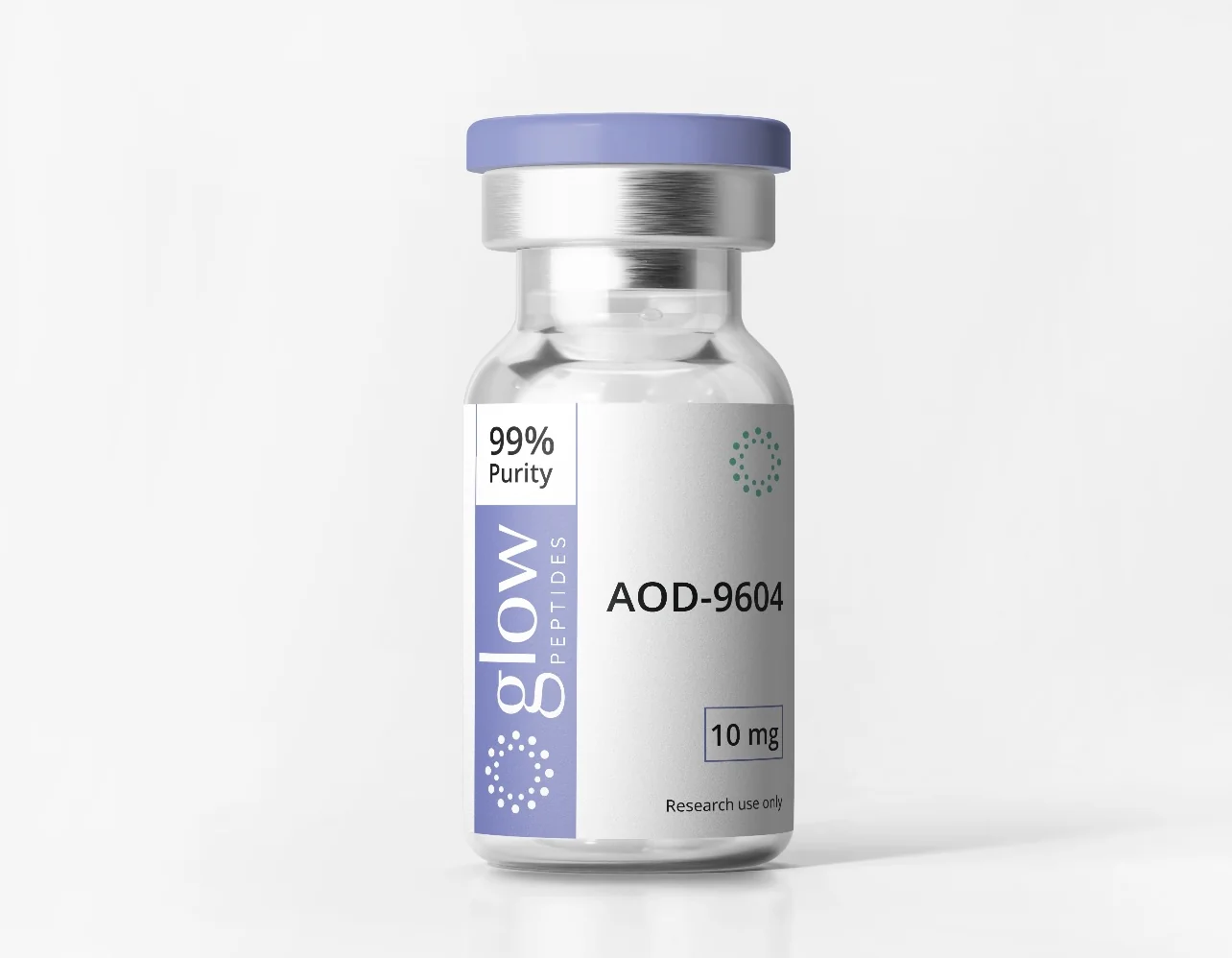
AOD-9604 Peptide: Sequence, Mass and the 176-191 Name
Glow Peptides Research Team · 2026-09-22
For research use only. Not for human or veterinary use, diagnostic use, or in any therapeutic application.
AOD-9604 and hGH fragment 176-191 are sold as the same thing, and in practice they are: order either name and you receive the same 16-residue peptide. But the name "176-191" is not quite accurate, and the inaccuracy is measurable. The molecule carries a tyrosine where human growth hormone residue 176 is a phenylalanine, which makes it sixteen mass units heavier than the fragment its name describes. This page sets out what is actually in a vial of research-grade AOD-9604, residue by residue, with the formula, the mass and the arithmetic that shows the difference.
Sixteen residues and a name that is almost right
AOD-9604 is a synthetic 16-amino-acid peptide. Fifteen of those residues are the C-terminal end of human growth hormone, positions 177 to 191. The sixteenth is a tyrosine sitting at the front. Two of the residues are cysteines and they are joined to each other by a disulfide bond, so the molecule carries a small internal loop rather than being a straight chain.
The name "hGH fragment 176-191" describes a 16-residue stretch of growth hormone starting at position 176. That stretch exists, but position 176 in human growth hormone is phenylalanine, and AOD-9604 has tyrosine there instead. The two differ by a single hydroxyl group, which is one oxygen atom, and on a mass spectrometer that is a difference of sixteen.
The short version
- AOD-9604 is C78H123N23O23S2, molecular weight 1,815.1, PubChem CID 71300630.
- Sequence: Tyr-Leu-Arg-Ile-Val-Gln-Cys-Arg-Ser-Val-Glu-Gly-Ser-Cys-Gly-Phe, with a disulfide between the two cysteines.
- Residues 2 to 16 are hGH 177 to 191, exactly.
- Residue 1 is a tyrosine. Human growth hormone has phenylalanine at position 176.
- True hGH(176-191) would weigh 1,799.1. AOD-9604 weighs 1,815.1. The 16-unit gap is one oxygen atom.
What is in the vial, residue by residue
The sequence, written in the three-letter code and then in single letters:
Tyr-Leu-Arg-Ile-Val-Gln-Cys-Arg-Ser-Val-Glu-Gly-Ser-Cys-Gly-Phe
Y L R I V Q C R S V E G S C G F
Sixteen residues. Two of them, at positions 7 and 14 of the peptide, are cysteine, and their side chains form a disulfide bond that closes a loop enclosing the six residues between them. That loop is not an artifact of synthesis: it is present in intact human growth hormone, where the same two cysteines are residues 182 and 189, and it is reproduced here.
The disulfide is the reason the molecular formula carries S2, and it is also why the molecule is two hydrogens lighter than the same sequence would be with the cysteines left free. That detail matters on an identity check, because a reduced, open-loop version of the same sequence would come back two mass units heavier and would not be the specified material.
Where the "176-191" name comes from, and where it breaks
Mature human growth hormone is a single chain of 191 amino acids. Its C-terminal end, read from the UniProt reference sequence for human somatotropin, runs as follows:
| Position 176 | Positions 177 to 191 | Molecule |
|---|---|---|
| Phe | Leu-Arg-Ile-Val-Gln-Cys-Arg-Ser-Val-Glu-Gly-Ser-Cys-Gly-Phe | True hGH fragment 176-191 |
| Tyr | Leu-Arg-Ile-Val-Gln-Cys-Arg-Ser-Val-Glu-Gly-Ser-Cys-Gly-Phe | AOD-9604 |
The fifteen residues after the first are identical. The first residue is not. Human growth hormone has phenylalanine at position 176; AOD-9604 has tyrosine.
Descriptions of this compound usually say that a tyrosine was "added to the N-terminus of hGH 176-191". Read literally, that would give a 17-residue peptide. What is actually the case is narrower and easier to check: the peptide is hGH(177-191) with a tyrosine in front of it, and because a residue does sit at position 176 in the parent protein, the result gets called 176-191 even though the residue there is a different amino acid.
The difference is exactly one oxygen, and you can check it
Tyrosine and phenylalanine are the same amino acid with one exception: tyrosine carries a hydroxyl group on its aromatic ring and phenylalanine does not. That hydroxyl is one oxygen and one hydrogen replacing one hydrogen, so the net difference between the two residues is a single oxygen atom.
The arithmetic lands exactly where it should:
| Molecule | Sequence | Residues | Molecular formula | Molecular weight |
|---|---|---|---|---|
| AOD-9604 | YLRIVQCRSVEGSCGF | 16 | C78H123N23O23S2 | 1,815.1 |
| True hGH(176-191) | FLRIVQCRSVEGSCGF | 16 | C78H123N23O22S2 | 1,799.1 |
| hGH(177-191) | LRIVQCRSVEGSCGF | 15 | C69H114N22O21S2 | 1,651.9 |
Compare the first two formulas. Every count is identical except the oxygens: O23 against O22. One oxygen, and 1,815.1 minus 1,799.1 is 16.0, which is what one oxygen weighs. The name and the molecule disagree by precisely that much.
Compare the first and third and you get the other way of describing the same compound: 1,815.1 minus 1,651.9 is 163.2, the mass of a tyrosine residue. That is the "tyrosine added to hGH 177-191" description, and it is the accurate one.
The computed formula for AOD-9604, built up from its sequence with one disulfide, is C78H123N23O23S2 at 1,815.1, and that is exactly what PubChem records for CID 71300630. Three independent routes, one answer.
Why sixteen mass units is worth knowing
A mass spectrometer resolves a 16-unit difference on a 1,800-dalton peptide without difficulty. So if a certificate reports an identity mass for this material, the number it should be matching is 1,815, not 1,799. A report citing the lower figure is either describing a different peptide or has taken the expected mass from the name rather than from the specification.
What this changes on a certificate of analysis
A certificate records what a laboratory measured on one batch, by named methods, on a stated date. For this compound three fields deserve particular attention.
The identity mass. As above, the expected figure is around 1,815. This is the single clearest check available on a peptide whose name misstates its composition by one residue.
The oxidation state of the cysteines. The specified molecule is the closed, disulfide-bonded form. The open form, with two free thiols, is the same sequence at two mass units heavier, and it is a plausible product of poor handling as well as of incomplete oxidation during synthesis. On a compound with only two sulfurs this is not an obscure concern, it is the main one.
The related-substance profile. A 16-residue synthesis produces deletion sequences where a coupling failed, and each missing residue shifts the mass by between 57 units for glycine and 163 for tyrosine, which mass spectrometry resolves without difficulty. On a reversed-phase trace the picture is less tidy, because closely related impurities elute near the target rather than far from it. A clean result is therefore one where the main peak accounts for nearly all the area under the trace, not one where the chromatogram simply looks empty, which is why the trace is worth reading rather than scrolling past. The mechanics of both techniques are covered in the reference on how HPLC and mass spectrometry verify peptide purity, and the distinction between purity and net peptide content is unpacked in what a purity percentage means and what it misses.
Published lot records for this catalog are listed on the quality page, each with its own certificate. Lot document availability varies by compound and by batch, so check the specific lot against the number on the label rather than assuming coverage.
Fragment, analog, or neither: where AOD-9604 sits
The words "fragment" and "analog" get used interchangeably in this category and they do not mean the same thing. A fragment reproduces part of a parent protein's sequence exactly. An analog departs from it, by a substitution, an added chemical group, or a change at one of the termini. AOD-9604 sits across that line: fifteen of its residues are an exact fragment, and the sixteenth makes the whole molecule an analog rather than a fragment.
That is not a pedantic distinction on a certificate. It determines what the expected mass is, and it is why a supplier's own description of this compound as a "fragment analog" is more accurate than either word alone.
Setting it beside the other compounds in this catalog that derive from larger proteins makes the pattern clear.
| Compound | Parent | Relationship | Exact fragment? | Residues |
|---|---|---|---|---|
| AOD-9604 | Human growth hormone, 191 residues | hGH 177-191 with tyrosine in front, where hGH 176 is phenylalanine | No, one residue differs | 16 |
| KPV | Alpha-MSH, 13 residues | Residues 11 to 13, as the free acid rather than the amide | Sequence yes, C-terminus no | 3 |
| Tesamorelin | Growth hormone-releasing hormone, 44 residues | All 44 residues with an N-terminal acyl group added | Sequence yes, modified | 44 |
| MOTS-c | None. Its own reading frame | Complete peptide, not a piece of anything larger | Not applicable | 16 |
None of the first three is an exact copy of its parent sequence. In every case the departure from the parent sequence is small, determinate and measurable, and in every case it changes the number that should appear on the identity line. That is the practical reason to care which category a compound falls into.
Storage and handling, and why they belong on the document
A certificate describes one sample of one batch at the moment it was tested. It says nothing about how the rest of that batch was stored, shipped or handled afterwards, and for this compound that gap is worth naming rather than glossing.
The disulfide bond is the reason. A closed disulfide can be reduced, and free thiols can re-oxidize in the wrong pairing, though with only two cysteines in the molecule there is only one correct pairing available, which makes this a simpler problem here than on a peptide carrying four or six. Lyophilized material held cold and dry is stable in a way that reconstituted material is not, which is why the storage line on a certificate is a specification rather than boilerplate. The field-by-field walkthrough of what else the document should carry is in how to read a peptide certificate of analysis.
Specification summary
| Property | Value |
|---|---|
| Other names in use | hGH fragment 176-191, hGH frag 176-191, AOD9604 |
| Class | Synthetic peptide, growth hormone C-terminal fragment analog |
| Residue count | 16 |
| Sequence | Tyr-Leu-Arg-Ile-Val-Gln-Cys-Arg-Ser-Val-Glu-Gly-Ser-Cys-Gly-Phe |
| Relationship to hGH | Residues 2 to 16 are hGH 177 to 191. Residue 1 is tyrosine where hGH 176 is phenylalanine |
| Disulfide bond | One, between the cysteines at peptide positions 7 and 14 (hGH 182 and 189) |
| Molecular formula | C78H123N23O23S2 |
| Molecular weight | 1,815.1 |
| PubChem CID | 71300630 |
| Expected mass on an MS identity line | About 1,815 |
| In this catalog | Lyophilized vial and encapsulated format; current specification on the product page |
What this page deliberately does not cover
Most pages returned for this compound move quickly to what it does, how much to take, how to prepare it and how it compares to other compounds on outcomes. Those subjects are absent here on purpose, and saying so is more useful than leaving the gap unexplained.
Glow Peptides supplies cataloged materials for laboratory research only. Nothing here is a drug, a supplement, a cosmetic or a medical device, and nothing here is intended for human or veterinary use. Dosing, administration, reconstitution and protocol questions are outside what a supplier of research materials should answer, and a page that answered them would be worse documentation rather than better. What is in scope, and what this page covers, is composition, structure, strength, purity, analytical method, handling and documentation. The single-compound reference page is at AOD-9604.
Frequently asked questions
Is AOD-9604 the same as hGH fragment 176-191?
In the catalog sense, yes: the two names refer to the same material and ordering either one gets you the same 16-residue peptide. In the strict chemical sense, no. AOD-9604 is Tyr-Leu-Arg-Ile-Val-Gln-Cys-Arg-Ser-Val-Glu-Gly-Ser-Cys-Gly-Phe, and the last fifteen of those residues are human growth hormone 177 to 191. The first residue is tyrosine, whereas human growth hormone carries phenylalanine at position 176. A true hGH 176-191 fragment would weigh 1,799.1; AOD-9604 weighs 1,815.1. The 16-unit gap is one oxygen atom, the hydroxyl that distinguishes tyrosine from phenylalanine.
What is the molecular weight and formula of AOD-9604?
The molecular formula is C78H123N23O23S2 and the molecular weight is 1,815.1. PubChem records it under CID 71300630. That figure can be checked from the sequence: summing the standard residue masses for Tyr-Leu-Arg-Ile-Val-Gln-Cys-Arg-Ser-Val-Glu-Gly-Ser-Cys-Gly-Phe, adding water for the chain termini and subtracting two hydrogens for the single disulfide bond gives 1,815.1 and reproduces the formula exactly. On a mass spectrometry identity line, 1,815 is the number the measured mass should be matching.
Why does AOD-9604 contain a disulfide bond?
Because the growth hormone segment it reproduces contains one. Two of the sixteen residues are cysteine, at positions 7 and 14 of the peptide, which correspond to residues 182 and 189 of human growth hormone. Their side chains are joined, closing a loop that encloses the six residues between them. That bond is the reason the molecular formula carries S2, and it makes the molecule two mass units lighter than the same sequence with free thiols would be. The reduced, open-loop form is a different species from the specified material, which is why oxidation state is a real specification question for this compound rather than a technicality.
Is the tyrosine added to the fragment or substituted into it?
Both descriptions are in circulation and only one of them is accurate for the molecule as built. The peptide is hGH 177 to 191 with a tyrosine placed in front of it, giving 16 residues in total. Describing that as a tyrosine added to hGH 176-191 would imply seventeen residues, which is not what the compound is. Because a residue does occupy position 176 of the parent protein, and the synthetic peptide puts a different amino acid there, tyrosine for phenylalanine, the practical effect is a substitution at 176 rather than an addition to it. That is why the name and the mass disagree by one oxygen.
Why does this page not cover what AOD-9604 does, or dosing?
Because Glow Peptides supplies cataloged materials for laboratory research only. The products are not drugs, supplements, cosmetics or medical devices, and they are not intended for human or veterinary use. Dosing, administration, reconstitution and protocol guidance are outside what a research materials supplier should provide, so they are deliberately absent rather than accidentally missing. What is covered here is composition, structure, strength, purity, analytical method, handling and documentation.
Sources
- PubChem, National Library of Medicine. AOD-9604, CID 71300630. Molecular formula and weight read 21 September 2026.
- UniProt. Human somatotropin, accession P01241. Mature chain residues 27 to 217 of the precursor, giving the 191-residue hormone. C-terminal sequence and the identity of residue 176 read 21 September 2026.
- Molecular weights and formulas for all three sequences independently computed from standard average residue masses, with water added for the chain termini and two hydrogens subtracted per disulfide bond, then reconciled against the PubChem record. Working shown in the body of this page.
For research use only. Not for human or veterinary use, diagnostic use, or any therapeutic application.