Glow Peptides · Research Journal
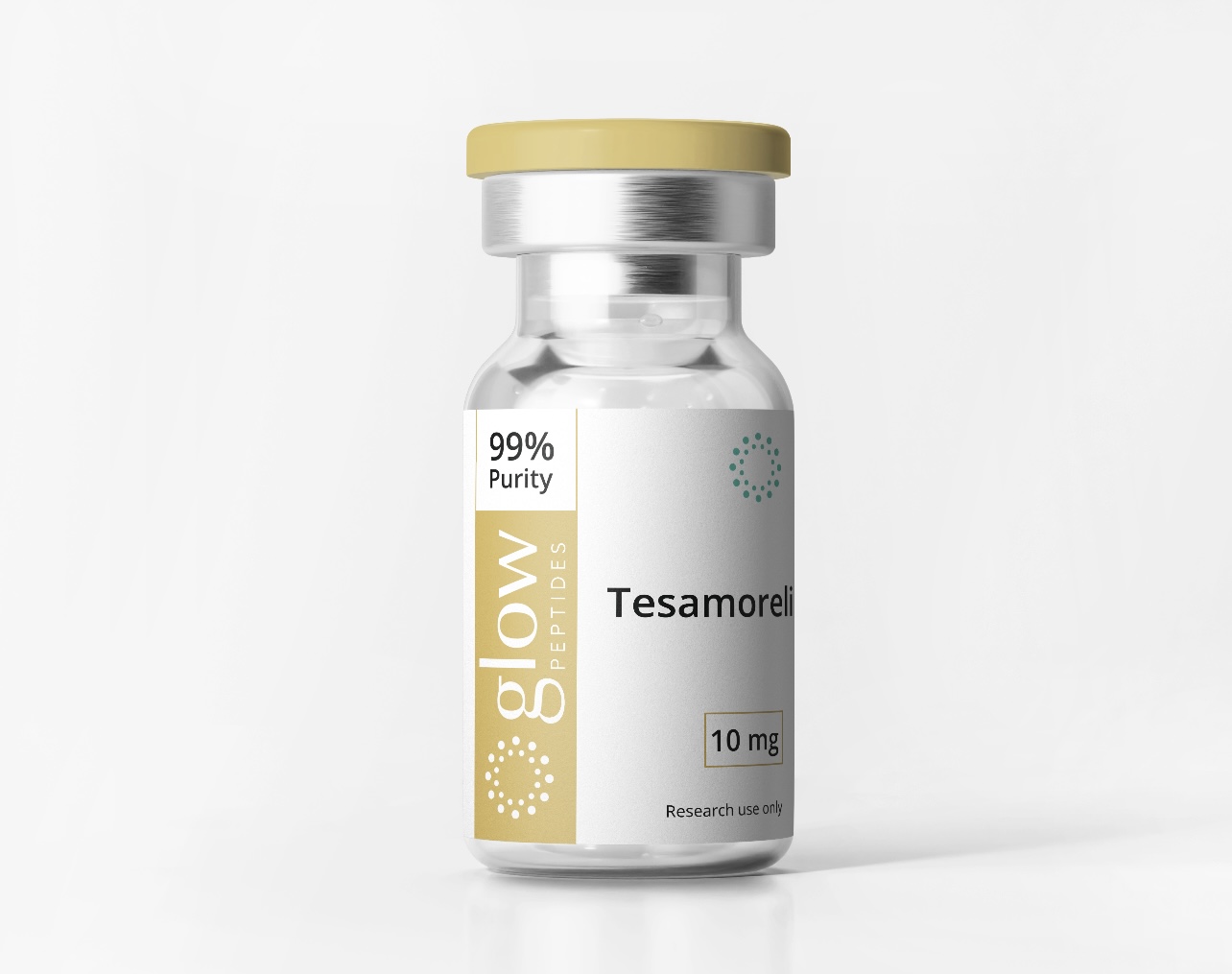
Tesamorelin vs Sermorelin: The Structural Difference
Glow Peptides Research Team · 2026-09-22
For research use only. Not for human or veterinary use, diagnostic use, or in any therapeutic application.
Tesamorelin and sermorelin are two different molecules built from the same parent sequence, and almost every comparison of them skips straight past that fact. This page stays on it. What each compound is made of, how the two differ atom for atom, what that difference does to the way each one is analyzed, and what a lot-specific certificate reports for a vial of research-grade tesamorelin. Every figure below is checkable against PubChem and the FDA's own database, and the checks are shown.
A fragment against a modified full chain
Sermorelin is the first 29 amino acids of human growth hormone-releasing hormone, with the C-terminus capped as an amide. Tesamorelin is the full 44 amino acids of the same hormone, also amidated, with one additional chemical group attached to the front end of the chain.
So they are not two unrelated peptides that happen to be discussed together. One is a fragment of the parent sequence. The other is the whole parent sequence with a modification. That single relationship explains the size difference and why a certificate for one tells you nothing at all about the other.
The short version
- Sermorelin is GRF(1-29) amide. 29 residues, C149H246N44O42S, molecular weight 3,357.9.
- Tesamorelin is GRF(1-44) amide carrying an N-terminal trans-3-hexenoyl group. 44 residues plus that group, C221H366N72O67S, molecular weight 5,136.
- The two differ by 15 amino acids and one acyl group. Tesamorelin is roughly 53 percent heavier.
- They are different analytical problems. Different expected masses, different retention behavior, different related-substance profiles.
- A certificate of analysis is compound-specific and lot-specific. Neither substitutes for the other.
Both derive from the same 44-residue hormone
Human growth hormone-releasing hormone is a 44-amino-acid peptide. Written in single-letter code, the full chain reads:
| Residues | Sequence | Present in |
|---|---|---|
| 1 to 29 | Y A D A I F T N S Y R K V L G Q L S A R K L L Q D I M S R | Both sermorelin and tesamorelin |
| 30 to 44 | Q Q G E S N Q E R G A R A R L | Tesamorelin only |
Sermorelin stops at residue 29. Tesamorelin carries all 44. That is the first of the two differences and it is the larger one by mass: those fifteen extra residues account for most of the gap between 3,358 and 5,136.
The second difference is one acyl group, and it weighs 96
The unmodified 44-residue peptide is cataloged separately, as somatorelin. Set the three formulas side by side and the modification falls out of the arithmetic:
| Compound | PubChem CID | Molecular formula | Molecular weight |
|---|---|---|---|
| Sermorelin | 16132413 | C149H246N44O42S | 3,357.9 |
| Somatorelin, the unmodified GRF(1-44) | 16132353 | C215H358N72O66S | 5,040 |
| Tesamorelin | 16137828 | C221H366N72O67S | 5,136 |
Subtract the second formula from the third. The nitrogen count is unchanged at 72, and what remains is C6H8O: six carbons, eight hydrogens, one oxygen. That fragment has a formula weight of 96.13, and 5,136 minus 5,040 is 96. The two numbers agree because they are describing the same thing.
C6H8O attached through an amide bond, with no change to the nitrogen count, is an acylation: a six-carbon unsaturated acyl group capping the N-terminal tyrosine. That is the trans-3-hexenoyl modification, and it is the entire chemical difference between tesamorelin and the plain 44-residue peptide.
The same arithmetic works from the other direction. Sum the standard residue masses for the 29-residue sermorelin sequence above, add water for the chain termini, and subtract 0.98 for the C-terminal amide, and the result is 3,357.9, which is what PubChem reports. Do it for all 44 residues and add 96.13 and you get 5,135.9, which rounds to the 5,136 on record. Three independent routes to the same pair of numbers.
Why this is worth checking rather than taking on faith
Mass spectrometry confirms identity by matching a measured mass against an expected one. If you do not know which expected mass applies to the material you ordered, the identity line on a certificate is a number you cannot evaluate. For these two compounds the expected masses are 3,358 and 5,136, and they are nowhere near each other, which is the one convenient thing about this comparison.
What the structural difference changes analytically
Chain length and an added acyl group are not cosmetic. They change how each compound behaves in the two assays that a certificate of analysis normally reports.
Retention behavior differs. Reversed-phase HPLC separates by hydrophobicity. A six-carbon unsaturated acyl cap on the N-terminus makes tesamorelin more hydrophobic than the peptide it is built from, so it holds on the column longer. A 29-residue fragment and a 44-residue chain also present different surfaces to the stationary phase. The practical consequence is that a gradient and a run time developed for one of these compounds is not the right method for the other, and a certificate that does not state its method leaves you unable to tell whether the right one was used.
The related-substance profile differs. Synthesis impurities in a peptide are mostly deletion sequences, incomplete couplings and side-chain artifacts, and they scale with chain length: a 44-residue synthesis has more opportunities to go wrong than a 29-residue one. Acylated peptides add their own failure mode, the under-acylated or unmodified chain, which for tesamorelin means the 5,040 species sitting close to the 5,136 target. Impurities that closely resemble the target are the ones that elute near it, so a clean-looking chromatogram is one where the main peak accounts for nearly all the area, not one where nothing else appears. The mechanics of both techniques are covered in the reference on how HPLC and mass spectrometry verify peptide purity.
The two figures answer different questions. Purity, from HPLC, describes what proportion of the peptide material is the intended compound. Net peptide content describes how much of the vial is peptide at all, once water and counterions are accounted for. A lot can report a high purity figure and still hold meaningfully less peptide by mass than the label weight suggests. That distinction is unpacked in the longer piece on what a peptide purity percentage means and what it misses.
Regulatory status, stated precisely
This is the field most comparisons get approximately right and specifically wrong, so here it is from the FDA's own Drugs@FDA records, read 21 September 2026.
| Tesamorelin | Sermorelin | |
|---|---|---|
| Application | BLA 022505 | NDA 019863 and NDA 020443 |
| Brand name on the application | EGRIFTA | GEREF |
| Applicant of record | Theratechnologies | EMD Serono |
| Strengths on the application | 1 mg and 2 mg per vial, as the acetate | 0.05 mg per ampoule; 0.5 mg and 1 mg per vial, as the acetate |
| Marketing status | Prescription | Discontinued |
The precise position is therefore this. Tesamorelin is the active ingredient in a currently marketed FDA-approved prescription product. Sermorelin was the active ingredient in approved products that are no longer marketed, under two separate applications, and the FDA record carries the Federal Register determination that those products were not discontinued or withdrawn for safety or effectiveness reasons.
Saying flatly that sermorelin "is not FDA approved" collapses that history into something misleading in both directions. It was approved. It is not currently marketed under that approval. Those are two different statements and the record supports both.
None of this describes the research materials in this catalog. An approval attaches to a specific finished drug product made by a specific applicant under a specific application. It does not transfer to material supplied for laboratory research, which is what is cataloged here, and it is not a statement about any use of that material.
What a certificate reports for a tesamorelin lot
A certificate of analysis records what a laboratory measured on one batch, by stated methods, on a stated date. For a compound like tesamorelin the useful fields are the ones that tie the document to the vial and show the working:
- The compound and the lot number, with the lot matching what is printed on the label in front of you.
- The issuing laboratory, named. A description such as "third-party tested" is not a name and cannot be checked.
- Purity with its method. Typically reversed-phase HPLC with UV detection, with the target peak reported as a percentage of total peak area.
- Identity confirmation, typically by mass spectrometry, matching the measured mass against the expected mass for the compound named. For tesamorelin that expectation is around 5,136.
- Net peptide content, which is a separate determination from purity and answers a separate question.
- A report date belonging to that batch, and an accession number or search code that lets the report be looked up at the issuing laboratory rather than confirmed by the seller.
The field-by-field walkthrough is in the guide on how to read a peptide certificate of analysis, and the longer piece on judging a document is at certificates of analysis explained. Published lot records for this catalog are listed on the quality page, each with its own certificate, and lot document availability varies by compound and by batch, so the honest thing to do is check the specific lot rather than assume coverage.
A certificate for one of these compounds says nothing about the other. That sounds obvious written down, and it is worth writing down anyway, because "we publish COAs" is a catalog-level statement and a certificate is a batch-level document. The expected mass differs, the method differs, the impurity profile differs. Documentation for a sermorelin lot is not evidence about a tesamorelin lot, and a certificate for one tesamorelin batch is not evidence about the next one.
Specification summary
| Property | Sermorelin | Tesamorelin |
|---|---|---|
| Relationship to GRF(1-44) | Residues 1 to 29 | All 44 residues, N-terminally acylated |
| Residue count | 29 | 44 |
| C-terminus | Amide | Amide |
| N-terminal modification | None | trans-3-hexenoyl |
| Molecular formula | C149H246N44O42S | C221H366N72O67S |
| Molecular weight | 3,357.9 | 5,136 |
| PubChem CID | 16132413 | 16137828 |
| Expected mass on an MS identity line | About 3,358 | About 5,136 |
| US marketing status of the approved product | Discontinued | Prescription |
| In this catalog | Not cataloged | Lyophilized vial, specified at 10 mg |
What this comparison deliberately does not cover
Most pages returned for this query compare the two compounds on outcomes: body composition, fat distribution, sleep, recovery, aging, athletic use, and which one somebody should choose. Those subjects are absent here on purpose, and it is more useful to say so than to leave the gap unexplained.
Glow Peptides supplies cataloged materials for laboratory research only. Nothing here is a drug, a supplement or a medical device, and nothing here is intended for human or veterinary use. Dosing, administration, reconstitution and protocol questions are outside what a supplier of research materials should be answering, and a page that answered them would be worse documentation, not better. What is in scope, and what this page covers, is composition, structure, strength, purity, analytical method, handling and documentation.
For the structural comparison against the CJC-1295 / Ipamorelin blend, see CJC-1295 / Ipamorelin vs Tesamorelin. The single-compound reference page is at tesamorelin.
Frequently asked questions
What is the main difference between sermorelin and tesamorelin?
Chain length and one added chemical group. Sermorelin is the first 29 amino acids of the 44-residue growth hormone-releasing hormone sequence, amidated at the C-terminus. Tesamorelin is all 44 of those residues, also amidated, with a trans-3-hexenoyl group attached to the N-terminal tyrosine. In numbers: sermorelin is C149H246N44O42S at a molecular weight of 3,357.9, tesamorelin is C221H366N72O67S at 5,136. Subtracting the formula of the unmodified 44-residue peptide from tesamorelin's leaves C6H8O, which weighs 96.13, and 5,136 minus 5,040 is 96. That is the acyl group, and it is the whole of the second difference.
Is sermorelin FDA approved?
It was, and no sermorelin product is currently marketed under that approval. FDA's Drugs@FDA records carry two applications, NDA 019863 and NDA 020443, both for GEREF from EMD Serono, covering strengths of 0.05 mg per ampoule and 0.5 mg and 1 mg per vial as sermorelin acetate. Both are listed with a marketing status of Discontinued, and the record includes the Federal Register determination that the products were not discontinued or withdrawn for safety or effectiveness reasons. Tesamorelin, by contrast, is the active ingredient in EGRIFTA under BLA 022505 from Theratechnologies, which carries a marketing status of Prescription. None of this applies to research materials, which are supplied for laboratory use and are not the approved finished products.
Which is bigger, tesamorelin or sermorelin?
Tesamorelin, by about 53 percent. Its molecular weight is 5,136 against sermorelin's 3,357.9, a difference of roughly 1,778. Most of that gap is the fifteen additional amino acids, residues 30 to 44 of the parent sequence, which sermorelin does not carry. The remaining 96 is the N-terminal acyl group. The size difference is the reason the two need different analytical methods rather than a shared one.
Can a certificate of analysis for one be used for the other?
No, and not for a different batch of the same compound either. A certificate reports what a laboratory measured on one specific lot, by named methods, on a stated date. The expected mass on the identity line differs between these two compounds, around 3,358 against around 5,136. The HPLC method differs because the retention behavior differs. The impurity profile differs because a 44-residue acylated synthesis fails in different ways from a 29-residue one. Match the lot number on the certificate to the lot number on the vial, every time.
Why does this page not cover dosing, side effects or which one to choose?
Because Glow Peptides supplies cataloged materials for laboratory research only. The products are not drugs, supplements, cosmetics or medical devices, and they are not intended for human or veterinary use. Dosing, administration, reconstitution and protocol guidance are outside what a research materials supplier should provide, so they are deliberately absent rather than accidentally missing. What is covered here is composition, structure, strength, purity, analytical method, handling and documentation.
Sources
- PubChem, National Library of Medicine. Tesamorelin, CID 16137828; Sermorelin, CID 16132413; Somatorelin, CID 16132353. Molecular formulas and weights read 21 September 2026.
- US Food and Drug Administration, Drugs@FDA. BLA 022505 (EGRIFTA, Theratechnologies); NDA 019863 and NDA 020443 (GEREF, EMD Serono). Application numbers, strengths and marketing status read 21 September 2026.
- Molecular weights independently recomputed from the stated molecular formulas and from the residue sequences, and reconciled against the PubChem figures. Working shown in the body of this page.
For research use only. Not for human or veterinary use, diagnostic use, or any therapeutic application.