Glow Peptides · Research Journal
Certificates of Analysis Explained: How to Read a COA and Spot a Fake
Glow Peptides Research Team · 2026-06-10
For research use only. Not for human or veterinary use, diagnostic use, or in any therapeutic application.
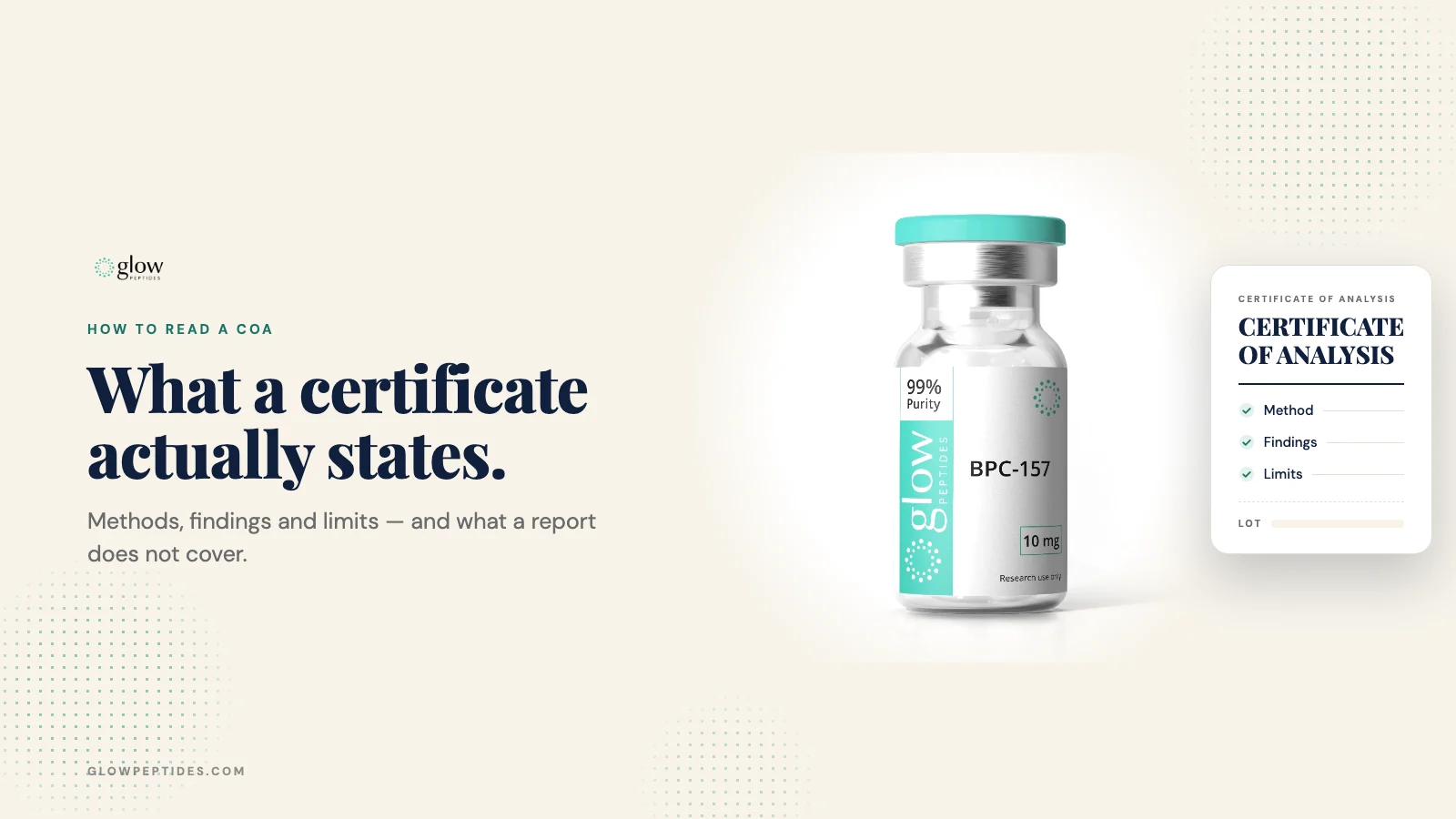
A certificate of analysis is the only document that connects the vial in your hand to a measurement somebody actually made. It is also among the easiest documents in this industry to fake, because it is so rarely checked. This guide explains what a complete certificate contains, how to tell a real one from a manufactured one, and how to verify a specific lot of research peptides against its own peptide COA at the issuing laboratory rather than taking a supplier's word for it.
If you want the quick field-by-field reference instead, the shorter guide on how to read a peptide certificate of analysis walks the document top to bottom. This page is the longer one, and it is about judgment rather than layout.
What a peptide COA is, and who issues it
A certificate of analysis reports what an analytical laboratory measured on a specific batch of material, using stated methods, on a stated date. It is a record of an analysis. It is not a warranty, not an approval and not a statement about any use.
Who issues it matters as much as what it says. A certificate produced by the manufacturer describes the manufacturer's own testing, which may be perfectly competent but is not independent. A certificate produced by an outside laboratory is a second measurement by an organization with no stake in the answer. Both are legitimate documents and they carry different weight, so the first thing worth locating on any certificate is the name of the laboratory that issued it.
The certificates published for Glow Peptides lots are issued by Freedom Diagnostics, an outside US laboratory rather than the manufacturer, and each one carries that laboratory's own accession number and search code, which is what lets the report be checked against the laboratory's records instead of being taken on the supplier's say-so.
What a complete certificate carries
A certificate worth relying on identifies the material, states the methods, reports the results and lets you trace it back. In practice that means eight things:
- Product identity and lot number. The compound named, and a batch code that appears on your vial.
- The issuing laboratory. Named, not described.
- A report date. Tied to that lot, not to a generic reference sample.
- The analytical method. Which techniques were run, not just what they concluded.
- Purity, with the method behind it. A percentage on its own is not a measurement.
- Identity confirmation. Usually mass spectrometry, confirming the measured mass matches the mass expected for the compound named on the label.
- Net peptide content. How much of the vial is peptide at all, as opposed to what proportion of the peptide is the right one.
- An identifier you can use to look the report up independently. The accession number or search code the issuing laboratory uses to retrieve its own copy.
The field-by-field detail on each of these lives in the shorter reference guide. What follows here is how to use them to form a judgment.
How to tell a real certificate from a manufactured one
Fabricated and misleading certificates are a known problem in this category, and they tend to fail in the same predictable ways. None of the checks below requires you to run an analysis yourself.
It has no lot number, or the lot number is not on your vial
This is the single most common failure and the most serious one. A certificate that is not tied to a batch cannot be matched to anything you received. A supplier publishing one generic certificate for a product, rather than one per lot, is showing you a document about material you almost certainly do not have.
The laboratory is described rather than named
"Independently tested by a third-party US lab" is not a name and cannot be checked. A real certificate carries the laboratory's identity on it. If you cannot tell who ran the analysis, there is nobody to verify it with.
There is a purity figure but no method
A number without a technique behind it is a claim, not a measurement. A real report states how purity was determined, typically reversed-phase HPLC. Stronger documents attach the chromatogram itself, and the trace is worth a look rather than a scroll past: a clean result is dominated by one peak that accounts for almost all of the area under the trace. Closely related impurities usually elute near the target rather than far from it, so how close a small peak sits means little. What matters is how little area it accounts for. A chromatogram lets you see the measurement instead of taking the number on faith, which is why the stronger documents include one.
The report date does not match the lot
Certificates dated well before or well after the batch they supposedly describe are a sign the document has been reused across lots. The date should belong to the analysis of that specific material. An undated report, or one carrying no date you can tie to the lot in front of you, is the worst version of this failure.
The numbers are suspiciously round, or impossibly perfect
Real analytical results are untidy. A single clean-looking figure proves nothing either way, but a catalog where every lot and every product reads 99% or 100% is a pattern rather than a set of measurements.
There is no way to verify it independently
This is the check that actually settles it, and it is covered in its own section below. A document you can only verify by asking the person who sold it to you is not independent verification.
What the numbers actually mean
Three figures appear on a complete peptide certificate and they answer three different questions.
Purity comes from reversed-phase HPLC with UV detection. The sample is separated and the target peak is reported as a percentage of total peak area. It tells you what proportion of the peptide material is the intended compound rather than related substances.
Identity comes from mass spectrometry. It confirms the mass of what eluted matches the expected mass of the compound named on the label. That rules out a different compound, though it does not on its own prove the sequence, since a rearrangement of the same residues carries the same mass. Purity without identity is a precise number describing an unknown substance.
The certificates for these lots state the method plainly: "All Chemical Analysis was performed by HPLC with UV Detection Coupled with Mass Spectrometry." The mechanics of both techniques are covered in the guide on how HPLC and mass spectrometry verify peptide purity.
Net peptide content is the third figure. Purity describes the composition of the peptide fraction. Net peptide content describes how much of the vial is peptide at all, once water, counterions and residual salts are accounted for, none of which are counted in the purity figure. It is a separate determination, usually by amino acid analysis, rather than a figure the HPLC run produces. A lot can be 99 percent pure and still be meaningfully less than 99 percent peptide by mass. That distinction is unpacked in detail in the article on what a peptide purity percentage means and what it misses.
Endotoxin testing, and when it matters
Purity and identity say nothing about bacterial endotoxin, which an HPLC assay does not detect at all. Where endotoxin is relevant to the work, it has to be measured separately.
Where a lot carries endotoxin testing, it appears as a second certificate alongside the first, performed in duplicate in accordance with USP <85>, with both replicates recorded as a pass and the endotoxin limit referenced to USP <85> Bacterial Endotoxins Test and USP <161>. Two honest qualifications: it is not on every certificate, and it is an additional measurement rather than a better one.
One further limit is worth stating, and it applies to the whole document rather than to this test. A certificate describes one sample of one batch at the moment it was tested. It says nothing about how the rest of that batch was stored, shipped or handled afterwards.
Verifying a lot yourself, without the seller
Everything above helps you judge a document. This is how you confirm one.
Each certificate carries two identifiers that exist for exactly this purpose: an accession number and a search code. Those let the report be looked up at the issuing laboratory directly. The verification route does not run back through the supplier, which is the entire point. A supplier can publish any PDF it likes. A supplier cannot make a laboratory's own records say something they do not say.
The sequence:
- Read the lot number off your vial.
- Find that lot on the quality and lot certificates page, which lists every published lot record.
- Open the certificate itself rather than the summary. The summary carries headline figures; the certificate carries the method, the appearance, the net peptide content and the identifiers.
- Take the accession number and search code from the certificate.
- Look the report up at the issuing laboratory using those identifiers. Freedom Diagnostics certificates carry the lookup route on the document itself, printed as the site the report is searchable from.
One practical caveat. A lot code is not always rendered identically on the summary page and on the certificate itself, so the same lot can appear in more than one format. Match on the certificate's own rendering and do not assume a differently formatted code is a different batch.
Three real lots, worked through
The published specification is ≥99.2% (HPLC). A specification is a floor rather than a result, so the question worth asking of any supplier is what its lots actually measured.
| Lot | Product | Measured purity | Certificate |
|---|---|---|---|
| 260130-HPC-GLO70-001 | GLOW, 70 mg | 99.767% | View certificate |
| 260410-HP-CP10-03 | CJC/Ipamorelin, 10 mg | 99.64% | View certificate |
| 260203QL-GH50-01 | GHK-Cu, 50 mg | 99.268% | View certificate |
Three lots, named, measured, each linked to the report it came from. All three cleared the specification. That is the only claim these documents support, and it is a narrower claim than "all our products are 99 percent pure", which no supplier can honestly make about lots it has not tested.
Run the six checks above against these three and they hold: the lot is named, the laboratory is named, the method is stated, the date belongs to the analysis, the figures are untidy in the way real measurements are, and the accession number lets you confirm it without asking anybody here.
Red flags, in order of seriousness
- No lot number. Nothing to match, nothing to verify. Treat the document as decorative.
- No named laboratory. Nobody to check with.
- No independent verification route. No accession number, no search code, no way to confirm the report exists.
- A purity figure with no method. Not a measurement.
- No identity confirmation. Purity alone does not establish what the compound is.
- A report date that does not belong to the lot, or no date at all. A document reused across batches describes none of them.
- Round or identical figures across every lot. Real measurements are untidy.
- Certificates behind a login, or available only on request. Documentation you cannot open before buying cannot inform the decision to buy.
- One certificate covering a whole product line. Certificates describe batches, not catalogs.
Frequently asked questions
How can you tell if a peptide COA is real?
Check four things on the document itself, then confirm it off the document. On the certificate: a lot number that matches your vial, the issuing laboratory named rather than described, the analytical method stated alongside the purity figure, and a report date that belongs to that batch. Then the check that actually settles it: find the accession number or search code and look the report up at the issuing laboratory. A certificate you can only confirm by asking the seller is not independent verification, however professional the PDF looks.
How much does it cost to get a COA on peptides?
If you are asking a laboratory to analyze material you already own, the cost varies by laboratory and by which analyses you request, since HPLC purity, mass spectrometry identity and endotoxin testing are often priced separately and a full panel costs more than a single assay. Contact the laboratory directly for current pricing. If you are asking about a supplier's own certificate, that should cost you nothing at all: a lot-specific certificate is documentation the supplier already holds, and publishing it openly rather than behind a request form is a reasonable expectation.
What is the difference between a COA and a COC?
A certificate of analysis reports measurements. It says what a laboratory found when it tested a batch, using named methods, with the results attached. A certificate of conformance, sometimes called a certificate of compliance, is a statement that a batch meets a specification, usually issued by the supplier rather than an independent laboratory, and frequently without the underlying data. A certificate of analysis shows you the numbers. A certificate of conformance asserts a conclusion. Where both are available, the certificate of analysis is the more useful document because you can check its reasoning.
How do I get a COA for a lot I have already received?
Start with the lot number on the vial and look for a published lot record. Every lot record published here is listed on the quality page with its certificate attached, and no account or request is needed to open one. If a supplier does not publish per-lot documentation, ask for the certificate matching your specific lot number rather than a general one for the product, and treat a refusal or a generic substitute as an answer in itself.
Sources
- Boutin JA, Tartar AL, van Dorsselaer A, Vaudry H. General lack of structural characterization of chemically synthesized long peptides. Protein Science 2019;28(5):857-867. DOI 10.1002/pro.3601. A review arguing that for longer synthetic peptides, published work often rests on material characterized by little more than its purity, its mass and its activity.
- Hoofnagle AN, Whiteaker JR, Carr SA, et al. Recommendations for the generation, quantification, storage, and handling of peptides used for mass spectrometry-based assays. Clinical Chemistry 2016;62(1):48-69. DOI 10.1373/clinchem.2015.250563. Consensus recommendations on peptide quantification and handling.
For research use only. Not for human or veterinary use, diagnostic use, or any therapeutic application.