Glow Peptides · Research Journal
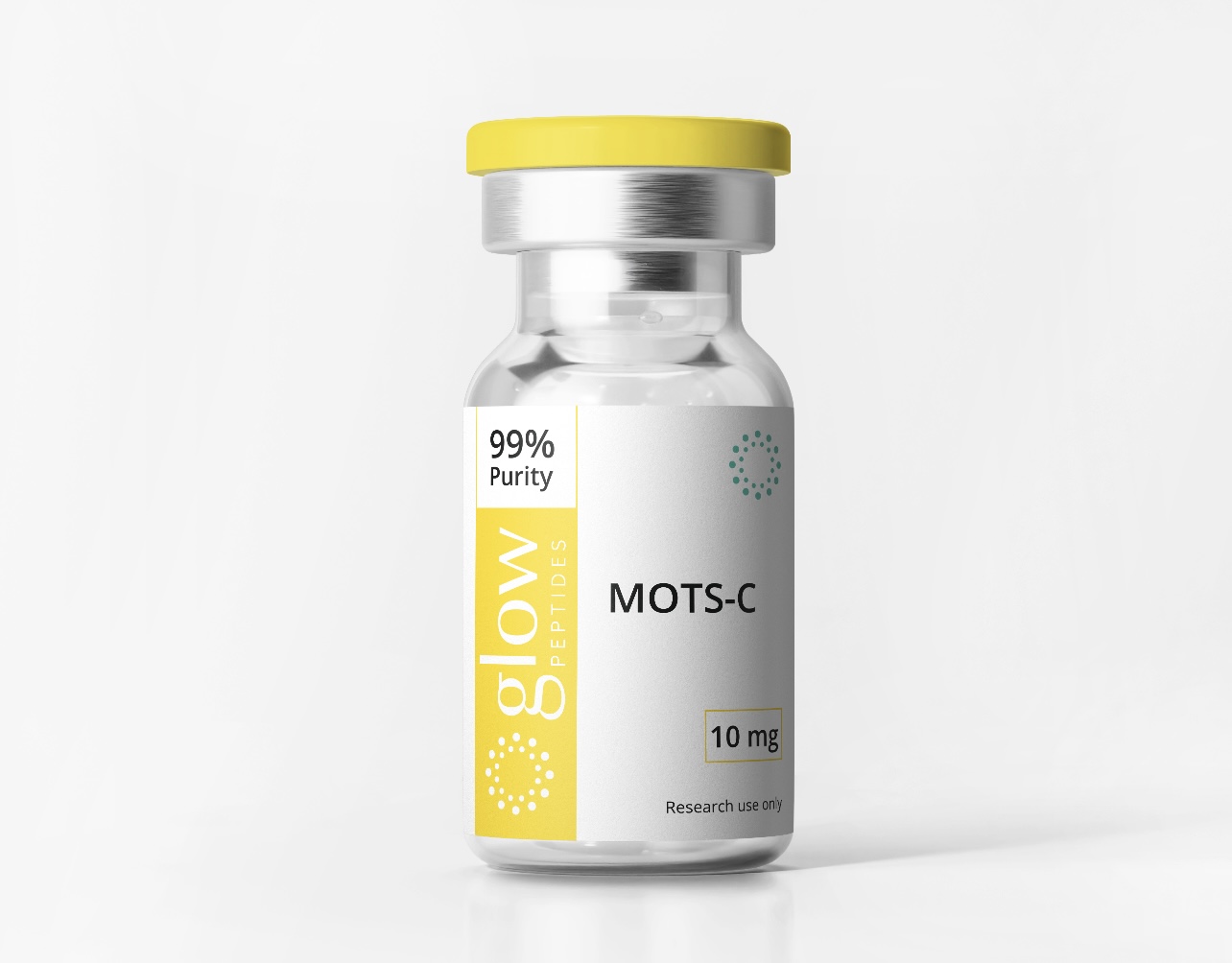
What Is MOTS-c? A Peptide Encoded in Mitochondrial DNA
Glow Peptides Research Team · 2026-09-22
For research use only. Not for human or veterinary use, diagnostic use, or in any therapeutic application.
MOTS-c is a peptide of sixteen amino acids, and the interesting thing about it is not its length but its address. Almost every peptide in a research catalog is either a synthetic construct or a fragment of a protein encoded in the nuclear genome. MOTS-c is neither. It is encoded inside mitochondrial DNA, in a gene that was cataloged for decades as a ribosomal RNA gene rather than a protein-coding one. This page sets out what is actually in a vial of research-grade MOTS-c: the sequence, the formula, the mass, the gene it comes from, and what its particular composition changes about how a lot is analyzed.
What MOTS-c is
MOTS-c is a 16-residue peptide with the sequence Met-Arg-Trp-Gln-Glu-Met-Gly-Tyr-Ile-Phe-Tyr-Pro-Arg-Lys-Leu-Arg. UniProt holds it under accession A0A0C5B5G6, where it is recorded as "Mitochondrial-derived peptide MOTS-c" and assigned to the gene MT-RNR1. Its molecular formula, computed from that sequence, is C101H152N28O22S2, and its molecular weight is approximately 2,174.6.
The short version
- 16 residues. MRWQEMGYIFYPRKLR. UniProt accession A0A0C5B5G6.
- Molecular formula C101H152N28O22S2, molecular weight about 2,174.6.
- Encoded in mitochondrial DNA, in the gene MT-RNR1, not in the nuclear genome.
- MT-RNR1 is the 12S ribosomal RNA gene. MOTS-c is an open reading frame sitting inside it.
- Two methionines and no cysteines, so oxidation is the failure mode, not disulfide scrambling. Four basic residues and four aromatics shape how it is separated and detected.
The name, decoded
MOTS-c stands for mitochondrial open reading frame of the twelve S ribosomal RNA type-c. Unpacked, the name is a description of where the peptide's coding sequence sits rather than of what the peptide is.
An open reading frame is a stretch of DNA that can be read as a series of codons from a start to a stop, which is to say a stretch that could encode a protein. The twelve S ribosomal RNA is one of the two ribosomal RNAs encoded by the mitochondrial genome, and its gene carries the symbol MT-RNR1. So the name says: an open reading frame found inside the mitochondrial 12S rRNA gene.
Where it is encoded, and why that is unusual
Human cells carry two genomes. The nuclear genome holds around twenty thousand protein-coding genes on twenty-three chromosome pairs. The mitochondrial genome is a separate circular molecule of about sixteen and a half thousand base pairs, present in many copies per cell, and it is small enough that its full contents are conventionally listed: thirteen protein-coding genes, twenty-two transfer RNA genes and two ribosomal RNA genes.
MOTS-c is not one of the thirteen. Its coding sequence sits inside MT-RNR1, which is one of the two ribosomal RNA genes, a gene whose cataloged product is a structural RNA rather than a protein. That is the unusual part, and it is why the compound is described as a mitochondrial-derived peptide rather than simply as a mitochondrial protein.
Three consequences follow, and all three are compositional facts rather than claims about what the peptide does.
It is a short, complete peptide, not a fragment. Tesamorelin is a modified version of a 44-residue hormone. AOD-9604 is a fifteen-residue stretch of growth hormone with an extra residue in front. KPV is the last three residues of a thirteen-residue hormone. MOTS-c is not a piece of anything larger: the sixteen residues are the whole reading frame.
Its sequence is not found in the nuclear genome. Anything encoded on mitochondrial DNA has a different evolutionary history from the nuclear-encoded peptides sitting next to it in a catalog.
The gene symbol is worth quoting. Most write-ups of this compound say "the mitochondrial 12S rRNA region", which is a description. MT-RNR1 is the gene symbol, and it is what resolves to a specific record in a reference database.
The sequence, and what is in it
| Position | 1 | 2 | 3 | 4 | 5 | 6 | 7 | 8 | 9 | 10 | 11 | 12 | 13 | 14 | 15 | 16 |
|---|---|---|---|---|---|---|---|---|---|---|---|---|---|---|---|---|
| Residue | Met | Arg | Trp | Gln | Glu | Met | Gly | Tyr | Ile | Phe | Tyr | Pro | Arg | Lys | Leu | Arg |
| Code | M | R | W | Q | E | M | G | Y | I | F | Y | P | R | K | L | R |
Three features of that composition matter for anyone reading a certificate.
Two methionines and no cysteines. The S2 in the molecular formula comes from the methionines at positions 1 and 6. There is no cysteine anywhere in the sequence, so there is no disulfide bond and no possibility of one.
Four aromatic residues. Tryptophan at position 3, tyrosine at 8, phenylalanine at 10 and tyrosine at 11. Tryptophan in particular absorbs strongly in the ultraviolet around 280 nanometers.
Four basic residues. Arginine at 2, 13 and 16, and lysine at 14, three of them clustered near the C-terminal end. The molecule carries a substantial positive charge at ordinary pH.
What that composition changes analytically
Oxidation is the failure mode to watch, not disulfide chemistry. Methionine oxidizes readily to the sulfoxide, and each oxidation adds sixteen mass units. With two methionines, a lot can carry a singly oxidized species at about 2,190.6 and a doubly oxidized one at about 2,206.6. Those are well-separated masses and they are also more polar than the parent, so they elute earlier on a reversed-phase column. This is the specific thing to look for on a MOTS-c chromatogram, and it is a handling and storage question as much as a synthesis one. Compounds whose sulfur sits in cysteine rather than methionine have the opposite concern, disulfide formation and scrambling, which does not apply here at all.
It can be detected at 280 nanometers. The tryptophan and the two tyrosines give the molecule a genuine absorbance in the near ultraviolet, which is not true of every peptide. That makes a second, more selective detection wavelength available alongside the backbone absorbance at 214 to 220 nanometers, and agreement between the two is a stronger result than either alone.
The charge shapes the separation. Four basic residues on a sixteen-residue chain is a high charge density, and it affects both retention on a reversed-phase column and the charge states seen in mass spectrometry. A method developed for a neutral peptide of similar length is not automatically the right method here.
The counterion is part of the weight. A strongly basic peptide is normally supplied as a salt, and the counterion contributes mass that is not peptide. That is why net peptide content is a separate figure from purity on a certificate, and why the two can diverge more than expected on a molecule like this one. The distinction is unpacked in what a purity percentage means and what it misses, and the techniques themselves in how HPLC and mass spectrometry verify peptide purity.
The three masses worth knowing
About 2,174.6 for the intended peptide. About 2,190.6 for the singly oxidized form. About 2,206.6 for the doubly oxidized form. Each step is one oxygen on one methionine. If an identity line reports a mass sixteen or thirty-two units above the expected figure, that is not a rounding difference, it is a different species.
Specification summary
| Property | Value |
|---|---|
| Full name | Mitochondrial open reading frame of the 12S rRNA type-c |
| Residue count | 16 |
| Sequence | Met-Arg-Trp-Gln-Glu-Met-Gly-Tyr-Ile-Phe-Tyr-Pro-Arg-Lys-Leu-Arg |
| Single-letter code | MRWQEMGYIFYPRKLR |
| Encoded in | Mitochondrial DNA, gene MT-RNR1 (the 12S rRNA gene) |
| UniProt accession | A0A0C5B5G6 |
| Molecular formula | C101H152N28O22S2 |
| Molecular weight | About 2,174.6 |
| Cysteines, disulfides | None |
| Methionines | Two, at positions 1 and 6. Oxidation adds 16 per methionine |
| Aromatic residues | Trp 3, Tyr 8, Phe 10, Tyr 11. Absorbs near 280 nm |
| Basic residues | Arg 2, Arg 13, Lys 14, Arg 16 |
| Expected mass on an MS identity line | About 2,175 |
| In this catalog | Lyophilized vial; current specification on the product page |
Reading a certificate for a MOTS-c lot
The general discipline is unchanged: a lot number that matches the vial in front of you, the issuing laboratory named rather than described, the analytical method stated alongside the purity figure, a report date belonging to that batch, and an accession number that lets the report be looked up at the laboratory rather than confirmed by the seller. The field-by-field walkthrough is in how to read a peptide certificate of analysis.
Two fields deserve extra attention on this compound. The identity mass should be matching about 2,175, and a figure sixteen or thirty-two above that is the oxidized material rather than the target. And the storage condition on the document is not boilerplate here, because methionine can keep oxidizing after synthesis with exposure to air, which makes handling after the certificate was issued a real variable. A certificate describes one sample of one batch at the moment it was tested; it says nothing about how the rest of that batch was stored afterwards.
Published lot records for this catalog are listed on the quality page, each with its own certificate. Lot document availability varies by compound and by batch, so check the specific lot rather than assuming coverage.
What this page deliberately does not cover
Most pages returned for this question move quickly to what MOTS-c does, what it may support, how much to take and how to take it. Those subjects are absent here on purpose, and saying so is more useful than leaving the gap unexplained.
Glow Peptides supplies cataloged materials for laboratory research only. Nothing here is a drug, a supplement, a cosmetic or a medical device, and nothing here is intended for human or veterinary use. Dosing, administration, reconstitution and protocol questions are outside what a supplier of research materials should answer. What is in scope, and what this page covers, is composition, structure, strength, purity, analytical method, handling and documentation. The single-compound reference page is at MOTS-c.
Frequently asked questions
What is MOTS-c?
MOTS-c is a peptide of sixteen amino acids with the sequence Met-Arg-Trp-Gln-Glu-Met-Gly-Tyr-Ile-Phe-Tyr-Pro-Arg-Lys-Leu-Arg, written MRWQEMGYIFYPRKLR. UniProt holds it under accession A0A0C5B5G6 as "Mitochondrial-derived peptide MOTS-c". Its molecular formula is C101H152N28O22S2 and its molecular weight is about 2,174.6. What distinguishes it from most peptides in a research catalog is where its coding sequence sits: inside mitochondrial DNA rather than the nuclear genome, in the gene MT-RNR1.
What does the name MOTS-c stand for?
Mitochondrial open reading frame of the twelve S ribosomal RNA type-c. The name describes the location of the coding sequence rather than the peptide itself. An open reading frame is a stretch of DNA that can be read as codons from a start to a stop. The 12S ribosomal RNA is one of the two ribosomal RNAs encoded by the mitochondrial genome, and its gene symbol is MT-RNR1. So the name says: an open reading frame found inside the mitochondrial 12S rRNA gene.
Which gene encodes MOTS-c?
MT-RNR1, on the mitochondrial genome. UniProt records MOTS-c under that gene, accession A0A0C5B5G6. MT-RNR1 is one of the mitochondrial genome's two ribosomal RNA genes, which is what makes the case unusual: the cataloged product of that gene is a structural RNA, and the MOTS-c reading frame sits inside it. The mitochondrial genome is a circular molecule of roughly sixteen and a half thousand base pairs carrying thirteen protein-coding genes, twenty-two transfer RNA genes and two ribosomal RNA genes. MOTS-c is not one of the thirteen.
Does MOTS-c contain a disulfide bond?
No. There is no cysteine anywhere in the sequence, so no disulfide bond is possible. The two sulfur atoms in the molecular formula come from the two methionines, at positions 1 and 6. That changes which failure mode matters: methionine oxidizes to the sulfoxide, adding sixteen mass units each time, so a lot can carry a singly oxidized species around 2,190.6 and a doubly oxidized one around 2,206.6. Those forms are more polar than the parent and elute earlier on a reversed-phase column, which is the specific thing to look for on a chromatogram.
Why does this page not cover what MOTS-c does, or dosing?
Because Glow Peptides supplies cataloged materials for laboratory research only. The products are not drugs, supplements, cosmetics or medical devices, and they are not intended for human or veterinary use. Dosing, administration, reconstitution and protocol guidance are outside what a research materials supplier should provide, so they are deliberately absent rather than accidentally missing. What is covered here is composition, structure, strength, purity, analytical method, handling and documentation.
Sources
- UniProt. Mitochondrial-derived peptide MOTS-c, accession A0A0C5B5G6, gene MT-RNR1. Sequence and gene assignment read 21 September 2026.
- Molecular formula and molecular weight computed from that sequence using standard average residue masses, with water added for the chain termini.
- PubChem, National Library of Medicine, for the comparison compounds referenced in this page: tesamorelin CID 16137828, AOD-9604 CID 71300630, KPV CID 125672. Read 21 September 2026.
For research use only. Not for human or veterinary use, diagnostic use, or any therapeutic application.