Glow Peptides · Research Journal
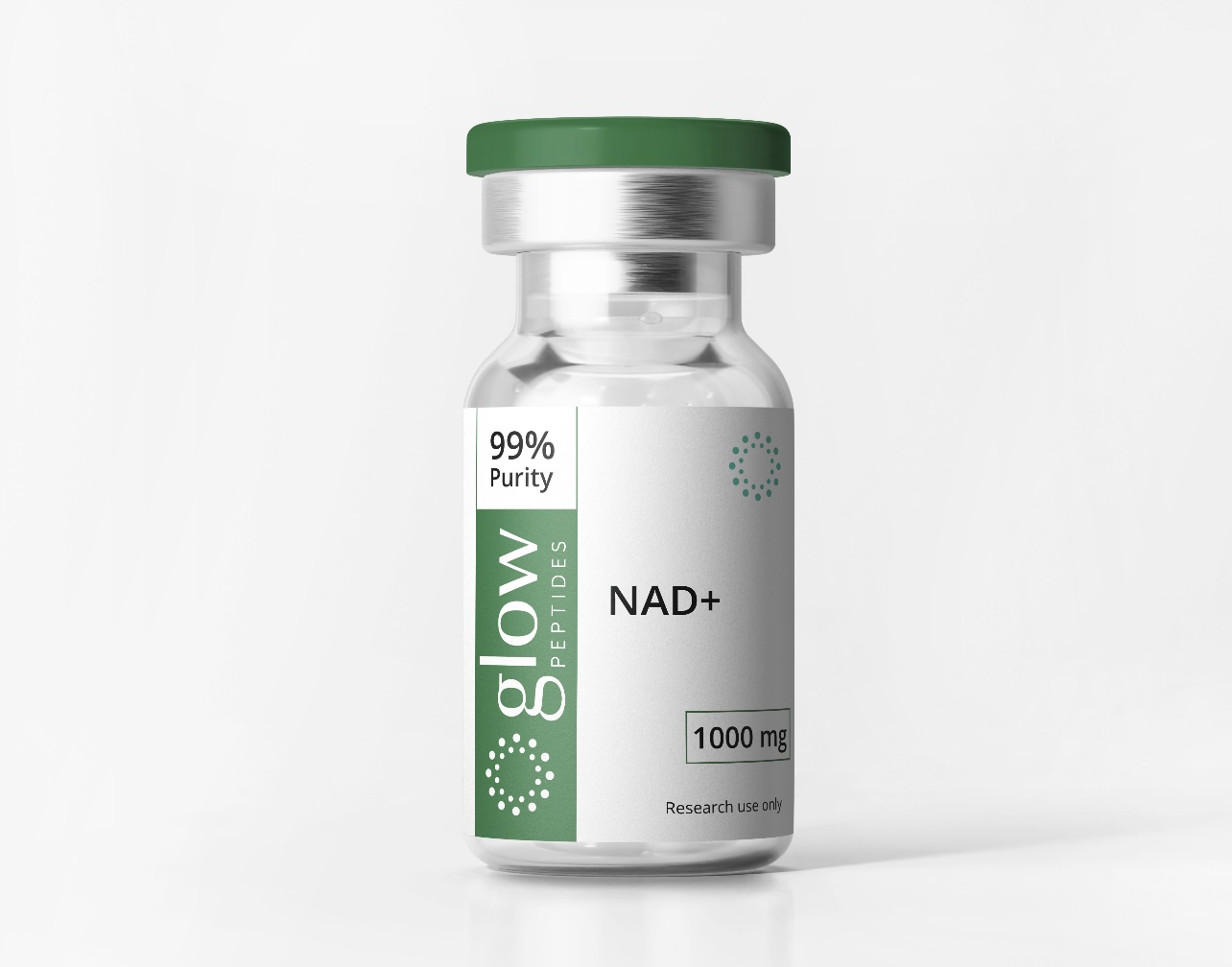
NMN vs NAD vs NR: What Each Name Means
Glow Peptides Research Team · 2026-09-30
For research use only. Not for human or veterinary use, diagnostic use, or in any therapeutic application.
NAD+, NMN and NR are three different molecules with three different molecular weights, and only one of them is NAD+. The other two are precursors: smaller molecules from which the larger one is built, related to it by the specific additions set out below, and routinely sold, discussed and searched for as though the three names were interchangeable. They are not. This page sets out what each name denotes, with the formula and mass for each, what is actually in a vial of research-grade NAD+, and why the distinction decides which certificate applies to which material.
The short version
- NAD+ is C21H27N7O14P2, about 663.4. PubChem CID 5892, held there under the title Nadide.
- NMN, nicotinamide mononucleotide, is C11H15N2O8P, about 334.22. CID 14180. Roughly half the mass of NAD+.
- NR, nicotinamide riboside, is C11H15N2O5+, about 255.25. CID 439924. The formula carries a positive charge, which is why it is handled as a salt.
- Two steps of the chain are exact arithmetic. NR plus a phosphoryl group gives NMN. NMN plus AMP, less one water, gives NAD+.
- NADH is not NAD+. It is C21H29N7O14P2 at about 665.4, roughly two units heavier. Same skeleton, different oxidation state.
- They are also in different regulatory categories depending on how they are sold, and a research material is in none of them.
The four names, and one more that matters
Every compound below contains a nicotinamide group, and nicotinamide itself is the first row. That shared fragment is why the names look related and why they get used loosely. Everything else about them differs, including the mass an instrument will report.
| Common name | PubChem title | CID | Molecular formula | Molecular weight |
|---|---|---|---|---|
| Nicotinamide | Nicotinamide | 936 | C6H6N2O | About 122.12 |
| NR, nicotinamide riboside | Nicotinamide Riboside | 439924 | C11H15N2O5+ | About 255.25 |
| NMN, nicotinamide mononucleotide | Nicotinamide Mononucleotide | 14180 | C11H15N2O8P | About 334.22 |
| NAD+ | Nadide | 5892 | C21H27N7O14P2 | About 663.4 |
| NADH | Nadh | 439153 | C21H29N7O14P2 | About 665.4 |
Two things in that table are worth stopping on before anything else.
PubChem's canonical title for NAD+ is "Nadide". Search the database for NAD+ and that is the record heading that comes back. It is the same compound, and the name is a database convention rather than a different material, but it is the kind of thing that makes a person think they have the wrong record.
NR carries a positive charge. The formula ends in a plus sign because the molecule is a cation, not a neutral species. A charged species of this kind is not isolated on its own, which is why nicotinamide riboside is handled as a salt, and a counterion then contributes mass that is not the compound. That is the same distinction between purity and net content that applies to any peptide handled as a salt, and it is set out in how research peptide purity is verified.
NMN vs NAD vs NR: the arithmetic that connects the names
The relationship between these compounds is usually described in terms of pathways and conversions. It can also be described as addition, which is checkable against the table above and does not require trusting anybody's summary.
Nicotinamide to NR: the ribose. Nicotinamide at 122.12 becomes nicotinamide riboside at 255.25 by the attachment of a ribose sugar. The compound is now a nucleoside and carries the positive charge noted above.
NR to NMN: one phosphoryl group, 78.97 units. NMN at 334.22 less NR at 255.25 is 78.97. A phosphoryl group, PO3, weighs 30.97 for the phosphorus plus 48.00 for three oxygens, which is 78.97. The two figures agree exactly. Adding a phosphate to a nucleoside makes it a nucleotide, which is what the "mononucleotide" in the name is recording.
NMN to NAD+: a second nucleotide, joined with the loss of water. This is the step that explains the "di" in dinucleotide. NMN at 334.22 plus adenosine monophosphate at 347.22 is 681.44. Forming the bond between them releases one molecule of water, 18.015, which leaves 663.43. PubChem gives NAD+ as about 663.4. The arithmetic closes.
| Step | What is added | Mass change | Result |
|---|---|---|---|
| Nicotinamide to NR | A ribose sugar | 122.12 to 255.25 | A nucleoside, carrying a positive charge |
| NR to NMN | One phosphoryl group, PO3 | Plus 78.97, and PO3 weighs 78.97 | A mononucleotide, 334.22 |
| NMN to NAD+ | Adenosine monophosphate, 347.22, less one water | 334.22 plus 347.22 less 18.015 equals 663.43 | A dinucleotide, about 663.4 |
| NAD+ to NADH | Two hydrogen atoms | Plus 2.016 | The reduced form, about 665.4 |
Why that last figure is the useful one
NAD+ is a dinucleotide: two nucleotides joined through their phosphate groups. One half is NMN. The other half is adenosine monophosphate, PubChem CID 6083, C10H14N5O7P at about 347.22. So the common shorthand that NMN is "half of NAD+" is close to literally true by mass: 334.22 against 663.4 is a fraction over half, and the difference is accounted for entirely by the adenosine half and the water lost on bonding. Nothing in that sentence is an interpretation. It is the two database records and one subtraction.
NADH is not NAD+, and the gap is two mass units
NAD+ and NADH are the oxidized and reduced forms of the same molecule. They share a skeleton and differ by two hydrogen atoms: C21H27N7O14P2 against C21H29N7O14P2. The mass difference is 665.4 less 663.4, which is about 2, and two hydrogen atoms weigh 2.016.
Two units on a molecule of 663 is a difference of about 0.3 percent, which is the practical problem. On an identity report the two sit only two units apart, so the result has to be quoted to at least the nearest unit and has to say which ion was observed. A figure rounded to the nearest ten, or one given without stating whether it is the neutral mass or a protonated ion, has not distinguished them. This is the narrowest gap in the whole series and it is the one most likely to be lost in reporting.
It is also the reason the plus sign in "NAD+" is doing work rather than decorating the name. It marks the oxidized form specifically. "NAD" without the sign is ambiguous between the two, and the two have different masses.
Where the regulatory categories diverge
The naming confusion has a second layer that has nothing to do with chemistry. These compounds are sold into more than one regulatory category, and the category is a fact about how the material is offered rather than about the molecule in the container.
In the United States the category of a new dietary ingredient is defined by statute, in section 413 of the Federal Food, Drug, and Cosmetic Act, which is where the 1994 grandfather date sits. The notification mechanics are separate and live in 21 CFR 190.6, which requires the manufacturer or distributor to notify the Food and Drug Administration at least 75 days before introducing into interstate commerce a supplement containing a new dietary ingredient. The requirement applies where the ingredient has not been present in the food supply as an article used for food in a form in which the food has not been chemically altered. The notification has to carry the identity of the ingredient, the level of it in the product, the conditions of use, and the evidence on which the submitter concluded the product will reasonably be expected to be safe. The regulation takes its authority from sections 201(ff), 301, 402, 413 and 701 of the Federal Food, Drug, and Cosmetic Act.
One clause in that regulation is worth quoting almost exactly, because it is regularly described backwards. Section 190.6(f) states that failure of the agency to respond to a notification does not constitute a finding that the ingredient or the supplement containing it is safe or is not adulterated. Silence is not clearance. A notification having been filed, and no objection having arrived, establishes that a process was followed and nothing more.
None of that applies to a research material, and that is the point of stating it. A compound supplied for in-vitro laboratory use is not being offered as a dietary supplement, is not subject to the notification route described above, and is not covered by anything that route would establish. It sits outside the category rather than inside it with a different label.
What the distinction changes on a certificate
Everything above reduces to three practical checks on a lot document.
Which molecule was measured. The identity result should correspond to the compound named on the vial: about 663 for NAD+, about 334 for NMN, about 255 for the nicotinamide riboside cation. A certificate naming one compound and reporting the mass of another has an internal contradiction that no purity figure fixes.
Whether the mass is quoted precisely enough. Given the two-unit gap between NAD+ and NADH, a figure rounded to the nearest ten, or one that does not say which ion was observed, leaves the oxidation state unresolved. This is the single most useful thing to look for on a document for this compound family.
Whether the figure is a specification or a measurement. A catalog specification is a floor the supplier undertakes to clear. A lot result is what was found in one sample of one batch on one date. The two are different kinds of statement and the second is the one that describes your container. The field-by-field walkthrough is in how to read a peptide certificate of analysis.
Published lot records for this catalog are listed on the quality page. As a worked example, the certificate for NAD+ lot 260123ZJND500 is public at its own address, with the method and the findings on the document rather than summarized elsewhere. Lot document availability varies by compound and by batch, so check the specific lot rather than assuming coverage.
One point of housekeeping that follows from all of this. The compound is cataloged here in more than one container format, and each released lot carries its own document regardless of format, so the lot on a NAD+ capsule record is not interchangeable with the lot on a vial. What the strength figure on each format refers to is a separate question from identity and is not covered here.
Also on this compound
The prior question, whether NAD+ belongs in a peptide catalog at all, is answered by formula in is NAD+ a peptide. It is not one, and the reason is the same dinucleotide structure set out above.
What this page deliberately does not cover
Almost every page returned for this comparison moves quickly to which of the three is better, what each may support, how much to take and what to expect. Those subjects are absent here on purpose, and saying so is more useful than leaving the gap unexplained.
Glow Peptides supplies cataloged materials for laboratory research only. The materials are not drugs, supplements, cosmetics or medical devices, and they are not intended for human or veterinary use. This page gives no dosing, administration or protocol guidance and no comparison of effects or expected outcomes; those questions are outside what a supplier of research materials should answer. What is in scope, and what this page covers, is composition, mass, purity, analytical methods, regulatory record and documentation.
Frequently asked questions
What is the difference between NAD+ and NMN?
They are two different molecules. NAD+ is C21H27N7O14P2 at about 663.4, held as PubChem CID 5892 under the title Nadide. NMN, nicotinamide mononucleotide, is C11H15N2O8P at about 334.22, CID 14180. NMN is one of the two halves of NAD+: NMN plus adenosine monophosphate, less one water molecule, gives 663.43 against NAD+ at 663.4.
What is NR, and how does it relate to NMN?
NR is nicotinamide riboside, PubChem CID 439924, C11H15N2O5+ at about 255.25. It differs from NMN by a single phosphoryl group: NMN at 334.22 less NR at 255.25 is 78.97, and a PO3 group weighs 78.97. Adding that phosphate turns a nucleoside into a nucleotide, which is what the word mononucleotide in the NMN name records. The formula carries a positive charge, which is why NR is handled as a salt.
Is NADH the same as NAD+?
No. They are the reduced and oxidized forms of the same skeleton and differ by two hydrogen atoms. NAD+ is C21H27N7O14P2 at about 663.4; NADH is C21H29N7O14P2 at about 665.4. The gap is about two mass units, the weight of two hydrogen atoms at 2.016, which is roughly 0.3 percent, so an identity result has to be quoted to at least the nearest unit, and has to say which ion was observed, to distinguish them. The plus sign in NAD+ marks the oxidized form specifically.
Why does PubChem call NAD+ "Nadide"?
Nadide is the canonical title PubChem holds for the compound record, CID 5892. It is a naming convention in that database rather than a different material, and searching for NAD+ returns the same record. The formula and mass on it are C21H27N7O14P2 and about 663.4, which is what confirms it is the compound you were looking for.
What does "new dietary ingredient" mean, and does it apply to a research material?
The category is defined by statute, in section 413 of the Federal Food, Drug, and Cosmetic Act, which is where the 1994 grandfather date sits. The notification mechanics sit separately in 21 CFR 190.6, which requires notice to the Food and Drug Administration at least 75 days before such a supplement enters interstate commerce. Section 190.6(f) adds that no response is not a finding of safety. None of it applies to a research material.
Why does this page not compare which of the three is better?
Because Glow Peptides supplies cataloged materials for laboratory research only. The products are not drugs, supplements, cosmetics or medical devices, and they are not intended for human or veterinary use. The page gives no dosing or protocol guidance and no comparison of effects or outcomes; those are outside what a research materials supplier should provide, so they are deliberately absent rather than accidentally missing. What is covered is composition, mass, purity, analytical methods, regulatory record and documentation.
Sources
- PubChem, National Library of Medicine, National Institutes of Health. Compound records read 24 September 2026: nicotinamide CID 936; nicotinamide riboside CID 439924; nicotinamide mononucleotide CID 14180; NAD+ (Nadide) CID 5892; NADH CID 439153; adenosine monophosphate CID 6083. Molecular formulas and molecular weights taken directly from those records.
- Code of Federal Regulations, Title 21, Section 190.6, "Requirement for premarket notification." Read in full at eCFR 24 and 29 September 2026, content current as of 25 September 2026. Source 62 FR 49891, 23 September 1997, as amended at 66 FR 17359, 81 FR 49897 and 88 FR 17725. Authority: sections 201(ff), 301, 402, 413 and 701 of the Federal Food, Drug, and Cosmetic Act.
- All mass differences quoted in this page were computed from the molecular weights on those PubChem records: the 78.97 phosphoryl step, the 18.015 water loss on dinucleotide bond formation, and the 2.016 unit gap between the oxidized and reduced forms, being the weight of two hydrogen atoms.
For research use only. Not for human or veterinary use, diagnostic use, or any therapeutic application.