Glow Peptides · Research Journal
Tesamorelin vs Ipamorelin: Mass and Sequence
Glow Peptides Research Team · 2026-10-19
For research use only. Not for human or veterinary use, diagnostic use, or in any therapeutic application.
Tesamorelin and ipamorelin are two different molecules from two different classes, not two versions of the same thing. Tesamorelin is a 44-residue analog of human growth hormone-releasing hormone with a six-carbon acyl group on its N-terminus, molecular weight about 5,136. Ipamorelin is a synthetic five-residue peptide with a mass of about 711.9, built around two D-amino acids and a naphthalene side chain, and it belongs to a different compound class. The mass ratio between them is roughly seven to one. This page sets out what each one is, what is actually in a vial of research-grade tesamorelin as against the vial ipamorelin is supplied in, and what a certificate has to show before either name on a label can be trusted.
The short version
- Tesamorelin is GRF(1-44) amide with a trans-3-hexenoyl group on the N-terminal tyrosine. C221H366N72O67S, about 5,136. PubChem CID 16137828.
- Ipamorelin is the pentapeptide Aib-His-D-2-Nal-D-Phe-Lys-NH2. C38H49N9O5, about 711.9. PubChem CID 9831659.
- Different classes. Tesamorelin is a GHRH analog. Ipamorelin is a growth hormone secretagogue receptor ligand. They are named, cataloged and analyzed separately.
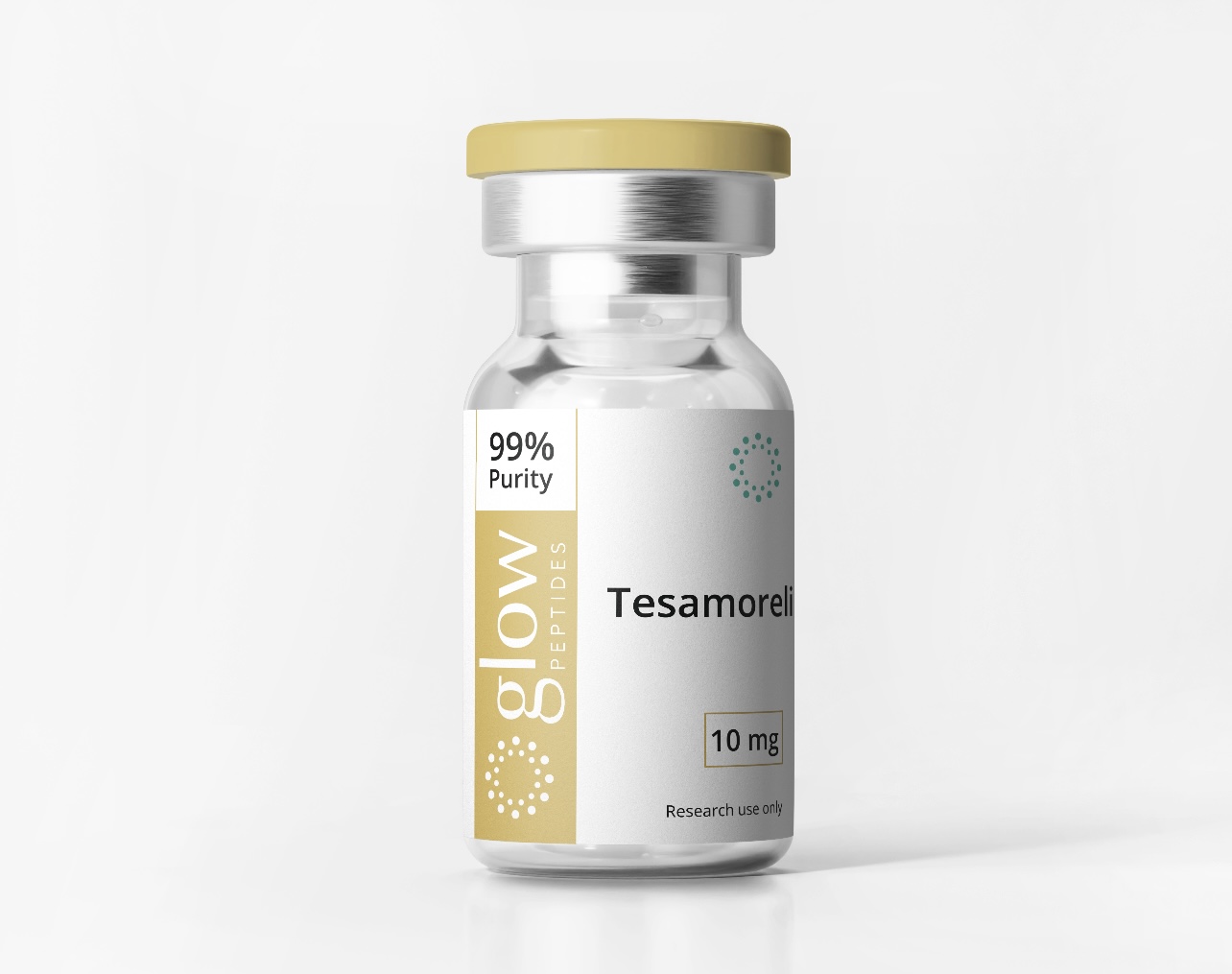
- Different containers. In this catalog tesamorelin is supplied on its own (catalog code TE10). Ipamorelin is supplied co-lyophilized with CJC-1295 (no DAC) under catalog code CP10, never alone.
- Different regulatory records. Tesamorelin is the active ingredient of a product licensed in the United States under a Biologics License Application. Ipamorelin has no application on the FDA's drug approval record.
- A certificate for one says nothing about the other. Identity is confirmed by mass, and the two masses are seven-fold apart.
Two classes, not two versions of one compound
The pages that rank for this comparison mostly treat the two names as rival options in the same category. Chemically they are not in the same category at all.
Tesamorelin is derived from a human hormone. Growth hormone-releasing hormone is a 44-residue peptide, and the mature chain sits at residues 32 to 75 of its precursor, UniProt entry P01286, with the C-terminal leucine carried as an amide. Tesamorelin is that entire 44-residue sequence, still amidated, with one addition: a trans-3-hexenoyl group attached to the N-terminal tyrosine. The unmodified peptide is the natural sequence. The acylated peptide is a synthetic analog of it.
Ipamorelin has no natural parent sequence. It is a designed pentapeptide, five residues long, carrying the development code NNC 26-0161 and the CAS number 170851-70-4 on its PubChem record. Its structure is Aib-His-D-2-Nal-D-Phe-Lys-NH2: an alpha-aminoisobutyric acid residue, a histidine, a D-configured 2-naphthylalanine, a D-phenylalanine and a lysine amide. Three of the five residues are non-standard. Aib does not occur in the twenty coded amino acids, 2-naphthylalanine is not a natural amino acid at all, and two of the residues are in the D configuration rather than the L configuration found in proteins.
The product pages in this catalog use the same distinction. Tesamorelin is listed as a synthetic 44-amino-acid GHRH analog. Ipamorelin is listed as a synthetic pentapeptide growth hormone secretagogue receptor ligand. Those are class labels drawn from the compound records, and they are the reason the two are cataloged, documented and tested as unrelated materials.
Tesamorelin vs ipamorelin: sequence, formula and mass, side by side
| Property | Tesamorelin | Ipamorelin |
|---|---|---|
| PubChem CID | 16137828 | 9831659 |
| Residues | 44 | 5 |
| Sequence basis | Human GRF(1-44), residues 32 to 75 of UniProt P01286 | Designed sequence, no natural parent |
| Sequence | YADAIFTNSYRKVLGQLSARKLLQDIMSRQQGESNQERGARARL, amidated | Aib-His-D-2-Nal-D-Phe-Lys, amidated |
| N-terminal modification | trans-3-hexenoyl group on Tyr1 | None; Aib is the first residue |
| C-terminus | Leucine amide | Lysine amide |
| Non-standard residues | None in the chain; the acyl cap is the only modification | Aib, D-2-Nal, D-Phe |
| Molecular formula | C221H366N72O67S | C38H49N9O5 |
| Molecular weight | about 5,136 | about 711.9 |
| Sulfur | One, in Met27 | None |
| Aromatic residues | Tyr1, Phe6, Tyr10 | His2, 2-Nal3, Phe4 |
Both molecular weights were reconciled three ways before being printed here: the database figure, the weight recomputed from the molecular formula, and the residue sum recomputed from the sequence. For ipamorelin the five residue masses come to 694.83, adding water for the chain termini gives 712.85, and converting the C-terminal acid to an amide takes off 0.98, which lands on 711.87 against the record's 711.9. The formula recomputed from those residues, C38H49N9O5, matches the record exactly. Tesamorelin was reconciled the same way in the tesamorelin and sermorelin comparison linked below, where the arithmetic of the hexenoyl group is worked through in full.
The single most useful number on the table is the ratio. At about 5,136 against about 711.9, tesamorelin is roughly 7.2 times the mass of ipamorelin. Nothing else on this page matters as much for reading a certificate, because identity on a certificate is confirmed by mass, and these two masses cannot be confused with each other by any instrument.
What the seven-fold difference changes on the bench
Size changes how a compound behaves in the two methods a lot document normally reports, high-performance liquid chromatography with UV detection and mass spectrometry.
In mass spectrometry, a 711.9 molecule is small enough to be observed as a single protonated ion. Its exact monoisotopic mass on the PubChem record is 711.386, so the protonated ion appears at about 712.39. A 5,136 molecule is observed differently. In electrospray ionization a peptide of that size typically carries several charges at once and appears as a series of peaks, one for each charge state, from which the instrument software reconstructs the neutral mass. A certificate for tesamorelin will therefore show either that charge series itself or a mass reconstructed from it, while a certificate for ipamorelin can report the ion directly. Both are legitimate. They simply look different on the page, and a reader who expects one format from the other will misread a correct document.
In chromatography, both compounds carry aromatic side chains that absorb ultraviolet light, so both are detectable at the wavelengths a purity assay uses. Tesamorelin has two tyrosines and a phenylalanine; ipamorelin has a histidine, a phenylalanine and a naphthalene ring on the 2-naphthylalanine residue. A single 44-residue chain also presents many more sites at which a related impurity can arise: a deletion, an oxidation or an incomplete deprotection at any one of 44 positions, against five for the pentapeptide. That is one reason the impurity profile on a tesamorelin chromatogram is typically busier than the profile on a short peptide, and it is not by itself a sign that anything is wrong with the lot.
Methionine is the one residue on the table worth singling out. Tesamorelin carries a methionine at position 27 and it is the only sulfur in the molecule. Methionine can oxidize to a sulfoxide, which is a separate chemical species that a chromatogram resolves as its own peak, 16 mass units heavier. Ipamorelin has no methionine and no sulfur, so that particular impurity cannot appear on its record. This is a compositional fact about the molecules, not a comment on any lot.
Two D-amino acids, and what a purity figure cannot see
Ipamorelin's 2-naphthylalanine and phenylalanine are both in the D configuration. A standard reversed-phase HPLC purity assay separates compounds by how they partition between a column and a solvent. It may not resolve a peptide in which one residue has the opposite configuration from the parent peak, and it cannot on its own assign the configuration at each center. A purity percentage on an ipamorelin document therefore states how much of the material is the intended compound as against other compounds, but it does not, on its own, confirm that the two D-configured centers are in the D configuration. Confirming stereochemistry takes a separate method, such as chiral amino acid analysis. This is a general property of the assay, and it applies to any peptide built with D-amino acids.
Why the two names are so often mentioned together
They travel together in search because of a third compound. Ipamorelin is very commonly supplied and discussed alongside CJC-1295, itself a GHRH analog, and the resulting combination is then compared with tesamorelin, which is also a GHRH analog. So "tesamorelin vs ipamorelin" is often really "tesamorelin vs the CJC-1295 and ipamorelin pair", and the search phrasing reflects that.
In this catalog that pairing is a physical product. The CJC-1295 and Ipamorelin research vial contains CJC-1295 without the DAC group, a 29-residue GHRH analog listed at C152H252N44O42 and about 3,367.9, co-lyophilized with ipamorelin, listed there at 711.8 against the PubChem record's 711.9, a rounding difference, in a single sealed vial under catalog code CP10. Ipamorelin is not stocked on its own. Tesamorelin is stocked on its own, under catalog code TE10. Both are also grouped, as separate vials, in the CJC-1295, Ipamorelin and Tesamorelin research set, where each component carries its own lot document and a report for one component establishes nothing about another.
| Product | Catalog code | Contents | Nominal total on the label |
|---|---|---|---|
| Tesamorelin | TE10 | Tesamorelin, single compound | 10 mg |
| CJC/Ipamorelin | CP10 | CJC-1295 (no DAC) and ipamorelin, co-lyophilized | 10 mg across both components |
Two things follow from that table. The digits in a catalog code are a nominal total, not a measurement, and on the two-component vial they are a total across both materials rather than an amount of either one. And a purity figure on a co-lyophilized vial has to be read knowing whether it is per component or combined, because on a vial that is supposed to contain two compounds the second compound is not an impurity; the CP10 page states a single floor without saying which, so that is the first thing to establish on its certificate. The difference between CJC-1295 with and without the DAC group is set out separately in CJC-1295 with and without DAC, and is why the CP10 vial's first component weighs about 3,367.9 rather than the 3,647.2 that PubChem holds for the DAC form under CID 91971820.
What the regulatory record says about each
The two compounds sit in different places on the public record, and that is a fact about the record rather than a statement about either material.
Tesamorelin is the active ingredient of EGRIFTA, held under Biologics License Application 022505 by Theratechnologies, and the FDA's drug approval database carries that application. The full application record, including the strengths on file, was set out in the tesamorelin and sermorelin comparison and was unchanged when re-read on 29 September 2026.
Ipamorelin returns no result at all when the same database is queried by generic name. It carries an International Nonproprietary Name, recorded as a synonym on its PubChem entry, and it has a CAS number, but it is not the active ingredient of any application in the FDA's approval record as read on 29 September 2026.
Neither fact transfers to a research vial. A licensed product is a specific formulation, strength and presentation that went through a specific review; a lyophilized research material sharing the active ingredient's chemical identity is a different article, supplied for laboratory use, and the license does not cover it. Equally, the absence of any application for ipamorelin says nothing about what is or is not in a given vial. What is in the vial is established by the lot document, and only by the lot document.
What a certificate has to show for each
Because the two molecules are so different, the checks on their documents are different too, and the same headline purity figure means something slightly different on each.
Identity first. The single check that separates the two is the mass on the certificate. A tesamorelin document should reconcile to about 5,136. A figure near 3,358 on a document labeled tesamorelin is the mass of sermorelin, the 29-residue fragment without the acyl group, and a figure near 5,040 is the unacylated 44-residue peptide. An ipamorelin document should report a protonated ion at about 712.4 or a neutral mass at about 711.9. Anything else is a different compound, whatever the label says.
Purity second, read with the method. On a single-compound tesamorelin vial, an HPLC purity percentage states what fraction of the peptide material is tesamorelin as against related impurities. On the CP10 vial the same percentage has to be read knowing whether it is per component or combined, because a combined figure across two intended compounds says less than one figure per compound. For ipamorelin specifically, the purity percentage does not confirm the D configuration of the two D-configured residues, for the reason given above.
Availability third. Lot documents are held per lot and per product, and availability varies by compound and by batch. Where no lot document is published for a given lot, that absence should be read at face value: it means that no measured result is being asserted for that lot, not that the specification is the result. The catalog's supplier specification for both products is stated in the composition block of each product page as a floor of ≥99.2% by HPLC, labeled there as a specification rather than a measured lot result. The way to distinguish the two on any document is set out on the quality page, which links each published lot record.
The other comparison people arrive from
If the question was really tesamorelin against the shorter GHRH fragment, that pair differs by 15 residues and one acyl group rather than by class, and the arithmetic is in tesamorelin vs sermorelin.
What this page deliberately does not cover
Every page returned for this comparison, and every question Google lists beneath them, moves quickly to which of the two is better, whether they belong together, which is stronger, and whether tesamorelin belongs on its own or paired with ipamorelin. Those subjects are absent here on purpose, and saying so is more useful than leaving the gap unexplained.
Glow Peptides supplies cataloged materials for laboratory research only. The materials are not drugs, supplements, cosmetics or medical devices, and they are not intended for human or veterinary use. This page gives no dosing, administration, reconstitution, combination or protocol guidance and no comparison of effects or expected outcomes; those questions are outside what a supplier of research materials should answer. What is in scope, and what this page covers, is composition, mass, regulatory record and documentation.
Frequently asked questions
What is the difference between tesamorelin and ipamorelin?
They are different molecules from different classes. Tesamorelin is a 44-residue analog of human growth hormone-releasing hormone with a trans-3-hexenoyl group on its N-terminus, molecular weight about 5,136, PubChem CID 16137828. Ipamorelin is a designed five-residue peptide, Aib-His-D-2-Nal-D-Phe-Lys-NH2, molecular weight about 711.9, PubChem CID 9831659, classed as a growth hormone secretagogue receptor ligand. Tesamorelin is roughly seven times its mass.
Is ipamorelin a GHRH analog like tesamorelin?
No. Tesamorelin is built from the full 44-residue human GHRH sequence, residues 32 to 75 of UniProt entry P01286, with one acyl group added. Ipamorelin has no natural parent sequence at all. It is a synthetic pentapeptide containing three non-standard residues, alpha-aminoisobutyric acid, D-2-naphthylalanine and D-phenylalanine, and it is cataloged as a secretagogue receptor ligand rather than as a GHRH analog.
Is ipamorelin sold on its own in this catalog?
No. Ipamorelin is supplied co-lyophilized with CJC-1295 (no DAC) in a single sealed vial under catalog code CP10, where the 10 in the code is a nominal total across both components. Tesamorelin is supplied as a single compound under catalog code TE10. The two are also grouped as separate vials in the CJC-1295, Ipamorelin and Tesamorelin research set.
How does a certificate tell tesamorelin from ipamorelin?
By mass. A tesamorelin document should reconcile to about 5,136, usually as a mass reconstructed from a multiply charged electrospray series. An ipamorelin document should show a protonated ion at about 712.4 or a neutral mass at about 711.9. A figure near 3,358 on a document labeled tesamorelin is the mass of sermorelin, the 29-residue fragment, and a figure near 5,040 is the unacylated 44-residue peptide.
Does an HPLC purity percentage confirm ipamorelin's D-amino acids?
No. A reversed-phase HPLC purity assay separates compounds by how they partition between the column and the solvent; it may not resolve a single-residue change of configuration from the main peak, and it cannot assign the configuration at each center. The percentage states how much of the material is ipamorelin as against other compounds. Confirming that the 2-naphthylalanine and phenylalanine residues are in the D configuration takes a separate chiral method, and that applies to any peptide built with D-amino acids.
Why does this page not say which one is better?
Because Glow Peptides supplies cataloged materials for laboratory research only. The products are not drugs, supplements, cosmetics or medical devices, and they are not intended for human or veterinary use. The page gives no dosing, combination or protocol guidance and no comparison of effects; those are outside what a research materials supplier should provide, so they are deliberately absent rather than accidentally missing. What is covered is composition, mass, regulatory record and documentation.
Sources
- PubChem, National Library of Medicine, National Institutes of Health. Compound records read 29 September 2026: tesamorelin CID 16137828; ipamorelin CID 9831659, including the synonym list carrying the sequence Aib-His-D-2-Nal-D-Phe-Lys-NH2, the code NNC 26-0161, CAS 170851-70-4 and the INN synonym entry; CJC-1295 CID 91971820. Molecular formulas, molecular weights and the ipamorelin exact mass taken directly from those records.
- UniProt. Somatoliberin precursor, accession P01286, read 29 September 2026, for the mature 44-residue growth hormone-releasing hormone chain at residues 32 to 75 and the C-terminal leucine amide.
- FDA, Drugs@FDA, queried through the openFDA drug application endpoint 29 September 2026. Tesamorelin: EGRIFTA, application BLA 022505, Theratechnologies. Ipamorelin: no application returned for the generic name.
- Ipamorelin residue sum recomputed from the sequence using standard average residue masses, with water added for the chain termini and the C-terminal amide correction applied. The recomputed weight and the recomputed formula agree with the database record.
- Catalog codes, class labels and the purity specification wording were read from the live tesamorelin and CJC/Ipamorelin product pages, 29 September 2026. Formulas and masses in this page are taken from the PubChem records.
For research use only. Not for human or veterinary use, diagnostic use, or any therapeutic application.