Glow Peptides · Research Journal
What Is GHK-Cu? The Copper Peptide, Decoded
Glow Peptides Research Team · 2026-11-16
For research use only. Not for human or veterinary use, diagnostic use, or in any therapeutic application.
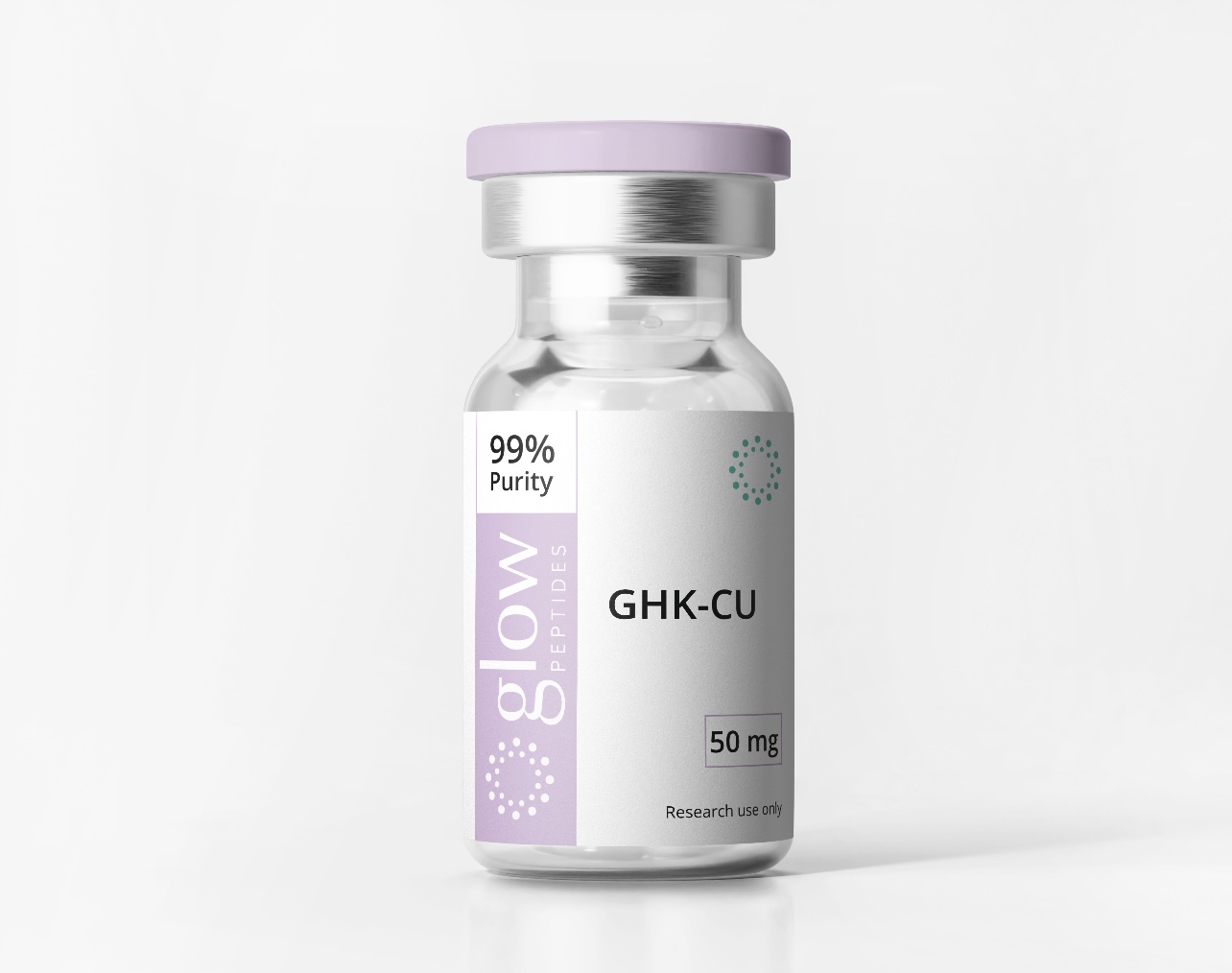
What is GHK-Cu? The name answers itself once you know how to read it, because it is a formula in miniature: three letters naming three amino acids, then the chemical symbol for copper. Nothing about the compound is hidden behind the label. The G, the H and the K each stand for one building block of a short peptide chain, and the Cu says that chain is holding a copper ion. This page decodes the GHK-Cu research vial label one piece at a time: what each letter stands for, what the copper changes, why the public databases keep separate records for what looks like one substance, and how a reader gets from the name on a label to the record that defines it.
The short version
- GHK is a tripeptide: glycine (G), histidine (H), lysine (K). Three amino acids joined in that order, nothing more.
- The Cu is not a fourth letter in the sequence. It is the chemical symbol for copper. GHK-Cu is the copper(II) complex of the tripeptide: the same three-residue chain, holding a copper ion.
- One substance in everyday speech, at least two records in the databases. The free tripeptide is PubChem CID 73587: C14H24N6O4, mass 340.38, CAS 49557-75-7. The copper complex is PubChem CID 71587328: C14H23CuN6O4+, mass 402.92, CAS 89030-95-5.
- The gap between the two masses is the copper, less one hydrogen. Add a copper atom at about 63.5, lose one hydrogen at about 1, and the record's mass climbs by about 62.5 units, from 340.38 to 402.92.
- In this catalog it is a compound of extremes: one of the shortest chains on the shelf, and also a component of the GLOW and KLOW multi-compound blends.
What is GHK-Cu? Read the name as a formula
Most compound names in a research catalog tell you nothing until you look them up. BPC-157 and TB-500 are codes; tesofensine and tesamorelin are invented words. GHK-Cu is the exception, because the name is built from two standard scientific shorthands that anyone can learn in a minute.
The first shorthand is the single-letter code for amino acids. Every one of the twenty standard amino acids has its own letter, and a peptide, which is a chain of amino acids, can be written as a string of those letters in chain order.
GHK is exactly that: a three-letter word spelling a three-residue chain. Chemists call a chain of three residues a tripeptide.
The second shorthand is the periodic table. Cu is the element symbol for copper. Joined to the peptide's letters with a hyphen, it says this is not the bare tripeptide but the tripeptide with a copper ion bound to it.
So the full name reads, in plain words: the glycine-histidine-lysine chain, carrying copper. Everything else on this page unpacks those two halves.
The three letters, one amino acid each
Here is the first half of the decode. Each letter in GHK maps to one amino acid, and the letters run in the same order the residues sit in the chain.
| Letter | Amino acid | What it brings to the chain |
|---|---|---|
| G | Glycine | The smallest of the twenty standard amino acids. It sits at the front of the chain |
| H | Histidine | The middle residue, and the working one: its ring structure is a classic metal-binding group in peptide chemistry, and it is central to how this chain holds copper |
| K | Lysine | The final residue. K is its standard single-letter code because L was already taken by leucine |
Run the three full names together and you get the systematic name the databases file the chain under: glycyl-L-histidyl-L-lysine. The L before histidyl and before lysine marks the mirror-image form of each residue, the one found in natural proteins. So a forbidding string of chemistry syllables turns out to be nothing but the table above read aloud.
That is also why the compound travels under so many spellings and aliases, from GHK Cu without the hyphen to copper tripeptide-1 on ingredient lists. Those are labeling conventions, not different substances, and this catalog has already untangled them one by one in one compound, several names. This page leaves the naming question there and stays with the chemistry.
What the Cu changes: one peptide, two records
Now the second half of the name. The published literature describes GHK as a peptide with a very high affinity for copper(II), meaning the chain binds a copper ion readily and holds it. The bound pair is a complex: a small molecule gripping a metal ion, the peptide supplying the grip and the histidine ring doing much of the gripping.
That bound pair is what GHK-Cu names. The hyphen and the Cu are doing real chemical work: they say the copper is part of the substance being described, not an ingredient listed alongside it.
Because the free chain and the copper-bound chain are different chemical species, the public databases keep a separate record for each, with its own identifier, its own formula and its own mass. Reading the two records side by side is the fastest way to see exactly what the copper changes.
| Free tripeptide (GHK) | Copper complex (GHK-Cu) | |
|---|---|---|
| PubChem CID | 73587 | 71587328 |
| Formula | C14H24N6O4 | C14H23CuN6O4+ |
| Mass | 340.38 | 402.92 |
| CAS number | 49557-75-7 | 89030-95-5 |
| What it describes | The bare three-residue chain | The same chain holding a copper ion |
Compare the two formulas character by character and the whole story is there. Carbon, nitrogen and oxygen counts are identical, because the chain itself is unchanged. The copper record adds one Cu.
And the record counts one fewer hydrogen, H23 against H24, because it writes the chain's acid group as a carboxylate; the charge nets out at plus one on that record. The masses tell the same story in numbers: copper arrives at about 63.5, a hydrogen leaves at about 1, and the recorded mass climbs by about 62.5 units, from 340.38 to 402.92.
This is the single most useful thing to know when reading paperwork for this compound. A document quoting a mass near 340 is describing the free tripeptide. A document quoting a mass near 403 is describing the copper complex.
One exception on certificates: under the acidic, electrospray conditions of an LC-MS run the copper can be displaced, so a lot report for GHK-Cu may record the copper-free ion near 341; that identifies the chain, it does not by itself measure the copper. Neither figure is wrong; they answer to different records, and a comparison is only meaningful against the record that matches the material.
PubChem also files other closely related entries for the copper-bound form; this page keeps to the positively charged complex record, CID 71587328, the one the compound's CAS number, 89030-95-5, resolves to, and the KLOW component guide walks that fork. A vial labeled GHK-Cu answers to the complex record, CID 71587328, with the copper counted in.
Where GHK-Cu sits in this catalog
Size is the quickest way to place the compound among its shelf-mates. At three residues, GHK is among the shortest chains in this catalog, a tripeptide alongside KPV, at a mass of about 342, and glutathione.
At the far end of the same shelf sits tesamorelin, a 44-residue chain with a mass of about 5,136, roughly fifteen times the mass of the free GHK chain. Measured by chain length, GHK sits at the small end of the catalog's single peptides.
Why a three-residue chain is easy to characterize
Chain length changes how hard a molecule is to pin down analytically. A 44-residue chain has dozens of positions where a synthesis can go slightly wrong, which is why its documentation deserves a slow, careful read.
A tripeptide has three. The distinctive thing about GHK-Cu is not the chain at all but the metal: the copper is part of the recorded formula and the recorded mass, so the record to compare a formula or a nominal mass against is the complex record, not the peptide-only record.
GHK-Cu also appears in this catalog in company. It is one of the three co-lyophilized compounds in the GLOW blend vial, alongside BPC-157 and TB-500.
It is likewise one of the four compounds in the KLOW blend, which adds KPV to the same trio; what each of those four names refers to is set out in the KLOW blend component guide. Those pages own the blend compositions, so this one simply notes the membership: the same compound defined by the same record, whether it is supplied on its own or as a named component of a combination vial.
From the label to the record
The reading discipline for a GHK-Cu label is the same three-line pattern used across this catalog, and it is short.
The name line resolves to the record. Whatever spelling the label uses, the substance it names is the copper complex, CID 71587328, CAS 89030-95-5. The record, not the spelling, defines the compound.
The strength line is a nominal figure. It declares the content of the vial as supplied. It is a specification, not a measurement of the vial in your hand.
The lot number points at the paperwork. It is the one string on the label that resolves to a specific production run and that run's certificate of analysis, where the measured figures live. How to work through a certificate field by field, including what purity and identity figures each mean, is covered in how to read a peptide certificate of analysis, and the same discipline applies here with one twist from this page: the record to compare a formula or a nominal mass against is the complex record, copper included.
Handling and storage for the supplied material are deliberately not covered here. They are set out in the GHK-Cu reference guide, and the documentation that ships with a specific lot is the authority for that lot.
The pattern across the catalog
Every compound here answers to a public record for the definition and a lot certificate for the vial. GHK-Cu is the compound where the definition fits inside the name itself: three letters for three amino acids, and a Cu for the copper the chain holds.
What this page deliberately does not cover
Most of what ranks for this question is built on material that falls outside the scope of a research-use page, and none of it is written here. Saying so plainly is more useful than leaving the gap unexplained.
Glow Peptides supplies cataloged materials for laboratory research only. The materials are not drugs, supplements, cosmetics or medical devices, and they are not intended for human or veterinary use.
This page gives no dosing, administration, reconstitution, duration, combination or protocol guidance, states no expected outcomes and makes no claim about what these materials do; those questions, along with every cosmetic formulation question, are outside what a supplier of research materials should answer. What is in scope, and what this page covers, is composition, identity, the public records, and documentation.
Frequently asked questions
What does copper(II) mean in descriptions of GHK-Cu?
The Roman numeral names the oxidation state of the copper, which is a bookkeeping figure for how many electrons the metal has given up: copper(II) is a copper ion carrying a two-plus charge. It matters on paperwork because copper can also exist as copper(I) and as uncharged metal, and those are chemically different species. When the literature and the records describe GHK binding copper(II), they are specifying exactly which form of copper the complex contains, the same way the L in glycyl-L-histidyl-L-lysine specifies which mirror form of each amino acid is in the chain.
Why does the copper record's formula end with a plus sign?
The plus sign is a charge marker: it records that the species described by the formula carries a net positive charge, one unit of it. It arises from the arithmetic of the complex: the copper ion brings a two-plus charge, the record writes the chain's acid group as a carboxylate, one hydrogen ion fewer, and the result nets out at plus one. Practically, the marker is a reminder that the record describes a charged complex rather than a neutral molecule, and that real supplied material pairs a charged species with counter-ions, which is one reason figures on a lot document can sit slightly away from the bare record value.
Does the order of the three amino acids matter?
Yes, completely. A peptide is defined by its sequence, not by its ingredient list, so glycine-histidine-lysine is a different compound from, say, lysine-histidine-glycine, even though both would contain the same three residues and share a molecular formula. The letters in GHK are written in chain order, front to back, and that order is part of the compound's identity. It is the reason the single-letter code works as a naming system at all: the string is the structure.
Where does the GHK sequence come from?
It was not invented for a catalog. The published literature describes GHK as a naturally occurring peptide, found in blood serum, which is where its study began. The catalog material is the same three-residue sequence produced by chemical synthesis, which is why its identity is checked against the public record rather than against any biological source: the record defines the molecule regardless of where a given sample of it was made.
Is the capsule listing a different compound?
No. This catalog lists GHK-Cu in two presentations, a lyophilized vial and an encapsulated format, and they carry different catalog codes because a catalog code names a product, not a molecule. The compound in both is the same copper complex, answering to the same public record, CID 71587328 and CAS 89030-95-5. Presentation, strength and count are product facts that live on each listing and each lot document; the chemical identity does not change between them.
Sources
- PubChem, National Library of Medicine, National Institutes of Health. Records read 28 October 2026: the copper complex (record title Prezatide copper, synonyms including copper tripeptide-1 and GHK copper), CID 71587328, formula C14H23CuN6O4+, mass 402.92, CAS 89030-95-5; and the free tripeptide glycyl-L-histidyl-L-lysine, CID 73587, formula C14H24N6O4, mass 340.38, CAS 49557-75-7. The KPV mass of about 342 used for catalog context comes from PubChem CID 125672, and the tesamorelin mass of about 5,136 from PubChem CID 16137828, both re-read the same day.
- Dou Y, Lee A, Zhu L, Morton J, Ladiges W. The potential of GHK as an anti-aging peptide. Aging Pathobiology and Therapeutics 2020;2(1):58-61, PMCID PMC8789089, read 28 October 2026, for the statements that GHK is a naturally occurring peptide found in human serum and that it binds copper(II) with very high affinity, forming the GHK-Cu complex. No other statement from that paper is carried on this page.
- Glow Peptides live pages, read 28 October 2026: the GHK-Cu product listing and reference guide, the GLOW blend listing (three co-lyophilized compounds: BPC-157, TB-500, GHK-Cu) and the KLOW blend component guide (four compounds: KPV, GHK-Cu, BPC-157, TB-500). The identity of any specific lot is a matter for that lot's certificate.
For research use only. Not for human or veterinary use, diagnostic use, or any therapeutic application.