Glow Peptides · Research Journal
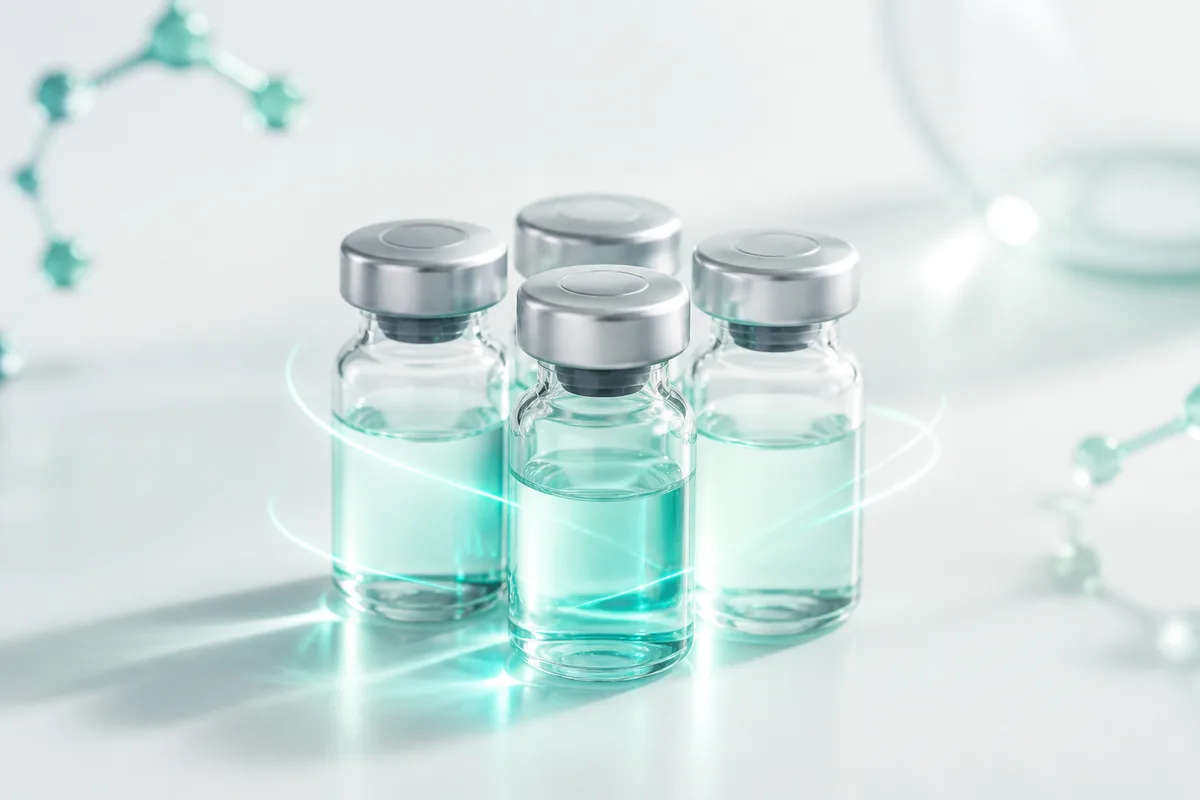
What Is in KLOW Peptide Blend: Ingredients Explained
Glow Peptides · 2026-09-17
For research use only. Not for human or veterinary use, diagnostic use, or in any therapeutic application.
KLOW is a four-peptide blend supplied as a single lyophilized vial, and the question people actually ask about it — what is in it — has a short answer and a long one. The short answer is BPC-157, TB-500, GHK-Cu and KPV. The long answer is what each of those four names refers to as a chemical entity, why four separate compounds share one vial, what the 80 mg on the KLOW blend listing is counting, and how to confirm that the specific vial in front of you matches the composition the listing describes. This guide is the long answer.
If you want the short reference instead, the KLOW blend learn page states the constituents and the specification in a few lines. And if your question is really which of the two Glow blends differs how, the comparison article on GLOW 70 mg and KLOW 80 mg sets them side by side. This page is neither of those. It is the composition reference for KLOW itself, and it goes down to the level of what each constituent is.
The composition, stated plainly
KLOW, as Glow Peptides supplies it, contains four peptides in one vial: BPC-157, TB-500, GHK-Cu and KPV. The vial is 3 mL. The published total is 80 mg of peptide across the vial. The purity specification is ‚â•99.2% per component by reverse-phase HPLC, which is a floor every released lot has to clear rather than a typical or average figure.
Those are the four facts a composition question is usually reaching for. Everything below is an expansion of them, because each one carries a qualification that matters more than it looks.
What each constituent is
The four names on the listing are not all the same kind of name. Two of them are chemical descriptions, one is a trade designation with a known ambiguity behind it, and one is an amino-acid sequence written as letters. Knowing which is which is most of what it takes to read a blend listing accurately.
BPC-157
BPC-157 is a synthetic peptide of fifteen amino acids — a pentadecapeptide — with the sequence Gly-Glu-Pro-Pro-Pro-Gly-Lys-Pro-Ala-Asp-Asp-Ala-Gly-Leu-Val, conventionally written GEPPPGKPADDAGLV. The designation stands for "body protection compound", and the sequence corresponds to a partial sequence of a protein identified in gastric juice. It is made by solid-phase synthesis rather than isolated from a biological source, which is why a synthesis-related impurity profile is what the analysis is looking for.
Because the sequence is fixed and public, BPC-157 is one of the easier constituents to confirm by mass: the theoretical mass follows from the sequence, and mass spectrometry either matches it or does not. Glow also supplies it on its own as a 10 mg BPC-157 vial, which means the standalone material and the blend constituent can be compared against each other's records.
TB-500
TB-500 is the one name on the list that is a trade designation rather than a chemical description, and it carries a genuine ambiguity across the industry. The name refers to synthetic material related to thymosin β-4, a 43-amino-acid peptide. Some suppliers use TB-500 to mean full-length thymosin β-4. Others use it to mean the short actin-binding fragment, an acetylated seven-residue sequence commonly written Ac-LKKTETQ. The two are very different molecules with very different masses, and both are sold under the same four characters.
This is not a reason to distrust the name. It is a reason to read the certificate rather than the name. Mass spectrometry settles which of the two is in a given vial, because the observed mass for a 43-residue peptide and a 7-residue peptide are not remotely close. When a supplier publishes the mass-spectrometry result for a lot, the ambiguity in the trade name stops mattering for that lot. When a supplier publishes only the name, it does not. Glow supplies the same constituent on its own as a 10 mg TB-500 vial.
GHK-Cu
GHK-Cu is the copper-bound form of the tripeptide glycyl-L-histidyl-L-lysine. It is the best-documented constituent of the four in formal chemical registries: PubChem, maintained by the National Library of Medicine, records the copper complex as prezatide copper, CID 71587328, with molecular formula C14H23CuN6O4+, molecular weight 402.92 g/mol and CAS number 89030-95-5. The parent tripeptide, glycyl-L-histidyl-L-lysine, is recorded separately as CID 73587.
That registry entry is useful for one specific reason: it fixes the identity of a constituent that appears in the wild under at least four different names. Copper tripeptide-1, GHK copper, GHK-Cu and CG-copper peptide are recorded synonyms for the same compound. Two listings using different names are describing the same material, and the CAS number is the way to establish that without guesswork. The naming problem on its own is covered in the article on GHK-Cu and copper tripeptide-1, and the standalone material is the 50 mg GHK-Cu vial.
One structural point is worth stating because it affects how the material is handled analytically: GHK-Cu is a metal complex, not a plain peptide. The copper is part of the identity of the compound, not a contaminant, and the blue colour associated with the material comes from the copper coordination.
KPV
KPV is the shortest of the four and the simplest to describe: a tripeptide of lysine, proline and valine, written H-Lys-Pro-Val-OH. Structurally it is the C-terminal tripeptide of α-melanocyte-stimulating hormone — that is, residues 11 to 13 of that larger sequence, made synthetically as a three-residue peptide in its own right rather than cleaved from anything.
KPV is also the only constituent that distinguishes KLOW from GLOW, which is covered below. Glow supplies it on its own as a 10 mg KPV vial.
| Constituent | What the name refers to | Class | Name stability |
|---|---|---|---|
| BPC-157 | A 15-residue synthetic peptide, GEPPPGKPADDAGLV | Linear peptide | Stable — one sequence, widely agreed |
| TB-500 | Synthetic material related to thymosin β-4 | Peptide or peptide fragment | Ambiguous — may denote the 43-residue peptide or a 7-residue fragment |
| GHK-Cu | Copper complex of glycyl-L-histidyl-L-lysine; CAS 89030-95-5 | Metal–peptide complex | Stable compound, unstable naming — at least four synonyms in use |
| KPV | The tripeptide Lys-Pro-Val | Tripeptide | Stable — the name is the sequence |
Why four compounds share one vial
A blend is not a mixture made at the point of sale. The four constituents are combined in solution and then lyophilized together, so what ends up in the vial is a single dry cake containing all four rather than four separable portions. This is worth stating because it has three consequences that come up constantly in questions about blends.
First, the constituents cannot be separated afterwards by any ordinary means. Whatever ratio was set before lyophilization is the ratio in the vial permanently. Second, the vial has one lot number and one production history covering all four constituents at once — there is no such thing as a KLOW vial whose BPC-157 came from one released batch and whose KPV came from another, at the level of the finished vial. Third, and most importantly for anyone reading a certificate, analysis of a blend has to resolve four compounds in one sample rather than one compound in one sample.
That last point is the reason the purity specification is written per component. A single number for "the blend" would be close to meaningless, because a blend is not one substance. ‚â•99.2% per component means the specification applies to each constituent separately as resolved by the method, not to the mixture treated as a unit.
What the 80 mg figure means, and four things it does not
The number most often misread on a blend listing is the strength figure. On KLOW that figure is 80 mg, and it means one thing: the total peptide content across the whole vial, all four constituents combined.
Four things it does not mean:
- It is not the amount of any single constituent. 80 mg is a sum across four compounds, not the content of BPC-157, or of KPV, or of any one of them. Reading it as a per-constituent figure overstates each of them by a large factor.
- It is not a per-millilitre figure. The vial is 3 mL of capacity; the 80 mg describes the vial's total contents, not a concentration.
- It is not a quantity figure of any practical kind. It is a description of what the vial contains as supplied. It is not an instruction, a recommendation, or a number to act on.
- It is not comparable across formats. A vial's total-content figure and a capsule's per-capsule figure are different kinds of number with different denominators. Comparing them directly produces a wrong answer, which is why the two supplied formats are set out separately in the guide on lyophilized vials and capsules.
The same applies to the 70 mg on GLOW and to every other blend figure you will encounter. The question to ask of any strength number is always "across what?" — across one vial, across one capsule, per millilitre, or per constituent. Listings that do not say are leaving the most important word out.
KLOW and GLOW: KPV is the whole of the difference
GLOW is BPC-157, TB-500 and GHK-Cu, published at 70 mg total per 3 mL vial. KLOW is those same three plus KPV, published at 80 mg total per 3 mL vial. KPV is the only compositional difference between them. Both carry the same ‚â•99.2% per-component specification and both are supplied in the same 3 mL vial format.
| Constituent | GLOW | KLOW |
|---|---|---|
| BPC-157 | Present | Present |
| TB-500 | Present | Present |
| GHK-Cu | Present | Present |
| KPV | Not present | Present |
| Published total per vial | 70 mg | 80 mg |
| Vial | 3 mL | 3 mL |
| Purity specification | ‚â•99.2% per component | ‚â•99.2% per component |
One caution about the 10 mg gap between the two totals. It is tempting to read it as "KLOW contains 10 mg of KPV and is otherwise identical to GLOW", and that inference is not something the published figures establish. Two total-content figures differing by 10 mg constrain the difference between the two formulations; they do not by themselves fix the content of any individual constituent in either one. What a given released lot contains is a matter for that lot's record, not for arithmetic on two listing figures. The side-by-side treatment of the two blends is in the GLOW 70 versus KLOW 80 article and the shorter GLOW versus KLOW learn page.
The capsule form, and how its numbers relate to the vial
KLOW is also supplied as KLOW blend capsules, 30 capsules per bottle. The per-capsule figures are stated per constituent rather than as a single total: BPC-157 500 mcg, GHK-Cu 2 mg, TB-500 500 mcg, KPV 500 mcg.
Two observations follow, and both of them are about arithmetic rather than about the material.
The per-capsule figures sum to 3.5 mg of peptide per capsule across the four constituents. Across a 30-capsule bottle that is 105 mg of total peptide content. The vial's figure is 80 mg across one vial. These two numbers describe different packages with different denominators, and setting 80 against 3.5 — or against 105 — is not a comparison of strength in any useful sense. One is a vial total; the other is a per-capsule figure and a bottle total.
The second observation is that the capsule format states its figures per constituent while the vial format states a single total. That is a genuine difference in how the two listings express the same kind of information, and it is the most common source of confusion about blends. The capsule per-constituent figures also line up with the standalone capsule strengths — GHK-Cu capsules are 2 mg, KPV capsules 500 mcg, BPC-157 capsules 500 mcg — which is a useful internal consistency check when reading a catalogue.
Checking the composition of the vial you hold
None of the above describes your vial. It describes what the listings publish. The vial in front of you is a specific released lot, and the only document that connects the two is that lot's certificate of analysis.
Every released lot's certificate is published at the quality and COA directory without an account or a request, and the QR code on the vial opens the record for that specific lot rather than a product-level document. Analysis is performed by an independent laboratory — Freedom Diagnostics, named on the certificates — using reverse-phase HPLC for purity and mass spectrometry for identity. Where a lot's report includes additional attributes such as endotoxin, those results appear on that lot's certificate and apply to that lot.
For a blend specifically, the identity confirmation is the part worth looking at closely. It is what resolves the TB-500 naming ambiguity described above, and it is what establishes that a vial labelled as a four-peptide blend is carrying four peptides rather than three and a name.
| Lot | Material | Record |
|---|---|---|
| 260320-HP-KL80-01 | KLOW, 80 mg blend vial | View certificate |
| 2605-SXH-KL35-01 | KLOW blend capsules | View certificate |
| 260421-HP-KP10-01 | KPV, 10 mg vial | View certificate |
Open any one of them and run the same three checks: does the lot number on the document match the lot number on the label, is the laboratory named rather than described, and is the analytical method stated next to each result. The field-by-field walkthrough of the document is in the article on certificates of analysis.
What a blend certificate can and cannot establish
A certificate for a blend is a stronger document than a certificate for a single compound in one respect and a weaker one in another, and it is worth being precise about which is which.
It is stronger in that it has more to establish and therefore reports more. Four identity confirmations carry more information than one.
It is weaker in the sense that resolving four compounds in one chromatographic run is a harder analytical problem than resolving one. Peaks can co-elute. A method optimised for one constituent is not automatically optimal for the other three. This is ordinary analytical chemistry rather than a flaw, but it is the reason the method matters even more on a blend than on a single-compound vial, and the reason a purity figure quoted without a method behind it is not a result you can compare to anything. The mechanics of both techniques are covered in the guide on HPLC and mass spectrometry.
Two limits apply to any certificate, blend or not. The analysis describes one batch on one date under one method — it says nothing about the batch before or after it. And it describes the material as analysed; conditions after that point sit outside what any certificate can speak to.
Red flags when reading a blend listing
- A single strength figure with no "across what". A blend number that does not say whether it is a vial total, a per-constituent figure or a concentration is the most common way a blend listing misleads without stating anything false.
- A purity figure for "the blend" rather than per component. A blend is not one substance. A single purity number for a four-peptide mixture is either a per-component specification stated carelessly or a number with no clear meaning.
- TB-500 with no mass confirmation anywhere. The name covers two very different molecules. Without a mass result, the listing has not told you which one is in the vial.
- A constituent list that varies between the product page, the label and the certificate. Three documents describing the same vial should agree on what is in it.
- A purity percentage with no qualifier attached. A bare figure with no method behind it, and no statement of whether it is a floor or a typical value, is not comparable to anything. A floor is a commitment every released lot clears; an average tolerates lots beneath it.
- One certificate covering the blend and its single-compound siblings. Certificates describe batches. A blend batch and a standalone batch are different batches.
- No lot number on the vial. If the label carries no batch code, no published record can ever be matched to what you are holding.
Frequently asked questions
What peptides are in KLOW?
KLOW contains four peptides in a single lyophilized vial: BPC-157, TB-500, GHK-Cu and KPV. The published total is 80 mg of peptide across the whole 3 mL vial, and the purity specification is ‚â•99.2% per component by reverse-phase HPLC. That 80 mg figure is a sum across all four constituents, not the content of any one of them. What a specific vial contains is established by the certificate of analysis for its own lot number rather than by the listing.
What is the difference between KLOW and GLOW?
KPV, and nothing else. GLOW is BPC-157, TB-500 and GHK-Cu, published at 70 mg total per 3 mL vial. KLOW is those same three constituents plus KPV, published at 80 mg total per 3 mL vial. Both carry the same ‚â•99.2% per-component purity specification and the same vial format. The 10 mg difference between the two published totals constrains the difference between the formulations but does not on its own establish the content of any individual constituent.
Does the 80 mg on KLOW mean 80 mg of each peptide?
No. It is the total peptide content across the entire vial, summed over all four constituents. Reading it as a per-constituent figure overstates each one substantially. It is also not a per-millilitre concentration — the vial is 3 mL and the figure describes the vial's contents, not a strength per unit volume. It is a description of what is supplied, not a quantity figure of any practical kind.
Why is TB-500 described as an ambiguous name?
Because the industry uses it for two different molecules. Some suppliers mean full-length thymosin β-4, a 43-amino-acid peptide. Others mean the short acetylated actin-binding fragment, seven residues, commonly written Ac-LKKTETQ. Their masses are far apart, so mass spectrometry distinguishes them without difficulty. The practical consequence is that the name alone does not tell you what is in a vial, and the mass-spectrometry result on the lot's certificate does.
How do I verify what is actually in the vial I received?
Find the lot number printed on the label, then open that lot's certificate — either from the QR code on the vial, which resolves to that specific lot, or from the published COA directory. Check three things: that the lot number on the document matches your label, that the issuing laboratory is named rather than described, and that the analytical method is stated next to each result. For a blend, the identity confirmations are the part that establish which compounds are present.