Glow Peptides · Research Journal
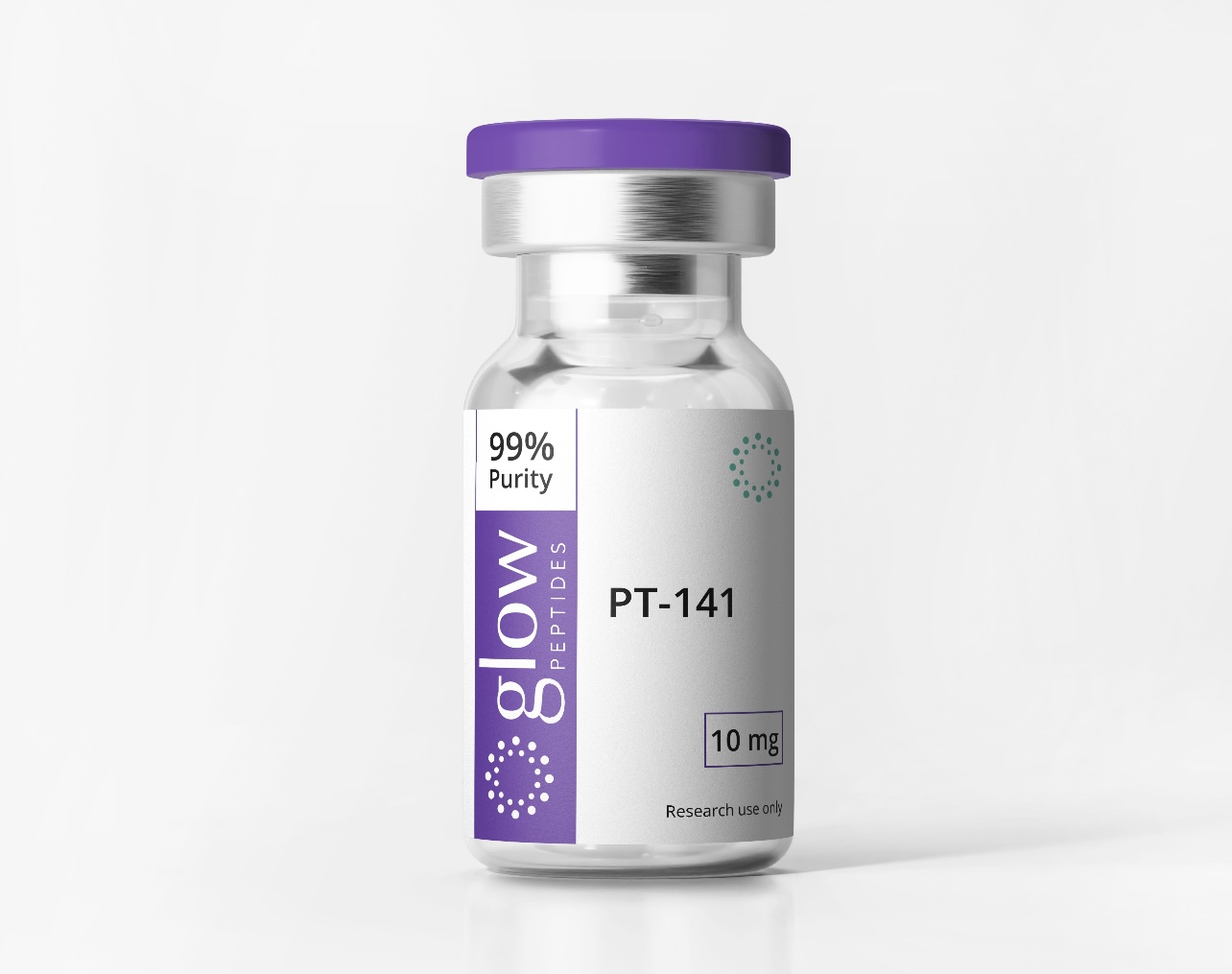
What Is PT-141? The Code That Became a Name
Glow Peptides Research Team · 2026-11-16
For research use only. Not for human or veterinary use, diagnostic use, or in any therapeutic application.
What is PT-141? It is the one name in this catalog that grew up in public. It started as a development code, became the nonproprietary name bremelanotide, and in 2019 became the active ingredient of an approved product. Three names, one molecule, all of it on the public record: a seven-residue peptide closed into a ring, with a mass of about 1,025.2, sitting about one mass unit away from another compound in this same catalog. This page traces the name from code to record, sets out the chemistry behind the PT-141 research vial, and explains what each of the three names can and cannot tell you about a vial in your hand.
The short version
- Three names, one molecule. PT-141 is the development code, bremelanotide is the nonproprietary name, and Vyleesi is the brand name of the approved product. PubChem holds the compound as CID 9941379: C50H68N14O10, mass about 1,025.2, CAS 189691-06-3.
- It is a ring, not a chain. Seven amino acid residues, six of them closed into a cycle by an internal bridge, with an acetyl cap and one mirror-image residue. The structure is written Ac-Nle-cyclo(Asp-His-D-Phe-Arg-Trp-Lys)-OH.
- Its closest relative is in this catalog. Melanotan II is about 1,024.2, roughly one mass unit lighter. The whole difference is the chemical ending: a free acid on bremelanotide, an amide on Melanotan II.
- An acetate record exists too, at about 1,085.2: the free peptide plus one acetic acid unit, the same arithmetic as other peptide acetates.
- The regulatory record is stated here as fact: application NDA 210557, approved 21 June 2019. What the approved product is for is outside the scope of this page.
- None of the three names identifies a vial. As everywhere in this catalog, the public record defines the molecule and the lot certificate describes the batch.
What is PT-141? Three names for one molecule
Most research peptide names are market labels with no registry behind them. PT-141 went the other way. The letters and digits are a development code, the kind of placeholder a compound carries while it is being studied.
The compound then received a nonproprietary name, bremelanotide, the standardized generic name that databases and regulators file it under. And in 2019 the name chain gained a third link: an approved product with bremelanotide as its active ingredient, marketed under the brand name Vyleesi.
That history is worth knowing because it decides where the facts live. Search a chemistry database for PT-141 and it resolves, because the code sits as a synonym on the bremelanotide record, and on the acetate record beside it.
PubChem holds the compound as CID 9941379: molecular formula C50H68N14O10, mass about 1,025.2, CAS registry number 189691-06-3. One of the record's own synonyms is "PT-141 FREE BASE", which quietly makes a point this page returns to below: the name on a label and the form of the material are two different questions.
| Name | What kind of name it is | What it tells you |
|---|---|---|
| PT-141 | A development code | The label the research market still uses. Resolves to the bremelanotide record as a synonym |
| Bremelanotide | The nonproprietary name | The name the public record files the molecule under: CID 9941379, CAS 189691-06-3 |
| Vyleesi | A brand name | The approved product containing bremelanotide, application NDA 210557, approved 21 June 2019. A brand names a product, never a research vial |
The practical reading order is the reverse of the fame order. The brand name belongs to one specific approved product and to nothing else.
The nonproprietary name is where the chemistry lives. The development code is the most searched and the least precise, because a code on a research label carries no registry of its own; it borrows its meaning from the record it points at.
Seven residues, six closed into a ring
Chain length has been the running measure across this catalog's articles, from three-residue tripeptides to a 46-residue synthetic chain. PT-141 breaks the ruler, because it is not a straight chain at all.
The record's structure names resolve to Ac-Nle-cyclo(Asp-His-D-Phe-Arg-Trp-Lys)-OH: seven residues in which the aspartate near the front and the lysine at the end are joined to each other through their side chains, closing six of the seven residues into a ring. The bond that closes the ring is a lactam, which is simply an amide bond used as a bridge rather than as a link in the chain.
| Position | Residue | Why it matters |
|---|---|---|
| 1 | Norleucine (Nle), acetyl-capped | A non-standard amino acid: it does not appear in natural proteins, which marks the molecule as a designed structure |
| 2 | Aspartate (Asp) | One anchor of the ring: its side chain bonds to the lysine side chain |
| 3 | Histidine (His) | |
| 4 | D-phenylalanine (D-Phe) | The one mirror-image residue, written with the D- prefix for the same reason some sequences are written in lowercase |
| 5 | Arginine (Arg) | |
| 6 | Tryptophan (Trp) | Gives the molecule a handle at 280 nanometers, one of the ultraviolet wavelengths detectors watch |
| 7 | Lysine (Lys), free acid end | The other anchor of the ring, and the ending that separates this molecule from its closest relative |
Two design features stand out even to a reader who never looks at structures. The norleucine at position 1 and the D-phenylalanine at position 4 are both things natural proteins do not contain, so their presence says, before any history is read, that this is a built molecule rather than a copied fragment. And the ring itself matters to identity work: a cyclic peptide of seven residues and a straight chain of seven residues can weigh almost the same, which is one more reason a mass figure is read together with the record it is checked against.
In the published literature the compound is studied as a melanocortin receptor agonist in laboratory models, which is the research context the supplier's own PT-141 reference guide states; agonist means a compound that binds and activates a receptor, here receptors of the melanocortin family. That is where this page leaves the subject.
One mass unit from Melanotan II
The closest relative is not an obscure database entry. It is the MT-II (Melanotan II) research vial, elsewhere in this same catalog. The two records read almost identically:
| Bremelanotide (PT-141) | Melanotan II | |
|---|---|---|
| PubChem record | CID 9941379 | CID 92432 |
| Formula | C50H68N14O10 | C50H69N15O9 |
| Mass | About 1,025.2 | About 1,024.2 |
| Chemical ending | Free acid | Amide |
| The ring | The same seven-residue cyclic design in both | |
Read the two formulas against each other and the entire difference is one nitrogen plus a hydrogen against one oxygen: the amide ending on Melanotan II carries the nitrogen and the hydrogen, the free acid ending on bremelanotide carries the oxygen. On the scale, that is a gap of about one mass unit, with the acid the heavier of the two: 1,025.2 against 1,024.2.
This catalog's KPV article makes the same point about acid and amide endings for a tripeptide. Here it is concrete, on two products a reader can put side by side.
Why a one-unit gap deserves respect
TB-500's naming fork is a factor of five and a half, visible from across the room. This one is the opposite: two different molecules, two different database records, two different regulatory histories, separated by about 0.1 percent of their mass.
A loosely rounded identity figure cannot tell them apart. On a document for either compound, the mass, or the spectrum peaks it is read from, needs to be checked against the record to the nearest unit, with the method stated beside it, before it distinguishes one catalog neighbor from the other.
There is also a salt layer, and it follows the same arithmetic as elsewhere in the catalog. PubChem carries bremelanotide acetate as its own record, CID 91971505: C52H72N14O12 at about 1,085.2.
The gap from the free peptide is 60.0, and acetic acid weighs 60.05, so the acetate is the free peptide plus one acetic acid unit. The "FREE BASE" synonym on the parent record and the separate acetate record are the public form of the question a lot document answers for a specific batch: which form of the material the figures describe.
The regulatory record, stated plainly
The public drug database carries one approved application for bremelanotide: NDA 210557, with original approval on 21 June 2019, the product marketed under the brand name Vyleesi, listed in an autoinjector presentation. Those are the facts this page states, and deliberately all of them. What the approved product is for, who uses it, and how, are questions about a medicine, and they sit outside what a research-use page covers.
What the record changes for a reader of research listings is the status of the name. For most compounds in this territory, "not approved anywhere" is the record, and any page implying otherwise is wrong. For this one, an approval exists, and the trap runs the other way: the existence of an approved product says nothing about any research vial.
The approval attaches to one specific product, from one manufacturing and documentation chain, under one brand name. A lyophilized research material sharing the molecule does not share the approval, and a listing that borrows the brand name's standing is making exactly the kind of claim the names in the table above are there to keep apart.
What this means when you read a certificate
The general discipline is the catalog's standard: a lot number matching the vial, the laboratory named, the method stated beside each figure, walked field by field in how to read a peptide certificate of analysis. Three points are specific to this molecule:
The identity mass should reconcile with about 1,025.2, read precisely. The nearest different molecule is one unit away, so the figure, or the spectrum peaks behind it, has to be read to the nearest unit with its method stated. A figure near 1,085 is describing the acetate rather than the free peptide, and the document's stated form should say so.
The name on the label is the loosest of the three identifiers. PT-141 on a vial borrows its meaning from the bremelanotide record. The CAS number, 189691-06-3, and the formula are what reconcile a document to the molecule; the code reconciles to nothing by itself.
The ring does not change the paperwork, but it does change the reading. A cyclic structure means there is no simple letter-sequence to print, so documents for this compound lean harder on formula, mass and method than on sequence-style identity lines. That is normal for a cyclic peptide and not a gap.
Published lot records for this catalog sit in the lot document directory, each linking its certificate. In this catalog the lyophilized, or freeze-dried, vial is listed as PT-141 · Bremelanotide with the record's own formula and mass printed on the product page, and the purity figure stated as a catalog specification rather than a measured lot result; the certificate for a given lot is where that lot's own figures are reported. The compound's naming family is covered from the other direction in Melanotan 1 versus Melanotan 2, which is where the melanocortin names are told apart.
The pattern across the catalog
Every compound here answers to a public record for the definition and a lot certificate for the vial. PT-141 adds a third document to the shelf, an approved product's record, and the discipline is knowing that it describes that product and nothing else.
What this page deliberately does not cover
Most of what ranks for this question is built on material that falls outside the scope of a research-use page, and none of it is written here. Saying so plainly is more useful than leaving the gap unexplained.
Glow Peptides supplies cataloged materials for laboratory research only. The materials are not drugs, supplements, cosmetics or medical devices, and they are not intended for human or veterinary use.
This page gives no dosing, administration, reconstitution, duration, combination or protocol guidance, states no expected outcomes and makes no claim about what these materials do; those questions are outside what a supplier of research materials should answer, and that includes every question about the approved product beyond the record fields quoted above. What is in scope, and what this page covers, is composition, strength, purity, analytical methods, handling, storage and documentation.
Frequently asked questions
Why do research labels say PT-141 instead of bremelanotide?
Habit, mostly. The research market adopted the development code early, and codes stick to labels long after the compound outgrows them. The code still resolves, because PT-141 sits as a synonym on the bremelanotide record, CID 9941379. The code works as a pointer; the record is where the chemistry lives.
What does FREE BASE mean on a peptide record?
It names the bare peptide with no salt partner attached. A lyophilized peptide is often handled as a salt, meaning the peptide travels with a small partner molecule, and the record system keeps the two forms separate, each with its own database entry and its own expected mass. Which form a specific vial holds, and which expected mass therefore applies, is stated on that lot's certificate.
What is norleucine, the first residue in the chain?
An amino acid that natural proteins do not contain. It shares its formula and mass with leucine, C6H13NO2 at about 131.17, but the side chain is built straight instead of branched, which makes the two different molecules with identical weights.
Is PT-141 the same as Melanotan I?
No, and the gap is not subtle. Melanotan I, held on PubChem as afamelanotide, CID 16197727, is C78H111N21O19 at about 1,646.8, a straight-chain peptide over 600 mass units heavier. PT-141's close relative is Melanotan II, the cyclic compound about one mass unit away. The three names sound like a series, but they are three different molecules with three different records, which is why the family is told apart name by name in this catalog's Melanotan article.
How is the lyophilized material stored?
The supplier's reference guide states the general practice for research materials of this type: keep the sealed vial cold and away from light, with long-term storage typically in a freezer, and keep the vial sealed until the material is needed for analysis. It also advises recording the lot number and its certificate for your records, which is the same habit every article in this catalog ends up recommending, since the lot number is the string that connects a vial to its paperwork.
Sources
- PubChem, National Library of Medicine, National Institutes of Health. Records read 21 October 2026: bremelanotide CID 9941379, with its formula, mass, CAS number 189691-06-3, the structure names giving Ac-Nle-cyclo(Asp-His-D-Phe-Arg-Trp-Lys)-OH with the (2->7) lactam bridge, and the synonyms PT-141, PT 141 and PT-141 FREE BASE; bremelanotide acetate CID 91971505, formula and mass from the record; melanotan-II CID 92432, formula and mass from the record; afamelanotide (Melanotan I) CID 16197727, formula and mass from the record; L-norleucine CID 21236 (a record titled Caprine) and L-leucine CID 6106, whose records carry the same formula and mass, C6H13NO2 at about 131.17.
- The United States public drug approval database, queried 21 October 2026 for bremelanotide: application NDA 210557, original approval dated 21 June 2019, brand name Vyleesi, autoinjector solution presentation. No statement about the product beyond those record fields is made on this page.
- The one-unit acid-versus-amide gap (1,025.2 against 1,024.2) and the 60.0 acetate gap against acetic acid at 60.05 were computed from the PubChem records named above.
- Glow Peptides live product page and reference guide for PT-141, read 21 October 2026, for the listing PT-141 · Bremelanotide, the formula and mass as printed (which match the public record), the catalog purity specification wording, and the description of the material as a cyclic melanocortin heptapeptide. The identity of any specific lot is a matter for that lot's certificate.
For research use only. Not for human or veterinary use, diagnostic use, or any therapeutic application.