Glow Peptides · Research Journal
Melanotan 1 vs 2: Two Names, Two Different Molecules
Glow Peptides Research Team · 2026-09-24
For research use only. Not for human or veterinary use, diagnostic use, or in any therapeutic application.
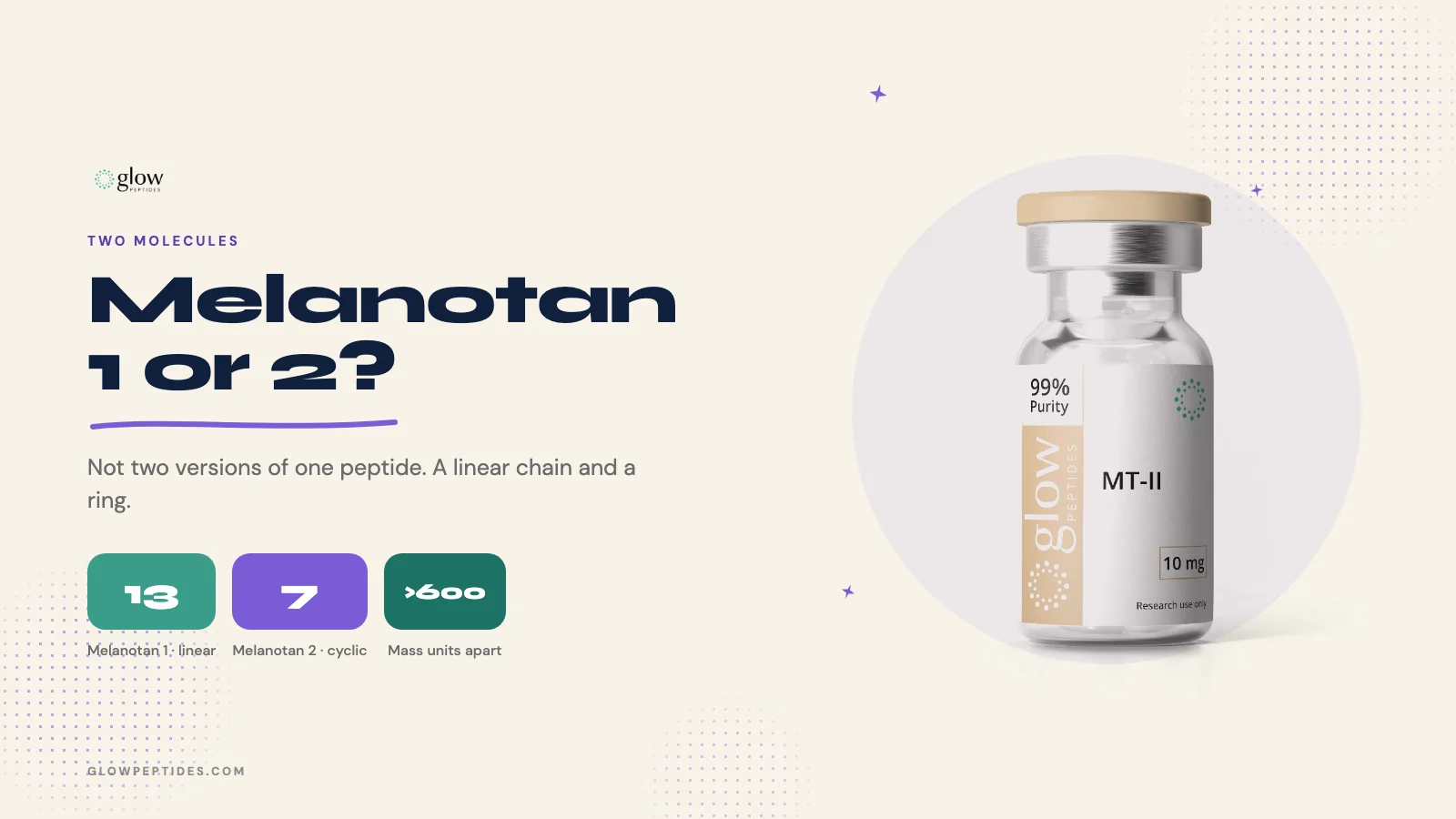
Melanotan I and Melanotan II are two structurally different molecules, not two versions of one: a thirteen-residue linear peptide and a seven-residue ring, more than six hundred mass units apart. The numbers in the names suggest a first and second version of one thing, and they are not. The naming is also less settled than it looks, because "Melanotan I" resolves in a chemical database to an entirely different name. This page sets out which name maps to which molecule, and what is actually in a vial of research-grade Melanotan II: the sequence, the ring, the formula, the mass, and the two specification points its structure creates.
Which name maps to which molecule
Query PubChem for Melanotan II and you are returned compound record CID 92432, molecular formula C50H69N15O9, molecular weight about 1,024.2.
Query it for Melanotan I and you are returned CID 16197727, whose canonical title is not Melanotan I at all. It is afamelanotide, molecular formula C78H111N21O19, molecular weight about 1,646.8. Melanotan I is carried as a synonym on that record.
So the first thing to establish is that these are two separate database records for two separate molecules, and that one of the two is better known under a different name entirely.
The short version
- Not two versions of one compound. Different length, different shape, different mass.
- Melanotan I resolves to afamelanotide, PubChem CID 16197727. Thirteen residues, linear. C78H111N21O19, about 1,646.8.
- Melanotan II, PubChem CID 92432. Seven residues, cyclic. C50H69N15O9, about 1,024.2.
- Both are built around the His-Phe-Arg-Trp core of alpha-MSH, a thirteen-residue peptide, CID 16133793, about 1,664.9.
- Melanotan I differs from alpha-MSH at two positions, but only one of them is visible in the molecular formula. The other is a stereochemical change and is mass-identical.
- Melanotan II and PT-141 differ by 0.98 mass units, one C-terminal group. Same seven residues, same ring.
- Both contain tryptophan, so unlike most short research peptides both do absorb at 280 nanometers.
Melanotan I: thirteen residues, linear, and two substitutions from alpha-MSH
Alpha-melanocyte-stimulating hormone, alpha-MSH, is a thirteen-residue peptide with an acetylated N-terminus and an amidated C-terminus. PubChem holds it as CID 16133793, formula C77H109N21O19S, about 1,664.9. Its sequence is Ac-Ser-Tyr-Ser-Met-Glu-His-Phe-Arg-Trp-Gly-Lys-Pro-Val-NH2.
Melanotan I keeps all thirteen positions and changes two of them:
Position 4, methionine to norleucine. Methionine's side chain contains a sulfur; norleucine's is the same length with a CH2 where that sulfur sat. This is visible in the formulas. Alpha-MSH carries an S and Melanotan I does not, and the change from S to CH2 accounts for the mass difference exactly: 1,664.9 less about 18 gives 1,646.8.
Position 7, L-phenylalanine to D-phenylalanine. This is a stereochemical change. The same atoms are present in the same connectivity, arranged as a mirror image around one carbon.
One of those two changes cannot be weighed
D-phenylalanine and L-phenylalanine have identical molecular formulas and identical molecular weights. They are stereoisomers, so a mass measurement cannot tell them apart. The consequence for a specification is concrete: mass spectrometry can confirm the norleucine substitution at position 4, because that one changes the formula, but it cannot confirm the D-phenylalanine at position 7. A peptide with L-phenylalanine at that position would give the same mass, to any precision.
Confirming stereochemistry requires a separation that resolves the two, such as chromatography on a chiral phase or a comparison against a known reference standard. It is the same class of limitation as the isoaspartate problem on other peptides: two species that differ structurally but not in composition can be separated but never weighed apart.
One consequence of the norleucine substitution is worth stating on its own. Removing the methionine removes the sulfur, and with it the whole methionine oxidation failure mode. Alpha-MSH can pick up sixteen mass units at position 4 through sulfoxide formation. Melanotan I has no sulfur anywhere in its formula and cannot.
Melanotan II: seven residues, and a ring
Melanotan II is not a shortened Melanotan I. It is a different construction: a cyclic heptapeptide. Its structure is written Ac-Nle-cyclo[Asp-His-D-Phe-Arg-Trp-Lys]-NH2.
Reading that from the outside in: the N-terminus is acetylated. The first residue, norleucine, sits outside the ring. The next six residues form a closed loop, because the side-chain carboxyl of the aspartate is joined to the side-chain amine of the lysine, forming what is called a lactam bridge. The C-terminus is amidated.
One thing the ring does contain is the His-D-Phe-Arg-Trp run, which is the same four-residue stretch that sits at positions 6 to 9 of Melanotan I and, as His-Phe-Arg-Trp, at positions 6 to 9 of alpha-MSH. That shared core is the one sequence feature the two Melanotan compounds genuinely have in common, and it is visible directly in the structures rather than inferred. The aspartate and lysine flanking it in Melanotan II have no counterpart at those positions in the thirteen-residue peptides; they are there to close the ring.
Two further structural points follow.
The ring is closed by a covalent amide bond, not a disulfide. This matters because the two are often conflated. A disulfide ring can be opened by reduction and can scramble between cysteines. A lactam bridge cannot; opening it requires hydrolyzing an amide bond, the same kind of bond that holds the backbone together. Melanotan II contains no cysteine at all, so disulfide chemistry does not apply to it in any form.
The linear version of the same residues weighs 18 more. Closing a ring by forming an amide bond releases one molecule of water. So a lot carrying uncyclized material, the same seven residues left open, would show a mass about eighteen units above the parent. That is a specific, checkable figure on an identity report, and it is the impurity the cyclization step can leave behind.
Melanotan II and PT-141 differ by one atom swap
This is worth knowing because both compounds exist in the same catalog and because the difference is unusually small.
PT-141, also called bremelanotide, is PubChem CID 9941379, formula C50H68N14O10, about 1,025.2. Melanotan II is C50H69N15O9, about 1,024.2.
Compare the two formulas atom by atom and the entire difference is one fewer nitrogen, one fewer hydrogen, one more oxygen. That is precisely the conversion of a C-terminal amide into a C-terminal free acid: an NH2 becomes an OH. Same carbon count, same seven residues, same lactam ring, same acetyl cap. The only change is the group at the end.
| Compound | Residues | Shape | Formula | Molecular weight |
|---|---|---|---|---|
| Alpha-MSH | 13 | Linear | C77H109N21O19S | About 1,664.9 |
| Melanotan I (afamelanotide) | 13 | Linear | C78H111N21O19 | About 1,646.8 |
| Melanotan II | 7 | Cyclic, lactam | C50H69N15O9 | About 1,024.2 |
| PT-141 (bremelanotide) | 7 | Cyclic, lactam | C50H68N14O10 | About 1,025.2 |
The practical reading of that table: a mass near 1,024 and a mass near 1,025 are two different compounds, one unit apart. On an instrument reporting to a whole number with no decimal, that gap is uncomfortably narrow, which is a good argument for reading the decimal places on an identity line rather than the rounded figure.
What these compositions change analytically
Both compounds do absorb at 280 nanometers, which is unusual in this catalog. Absorbance at that wavelength comes from tryptophan and tyrosine. Melanotan II contains a tryptophan inside its ring. Melanotan I contains a tryptophan at position 9 and a tyrosine at position 2. So both have a genuine second detection wavelength available alongside the backbone absorbance near 214 nanometers, and agreement between the two readings is a stronger result than either alone. Most of the short peptides in a research catalog have no aromatic residue at all and cannot do this.
Tryptophan is the residue to watch for oxidation here. With the methionine replaced by norleucine in both compounds, there is no sulfur to form a sulfoxide. Tryptophan's indole ring is the remaining oxidation-sensitive group, and its oxidation products add sixteen or thirty-two mass units.
Both run net basic, by about one charge. The accounting on Melanotan II is worth setting out, because the lactam bridge consumes two side chains at once. The aspartate's carboxyl and the lysine's amine are both used to form the ring, so neither contributes a charge. Both termini are capped, the acetyl at one end and the amide at the other. The histidine is only weakly basic and is largely uncharged at neutral pH. That leaves the arginine as the one clearly ionized group in the molecule. Melanotan I arrives at a similar place by a different route: an arginine at 8 and a free lysine at 11 against a glutamate at 5. A basic peptide is normally supplied as a salt, and the counterion contributes mass that is not peptide, which is why net peptide content is a separate figure from purity on a certificate. That distinction is unpacked in what a purity percentage means and what it misses, and the techniques themselves in how HPLC and mass spectrometry verify peptide purity.
Specification summary
| Property | Melanotan II | Melanotan I |
|---|---|---|
| Database title | Melanotan II | Afamelanotide |
| PubChem CID | 92432 | 16197727 |
| Residue count | 7 | 13 |
| Topology | Cyclic, via an Asp to Lys lactam bridge | Linear |
| Structure | Ac-Nle-cyclo[Asp-His-D-Phe-Arg-Trp-Lys]-NH2 | Ac-Ser-Tyr-Ser-Nle-Glu-His-D-Phe-Arg-Trp-Gly-Lys-Pro-Val-NH2 |
| Molecular formula | C50H69N15O9 | C78H111N21O19 |
| Molecular weight | About 1,024.2 | About 1,646.8 |
| N-terminus | Acetylated | Acetylated |
| C-terminus | Amide | Amide |
| Sulfur in formula | None | None |
| Cysteines, disulfides | None. The ring is a lactam, not a disulfide | None |
| D-amino acid | D-Phe in the ring. Mass-identical to L-Phe | D-Phe at position 7. Mass-identical to L-Phe |
| Tryptophan or tyrosine | Trp in the ring | Tyr 2 and Trp 9 |
| 280 nm absorbance | Yes | Yes |
| Related mass to watch | About 1,042, the uncyclized form, plus 18 | Tryptophan oxidation, plus 16 or 32 |
| Nearest neighbor by mass | PT-141 at about 1,025.2, one C-terminal group away | Alpha-MSH at about 1,664.9, one S to CH2 swap away |
| In this catalog | Lyophilized vial; current specification on the product page | Not stocked. Described here for identification only |
Reading a certificate for a Melanotan II lot
The general discipline is unchanged: a lot number that matches the vial in front of you, the issuing laboratory named rather than described, the analytical method stated alongside the purity figure, a report date belonging to that batch, and an accession number that lets the report be looked up at the laboratory rather than confirmed by the seller. The field-by-field walkthrough is in how to read a peptide certificate of analysis.
Three fields carry extra weight on this compound.
The decimal places on the identity mass. PT-141 sits one mass unit away at about 1,025.2. A report giving a whole number with no decimal leaves less margin than usual between two compounds that both exist in the same catalog.
Any mass about eighteen units high. A figure near 1,042 is the uncyclized form, the same seven residues with the ring left open. That is the specific residual the cyclization step can leave, and it is identifiable from the mass alone.
What the report does and does not establish about the D-phenylalanine. A mass measurement cannot confirm it, because L-phenylalanine at that position gives an identical mass. If stereochemical identity matters for a given use, the document has to show a method capable of resolving it rather than a mass alone.
Published lot records for this catalog are listed on the quality page, each with its own certificate. Lot document availability varies by compound and by batch, so check the specific lot rather than assuming coverage.
What this page deliberately does not cover
Most pages returned for this comparison move quickly to what each compound may do, which of the two may suit a given purpose, what results to expect, how much to take and how to take it. Those subjects are absent here on purpose, and saying so is more useful than leaving the gap unexplained.
Glow Peptides supplies cataloged materials for laboratory research only. Nothing here is a drug, a supplement, a cosmetic or a medical device, and nothing here is intended for human or veterinary use. Dosing, administration, reconstitution, expected outcomes, comparison of effects and protocol questions are outside what a supplier of research materials should answer. What is in scope, and what this page covers, is composition, structure, strength, purity, analytical method, handling and documentation.
Frequently asked questions
What is the difference between Melanotan I and Melanotan II?
They are two structurally different molecules, not two versions of one. Melanotan I is a thirteen-residue linear peptide with molecular formula C78H111N21O19 and a molecular weight of about 1,646.8. Melanotan II is a seven-residue cyclic peptide with molecular formula C50H69N15O9 and a molecular weight of about 1,024.2. They differ by more than six hundred mass units, by six residues, and by topology, since Melanotan II is closed into a ring and Melanotan I is not. The numbering in the names does not indicate a sequence of versions.
Is Melanotan I the same as afamelanotide?
Yes. PubChem holds one record for the compound, CID 16197727, whose canonical title is afamelanotide and which carries Melanotan I as a synonym. Its molecular formula is C78H111N21O19 and its molecular weight is about 1,646.8. A search for either name returns that same record. This is the same pattern seen with other research peptides that acquired a development code name and a formal name separately.
What is the structure of Melanotan II?
A cyclic heptapeptide, written Ac-Nle-cyclo[Asp-His-D-Phe-Arg-Trp-Lys]-NH2. The N-terminus is acetylated, the first residue norleucine sits outside the ring, and the following six residues form a closed loop because the aspartate side-chain carboxyl is bonded to the lysine side-chain amine. That linkage is a lactam bridge, an amide bond, not a disulfide. The C-terminus is amidated. There is no cysteine anywhere in the molecule, so disulfide chemistry does not apply to it.
How does Melanotan I differ from alpha-MSH?
At two positions out of thirteen. Position 4 changes from methionine to norleucine, which replaces a sulfur with a CH2 group. That change is visible in the molecular formula: alpha-MSH is C77H109N21O19S at about 1,664.9 and Melanotan I is C78H111N21O19 at about 1,646.8, a difference of about 18 accounted for entirely by that swap. Position 7 changes from L-phenylalanine to D-phenylalanine, a stereochemical change that does not alter the formula or the mass at all.
Can mass spectrometry confirm the D-phenylalanine in these compounds?
No. D-phenylalanine and L-phenylalanine are stereoisomers: identical molecular formula, identical molecular weight, differing only in the three-dimensional arrangement around one carbon. A peptide carrying L-phenylalanine at that position would give exactly the same mass, to any precision. Mass spectrometry can confirm the norleucine substitution, because that one changes the formula, but stereochemistry requires a separation capable of resolving the two forms, such as chiral chromatography or comparison against a known reference standard.
How close in mass are Melanotan II and PT-141?
About one unit apart. Melanotan II is C50H69N15O9 at about 1,024.2 and PT-141, also called bremelanotide, is C50H68N14O10 at about 1,025.2. Comparing the formulas, the whole difference is one fewer nitrogen, one fewer hydrogen and one more oxygen, which is exactly the conversion of a C-terminal amide into a C-terminal free acid. Same residue count, same lactam ring, same acetyl cap. Because the gap is so small, the decimal places on an identity mass matter more than usual.
Can Melanotan II be detected at 280 nanometers?
Yes, which makes it unusual among short research peptides. Absorbance at 280 nanometers comes from tryptophan and tyrosine, and Melanotan II contains a tryptophan inside its ring. That gives a genuine second detection wavelength alongside the backbone absorbance near 214 nanometers, and agreement between the two is a stronger result than either alone. Melanotan I contains both a tryptophan and a tyrosine and also absorbs there. Tryptophan is also the residue most likely to oxidize in these molecules, since neither contains any sulfur.
Why does this page not compare what Melanotan I and Melanotan II do?
Because Glow Peptides supplies cataloged materials for laboratory research only. The products are not drugs, supplements, cosmetics or medical devices, and they are not intended for human or veterinary use. Comparing effects or expected outcomes, and giving dosing, administration, reconstitution or protocol guidance, are outside what a research materials supplier should provide, so they are deliberately absent rather than accidentally missing. What is covered here is composition, structure, strength, purity, analytical method, handling and documentation.
Sources
- PubChem, National Library of Medicine. Melanotan II, CID 92432. Read 22 September 2026.
- PubChem, National Library of Medicine. Afamelanotide, CID 16197727, carrying Melanotan I as a synonym. Read 22 September 2026.
- PubChem, National Library of Medicine. Alpha-MSH, CID 16133793. Read 22 September 2026.
- PubChem, National Library of Medicine. Bremelanotide, CID 9941379, carrying PT-141 as a synonym. Read 22 September 2026.
- All mass differences quoted in this page were computed directly from the database molecular formulas: the S to CH2 swap between alpha-MSH and Melanotan I, the amide to free acid difference between Melanotan II and PT-141, and the loss of water on ring closure.
For research use only. Not for human or veterinary use, diagnostic use, or any therapeutic application.