Glow Peptides · Research Journal
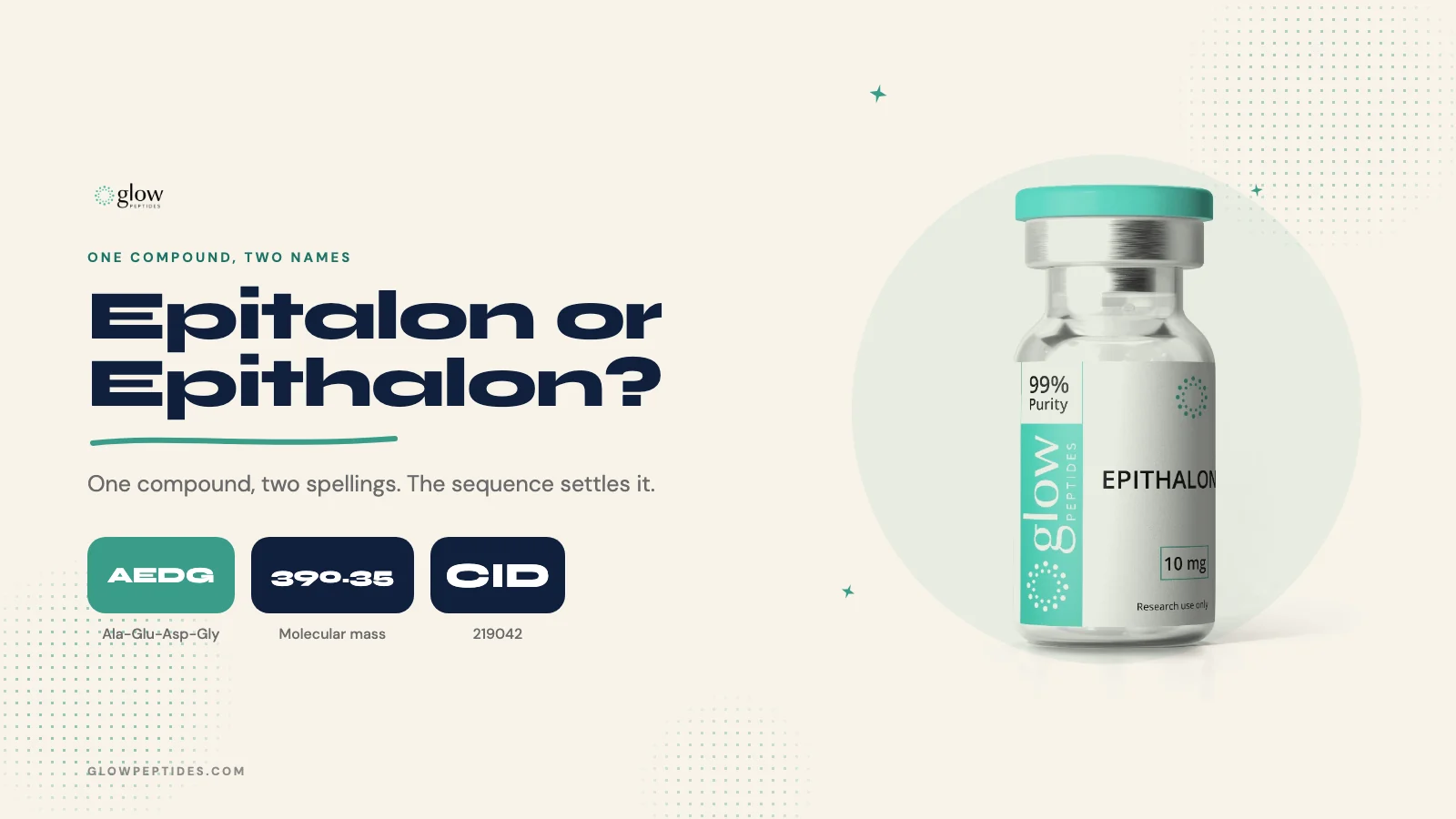
Epitalon Peptide or Epithalon: One Compound, Two Names
Glow Peptides Research Team · 2026-09-24
For research use only. Not for human or veterinary use, diagnostic use, or in any therapeutic application.
Epitalon is a four-residue research peptide, Ala-Glu-Asp-Gly, and Epithalon is the same compound under a second spelling. A third spelling, Epithalone, is in circulation as well. Search for any of them in a chemical database and the same record comes back. This page sets out what is actually in a vial of research-grade Epitalon peptide: which spellings resolve to which record, the sequence, the formula, the mass, and the specific things its composition changes about how a lot is separated and detected.
One compound, three spellings
Query PubChem for epithalon and you are returned compound record CID 219042. Query it for epitalon and you are returned the same record, CID 219042. That record's canonical title is Epitalon, and its synonym list carries Epithalon and Epithalone alongside it.
That is the whole answer to the spelling question, and it is worth stating plainly because most pages returned for this query either treat the spelling as an open matter or never raise it. There is no chemical difference between a vial labeled Epitalon and a vial labeled Epithalon. There is no different sequence, no different mass, no different purity standard. The variation is transliteration, not chemistry.
The short version
- Epitalon, Epithalon and Epithalone are one compound. All three resolve to PubChem CID 219042.
- Four residues. Ala-Glu-Asp-Gly, written AEDG.
- Molecular formula C14H22N4O9, molecular weight about 390.35.
- No cysteine, no methionine. No disulfide bond is possible and there is no sulfur to oxidize.
- No aromatic residues at all, so it does not absorb at 280 nanometers. Detection has to be done on the backbone, near 214 nanometers.
- Two of its four residues are acidic. The molecule is strongly negatively charged at neutral pH, which changes the separation method.
Why there are three spellings
The compound was first described in Russian-language literature, and the name entered English through transliteration rather than through a naming committee. Cyrillic transliteration is not one-to-one, so a single source name produces more than one defensible English spelling, and all of them then persist in parallel because each has been used in print.
The practical consequence is a database and catalog problem rather than a scientific one. A supplier who lists the vial under one spelling and the capsules under another has not made an error; both labels point at the same material. This catalog does exactly that, with the lyophilized vial listed as Epithalon and the encapsulated format as Epitalon capsules.
One name that is not a fourth spelling is worth separating out. Epithalamin, sometimes written Epithalamine, also appears on the same database record's synonym list, but it refers to a pineal extract preparation rather than to the four-residue peptide. A name being listed as a synonym is not the same as it describing the same defined molecule, and this is the one entry on that list to treat with care.
The sequence
Epitalon is a tetrapeptide: four amino acid residues, joined by three peptide bonds, with a free amine at one end and a free carboxyl at the other.
| Position | Residue | Code | Side chain character |
|---|---|---|---|
| 1 | Alanine | A | Small, neutral, nonpolar |
| 2 | Glutamic acid | E | Acidic, negatively charged at neutral pH |
| 3 | Aspartic acid | D | Acidic, negatively charged at neutral pH |
| 4 | Glycine | G | Smallest residue, no side chain |
Written in single-letter code the sequence is AEDG. Written in full it is Ala-Glu-Asp-Gly. The molecular formula computed from that sequence is C14H22N4O9 and the molecular weight is approximately 390.35, which agrees with the figure PubChem holds.
How small 390 actually is
A molecular weight under four hundred puts this compound in unusual company for a research peptide catalog. For scale, using figures from the same database:
| Compound | Residues | Molecular weight |
|---|---|---|
| Epitalon | 4 | About 390.35 |
| Glutathione | 3 | About 307.33 |
| Semax | 7 | About 813.9 |
| TB-500 | 7 | About 889.0 |
| BPC-157 | 15 | About 1,419.5 |
| MOTS-c | 16 | About 2,174.6 |
That size is not a curiosity, it changes the analysis. Small, highly polar molecules are the hardest class to hold onto on a standard reversed-phase column, and they are the easiest to lose in the void volume at the front of a chromatogram. A method that separates a fifteen-residue peptide cleanly will not necessarily resolve this one from its own related substances.
What the composition changes analytically
There is no 280 nanometer handle. Ultraviolet detection at 280 nanometers relies on aromatic side chains, and only tryptophan and tyrosine absorb meaningfully there. Epitalon has neither. It has no phenylalanine, no histidine, no aromatic ring anywhere in the molecule. So the only ultraviolet detection available is the peptide bond itself, which absorbs near 214 to 220 nanometers. That single wavelength has to carry the whole measurement, and it is a far less selective wavelength than 280, because almost everything absorbs there, including many buffer components and solvents. This removes an option that is available on compounds like MOTS-c and it is the single most consequential fact about analyzing this peptide.
No disulfide, no oxidation. There is no cysteine, so no disulfide bond can form and disulfide scrambling is not a possible failure mode. There is no methionine, so there is no sulfur to oxidize to a sulfoxide. The molecular formula contains no sulfur at all. Compared with the compounds in this catalog that do carry cysteine or methionine, two whole categories of degradation are simply absent here.
The charge is strongly negative, and that dictates the method. Two of the four residues, glutamic acid and aspartic acid, carry side-chain carboxyl groups that are deprotonated and negatively charged at neutral pH. Add the free C-terminal carboxyl on the glycine and the molecule carries three negative charges against a single positive one on the N-terminal amine. This is close to the opposite situation from a basic peptide like MOTS-c, and it means retention on a reversed-phase column depends heavily on the mobile phase being acidic enough to suppress those charges. In mass spectrometry it also favors negative-ion detection, whereas most peptide work is done in positive-ion mode.
The Asp-Gly problem, and why mass spectrometry cannot see it
Aspartic acid followed immediately by glycine is the most labile aspartate motif in peptide chemistry. The aspartate can cyclize to a succinimide intermediate and reopen as isoaspartate, where the backbone runs through the side-chain carboxyl instead of the alpha carboxyl. Epitalon has that exact motif at positions 3 and 4. The critical point for anyone reading a certificate is that isoaspartate has the same molecular formula and the same molecular weight as aspartate. It is a rearrangement, not an addition or a loss. A mass spectrometry identity line showing 390 cannot distinguish the two, because both are 390. Only a chromatographic separation can, and only if the method was developed to resolve them.
That last point is the same class of limitation that appears with stereochemistry: two species that differ in structure but not in formula are invisible to a mass measurement and can only be separated, never weighed apart. It is a good reason to read the chromatogram on a certificate rather than only the identity mass. What a purity figure does and does not capture is unpacked in what a purity percentage means and what it misses, and the two techniques themselves in how HPLC and mass spectrometry verify peptide purity.
Specification summary
| Property | Value |
|---|---|
| Accepted spellings | Epitalon, Epithalon, Epithalone |
| PubChem CID | 219042 (all three spellings resolve here) |
| Canonical database title | Epitalon |
| Residue count | 4 |
| Sequence | Ala-Glu-Asp-Gly |
| Single-letter code | AEDG |
| Molecular formula | C14H22N4O9 |
| Molecular weight | About 390.35 |
| Cysteines, disulfides | None. No disulfide possible |
| Methionines | None. No sulfur in the molecule |
| Aromatic residues | None. Does not absorb at 280 nm |
| Detection wavelength | Backbone only, near 214 to 220 nm |
| Acidic residues | Glu 2, Asp 3. Strongly negative at neutral pH |
| Labile motif | Asp-Gly at positions 3 to 4. Isoaspartate is mass-identical |
| Expected mass on an MS identity line | About 390 |
| In this catalog | Lyophilized vial and capsules; current specification on the product pages |
Reading a certificate for an Epitalon lot
The general discipline does not change by compound: a lot number that matches the vial in front of you, the issuing laboratory named rather than described, the analytical method stated alongside the purity figure, a report date belonging to that batch, and an accession number that lets the report be looked up at the laboratory rather than confirmed by the seller. The field-by-field walkthrough is in how to read a peptide certificate of analysis.
Three fields carry extra weight on this particular compound.
The detection wavelength. Because there is no 280 nanometer option, the wavelength on the chromatogram should read somewhere in the 214 to 220 nanometer range. A certificate reporting 280 nanometer detection for a peptide with no aromatic residues is describing a measurement that cannot work as stated.
The chromatogram, not just the identity mass. Isoaspartate weighs the same as aspartate, so the mass measurement cannot rule it out. The separation is the only place a related substance of that kind would appear.
Net peptide content against purity. A strongly acidic peptide is normally supplied as a salt, typically with a counterion that contributes mass which is not peptide. Purity and net peptide content are two different figures and they can diverge more than expected on a molecule this small, because the counterion is a larger fraction of a 390 dalton molecule than of a 2,000 dalton one.
Published lot records for this catalog are listed on the quality page, each with its own certificate. Lot document availability varies by compound and by batch, so check the specific lot rather than assuming coverage.
What this page deliberately does not cover
Most pages returned for this query move quickly to what the compound may do, what it may support, how much to take and how to take it. Those subjects are absent here on purpose, and saying so is more useful than leaving the gap unexplained.
Glow Peptides supplies cataloged materials for laboratory research only. Nothing here is a drug, a supplement, a cosmetic or a medical device, and nothing here is intended for human or veterinary use. Dosing, administration, reconstitution and protocol questions are outside what a supplier of research materials should answer. What is in scope, and what this page covers, is composition, structure, strength, purity, analytical method, handling and documentation.
Frequently asked questions
Is Epitalon the same as Epithalon?
Yes. They are two spellings of one compound. Both resolve to PubChem compound record CID 219042, whose canonical title is Epitalon and whose synonym list includes Epithalon and a third spelling, Epithalone. There is no difference in sequence, molecular formula, molecular weight or specification between a vial labeled one way and a vial labeled the other. The variation comes from transliteration out of the original Russian-language literature rather than from any chemical distinction.
What is the sequence of Epitalon?
Ala-Glu-Asp-Gly, written AEDG in single-letter code. It is a tetrapeptide, meaning four amino acid residues joined by three peptide bonds, with a free amine at the N-terminus and a free carboxyl at the C-terminus. Its molecular formula is C14H22N4O9 and its molecular weight is about 390.35, a figure that agrees between the PubChem record and an independent recalculation from the sequence.
Why can Epitalon not be detected at 280 nanometers?
Because absorbance at 280 nanometers comes from aromatic side chains, and in practice only tryptophan and tyrosine absorb meaningfully at that wavelength. Epitalon contains neither, and it has no aromatic ring of any kind. That leaves only the peptide backbone, which absorbs near 214 to 220 nanometers, as a detection option. That wavelength is much less selective than 280 because many solvents and buffer components absorb there too, so the chromatographic separation has to do more of the work.
Does Epitalon contain a disulfide bond?
No. There is no cysteine in the sequence, so no disulfide bond is possible. There is also no methionine, so there is no sulfur anywhere in the molecule and the molecular formula contains none. Both sulfur-related failure modes that matter on other peptides, disulfide scrambling and methionine oxidation to the sulfoxide, are absent here. The degradation route that does matter is different: aspartate at position 3 is followed by glycine at position 4, which is the most labile aspartate motif in peptide chemistry, and it can rearrange to isoaspartate.
Can mass spectrometry confirm Epitalon has not rearranged?
Not on its own. Isoaspartate, the product of the Asp-Gly rearrangement, has exactly the same molecular formula and the same molecular weight as aspartate, because the change is in which carboxyl group carries the backbone rather than in the atoms present. Both species read as about 390. Only a chromatographic separation can distinguish them, and only if the method was developed to resolve that pair. This is why the chromatogram on a certificate carries information the identity mass cannot.
Why does this page not cover what Epitalon does, or dosing?
Because Glow Peptides supplies cataloged materials for laboratory research only. The products are not drugs, supplements, cosmetics or medical devices, and they are not intended for human or veterinary use. Dosing, administration, reconstitution and protocol guidance are outside what a research materials supplier should provide, so they are deliberately absent rather than accidentally missing. What is covered here is composition, structure, strength, purity, analytical method, handling and documentation.
Sources
- PubChem, National Library of Medicine. Epitalon, CID 219042, including the synonym list carrying Epithalon and Epithalone. Read 22 September 2026.
- Molecular formula and molecular weight independently recomputed from the AEDG sequence using standard average residue masses, with water added for the chain termini. The recomputed figure agrees with the database value.
- PubChem, National Library of Medicine, for the comparison compounds in this page: glutathione CID 124886, Semax CID 9811102, TB-500 CID 62707662, BPC-157 CID 9941957, MOTS-c computed from UniProt A0A0C5B5G6. Read 22 September 2026.
For research use only. Not for human or veterinary use, diagnostic use, or any therapeutic application.