Glow Peptides · Research Journal
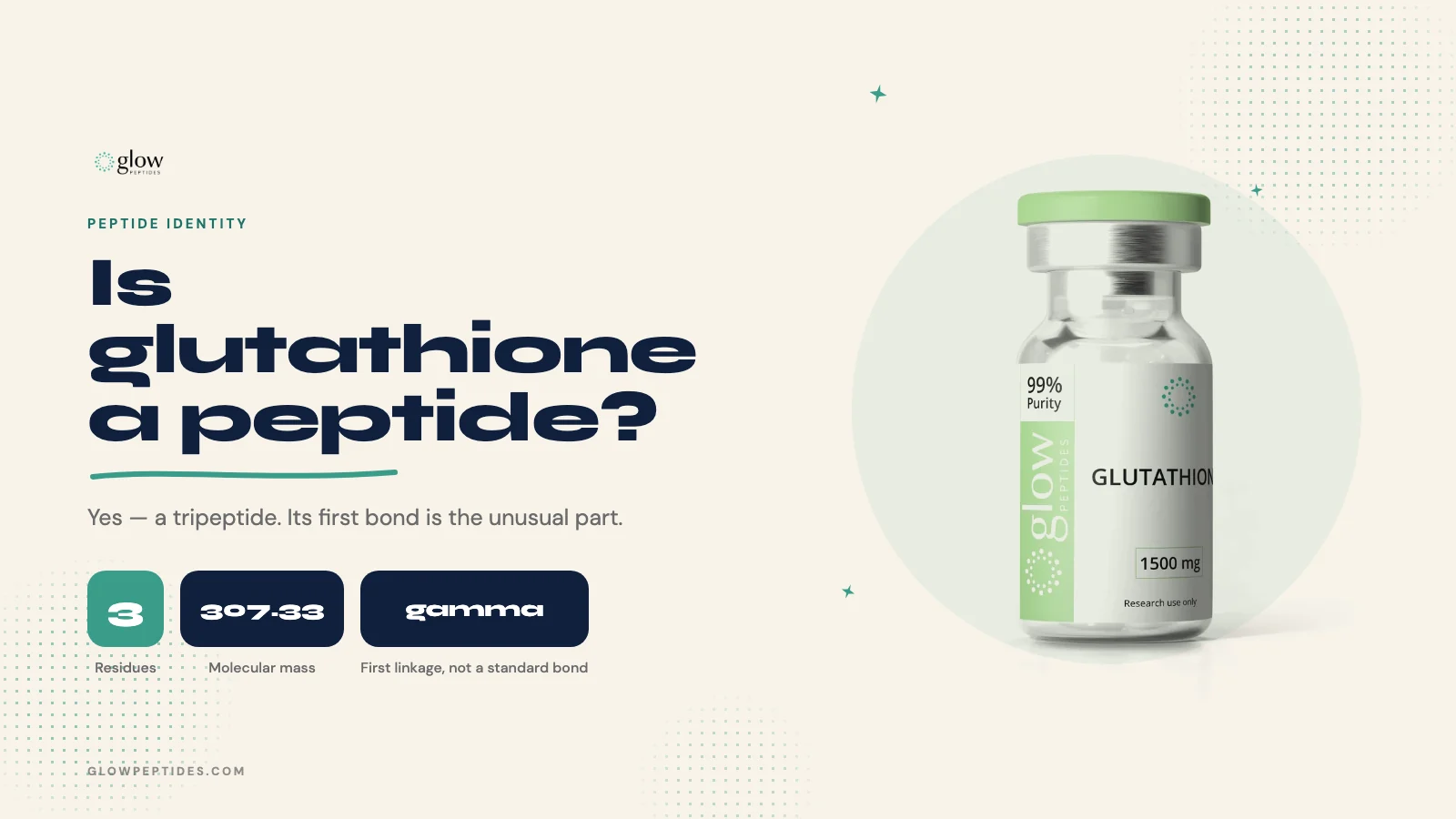
Is Glutathione a Peptide? Yes, With One Unusual Bond
Glow Peptides Research Team · 2026-09-24
For research use only. Not for human or veterinary use, diagnostic use, or in any therapeutic application.
Yes, glutathione is a peptide. It is a tripeptide, three amino acid residues joined by two bonds. But only one of those two bonds is a standard peptide bond, and that irregularity is the most interesting thing about the molecule. It is also the detail that almost every page answering this question leaves out. This page sets out what is actually in a vial of research-grade glutathione: the three residues, the unusual first linkage, the formula, the mass, and what its single reactive group changes about how a lot is analyzed.
The short answer, with the qualification that matters
Glutathione is a tripeptide composed of glutamate, cysteine and glycine, written gamma-Glu-Cys-Gly. PubChem holds it as compound record CID 124886, with molecular formula C10H17N3O6S and a molecular weight of about 307.33. A recalculation from the residues gives 307.32, which agrees.
The qualification is the gamma in that name. An ordinary peptide bond joins the alpha carboxyl of one residue to the amine of the next. In glutathione, the glutamate contributes its side-chain carboxyl instead, the one on the far end of the side chain, conventionally the gamma position. So the first of the two linkages is an amide bond in the wrong place. The second linkage, cysteine to glycine, is an entirely normal peptide bond.
The short version
- Yes, it is a peptide. Specifically a tripeptide: three residues, two bonds.
- Sequence gamma-Glu-Cys-Gly. PubChem CID 124886.
- Molecular formula C10H17N3O6S, molecular weight about 307.33.
- The first bond is not a standard peptide bond. Glutamate joins through its side-chain carboxyl, not its alpha carboxyl. The second bond, Cys to Gly, is standard.
- That gamma linkage is why ordinary peptidases do not cleave it. They do not recognize the bond.
- One free cysteine thiol. It oxidizes to a dimer, glutathione disulfide, at about 612.6, which is exactly twice 307.33 minus two hydrogens.
- No aromatic residues, so no 280 nanometer absorbance. Detection is backbone-only.
Alpha and gamma, and why the distinction is not pedantry
Glutamate has two carboxyl groups. One is the alpha carboxyl, attached to the same carbon as the amine, which is the group every amino acid has and the group that normally forms the peptide bond. The other sits at the end of the three-carbon side chain, and by convention the carbons of that side chain are labeled beta, gamma and so on, which makes that second carboxyl the gamma carboxyl.
In a normal tripeptide, glutamate at position one would use its alpha carboxyl to bond to the next residue and its gamma carboxyl would hang free as a negatively charged side chain. In glutathione that is reversed: the gamma carboxyl forms the bond, and the alpha carboxyl hangs free.
Three things follow, and all three are structural facts rather than claims about function.
Ordinary peptidases cannot cleave it. Enzymes that break peptide bonds are shaped around the alpha-linked geometry. The gamma-linked bond presents a different arrangement of atoms, and the general-purpose peptidases do not read it as a substrate. Breaking that specific bond requires an enzyme evolved for it.
The free alpha carboxyl changes the charge distribution. The molecule carries two free carboxyl groups, the alpha carboxyl on the glutamate and the C-terminal carboxyl on the glycine, against a single free amine on the glutamate. At neutral pH it runs net negative.
Writing the name without the gamma is incomplete. "Glu-Cys-Gly" describes a different molecule from gamma-Glu-Cys-Gly. Same three residues, same molecular formula, same mass, different connectivity. The gamma prefix is doing real work.
Tripeptide, not "tripeptide amino acid"
A phrase in circulation on this subject is "a naturally occurring tri-peptide amino acid", and it is a category error worth untangling. An amino acid is a single building block. A peptide is a chain of them. Glutathione is a chain of three, so it is a tripeptide and it is not an amino acid. It is also not a protein: there is no hard boundary, but chains of a few dozen residues and up are conventionally proteins, and three residues is nowhere near it. At about 307.33 it is smaller than almost anything else in a peptide catalog, including four-residue peptides, simply because it has three residues rather than four and one of them is glycine, the smallest there is.
The one reactive group, and what it does
The cysteine in the middle carries a thiol, an SH group, and it is the only sulfur atom in the molecule. It is also the only strongly reactive group glutathione has, and the compound's degradation behavior and its identity chemistry both follow from it.
A free thiol readily pairs with another free thiol to form a disulfide bond, releasing two hydrogen atoms in the process. When two glutathione molecules do this to each other, the product is glutathione disulfide, a dimer of two glutathione units joined through their cysteines.
The arithmetic is exact and easy to check on a certificate. Two glutathione molecules weigh 2 times 307.33, which is 614.66. Forming the disulfide removes two hydrogens, 2.016. That gives about 612.6, with molecular formula C20H32N6O12S2.
| Form | Common abbreviation | Formula | Molecular weight |
|---|---|---|---|
| Glutathione, reduced | GSH | C10H17N3O6S | About 307.33 |
| Glutathione disulfide, oxidized | GSSG | C20H32N6O12S2 | About 612.6 |
Those two abbreviations, GSH and GSSG, appear constantly in source material and are worth knowing. The SS in the middle of GSSG is the disulfide: two G-S units bonded sulfur to sulfur.
What that composition changes analytically
The oxidized dimer is the impurity to look for, and it has an unmistakable mass. Glutathione can oxidize on exposure to air, so a lot can carry some proportion of the disulfide. Unlike many degradation products, this one is trivially identifiable: it is almost exactly double the parent mass. A peak at roughly 613 on a glutathione identity report is not a contaminant of unknown origin, it is the compound paired with itself.
There is no 280 nanometer handle. Absorbance at 280 nanometers comes from aromatic side chains, in practice tryptophan and tyrosine. Glutathione has neither, and no aromatic ring of any kind. Cysteine's sulfur does not provide a useful absorbance there either. So detection falls to the peptide backbone near 214 to 220 nanometers, a much less selective wavelength.
It is very small and very polar, which is the hard case for reversed-phase separation. At about 307 with two free carboxyls, a free amine and a thiol, glutathione has almost nothing hydrophobic to grip a reversed-phase column with. Retaining it well enough to separate it from its own oxidized form and from small related substances is a real method development problem, not a default.
Purity and net content diverge more than usual on a molecule this small. Counterions and residual water contribute a larger fraction of the total mass of a 307 dalton compound than of a 1,400 dalton one. Purity and net peptide content are separate figures and the gap between them is proportionally wider here. What a purity percentage does and does not capture is unpacked in what a purity percentage means and what it misses, and the techniques themselves in how HPLC and mass spectrometry verify peptide purity.
Specification summary
| Property | Value |
|---|---|
| Classification | Tripeptide. Not an amino acid, not a protein |
| Residue count | 3 |
| Sequence | gamma-Glu-Cys-Gly |
| First linkage | Glutamate side-chain (gamma) carboxyl to cysteine amine. Not a standard peptide bond |
| Second linkage | Cysteine to glycine. A standard peptide bond |
| Molecular formula | C10H17N3O6S |
| Molecular weight | About 307.33 |
| PubChem CID | 124886 |
| Free carboxyl groups | Two. Glutamate alpha carboxyl and glycine C-terminus |
| Reactive group | One free cysteine thiol. The only sulfur in the molecule |
| Oxidized form | Glutathione disulfide, GSSG, PubChem CID 65359, C20H32N6O12S2, about 612.6 |
| Aromatic residues | None. Does not absorb at 280 nm |
| Detection wavelength | Backbone only, near 214 to 220 nm |
| Expected mass on an MS identity line | About 307. A peak near 613 is the oxidized dimer |
| In this catalog | Lyophilized vial; current specification on the product page |
Reading a certificate for a glutathione lot
The general discipline does not change by compound: a lot number that matches the vial in front of you, the issuing laboratory named rather than described, the analytical method stated alongside the purity figure, a report date belonging to that batch, and an accession number that lets the report be looked up at the laboratory rather than confirmed by the seller. The field-by-field walkthrough is in how to read a peptide certificate of analysis.
Two fields carry extra weight here.
Any peak near 613. That is the oxidized dimer, and because it is almost exactly double the parent mass it is the one related substance on this compound that can be identified from the mass alone with no ambiguity.
The storage condition. Oxidation of a free thiol continues after synthesis with exposure to air and moisture, so the handling between testing and delivery is a genuine variable rather than boilerplate. A certificate describes one sample of one batch at the moment it was tested; it says nothing about how the rest of that batch was kept afterward.
Published lot records for this catalog are listed on the quality page, each with its own certificate. Lot document availability varies by compound and by batch, so check the specific lot rather than assuming coverage.
What this page deliberately does not cover
Most pages returned for this question move quickly to what glutathione may do, what it may support, how much to take and how to take it. Those subjects are absent here on purpose, and saying so is more useful than leaving the gap unexplained.
Glow Peptides supplies cataloged materials for laboratory research only. Nothing here is a drug, a supplement, a cosmetic or a medical device, and nothing here is intended for human or veterinary use. Dosing, administration, reconstitution and protocol questions are outside what a supplier of research materials should answer. What is in scope, and what this page covers, is composition, structure, strength, purity, analytical method, handling and documentation.
Frequently asked questions
Is glutathione a peptide?
Yes. Glutathione is a tripeptide, meaning a chain of three amino acid residues joined by two bonds. The three residues are glutamate, cysteine and glycine, written gamma-Glu-Cys-Gly. PubChem holds it as CID 124886 with molecular formula C10H17N3O6S and a molecular weight of about 307.33. The qualification worth adding is that only one of its two linkages is a standard peptide bond; the first involves the glutamate side chain rather than its alpha carboxyl.
What does the gamma in gamma-Glu-Cys-Gly mean?
It identifies which of glutamate's two carboxyl groups forms the bond. Glutamate has an alpha carboxyl, attached to the same carbon as its amine, and a second carboxyl at the end of its side chain, at the position conventionally labeled gamma. An ordinary peptide bond uses the alpha carboxyl. In glutathione the gamma carboxyl forms the bond instead, and the alpha carboxyl is left free. Writing the sequence as Glu-Cys-Gly without the gamma describes a different molecule with the same three residues and the same mass but different connectivity.
Why can ordinary peptidases not break down glutathione?
Because peptidases are shaped around the geometry of an alpha-linked peptide bond, and glutathione's first bond is gamma-linked. The atoms are arranged differently, so general-purpose peptidases do not recognize it as a substrate. Cleaving that particular bond requires an enzyme evolved for the gamma linkage specifically. The second bond in the molecule, cysteine to glycine, is a normal peptide bond and presents no such problem.
What is the difference between GSH and GSSG?
GSH is reduced glutathione, the single molecule with a free cysteine thiol, at about 307.33. GSSG is glutathione disulfide, two glutathione units joined sulfur to sulfur through their cysteines, at about 612.6 with molecular formula C20H32N6O12S2. The arithmetic is exact: two units at 307.33 is 614.66, and forming the disulfide removes two hydrogens, 2.016, giving 612.6. The SS in the middle of the abbreviation GSSG is that disulfide bond.
Is glutathione a protein or an amino acid?
Neither. An amino acid is a single building block, and glutathione is a chain of three of them, so it is a peptide rather than an amino acid. A protein is conventionally a much longer chain, typically a few dozen residues and up, so three residues is far short of that. The correct term is tripeptide. A phrase sometimes used for it, "tripeptide amino acid", combines two categories that exclude each other.
Can glutathione be detected at 280 nanometers?
No. Absorbance at 280 nanometers comes from aromatic side chains, in practice from tryptophan and tyrosine. Glutathione contains neither, and it has no aromatic ring at all. The sulfur in its cysteine does not give a useful absorbance at that wavelength either. So detection falls to the peptide backbone near 214 to 220 nanometers, which is a far less selective wavelength because many solvents and buffer components absorb there as well.
Why does this page not cover what glutathione does, or dosing?
Because Glow Peptides supplies cataloged materials for laboratory research only. The products are not drugs, supplements, cosmetics or medical devices, and they are not intended for human or veterinary use. Dosing, administration, reconstitution and protocol guidance are outside what a research materials supplier should provide, so they are deliberately absent rather than accidentally missing. What is covered here is composition, structure, strength, purity, analytical method, handling and documentation.
Sources
- PubChem, National Library of Medicine. Glutathione, CID 124886, including the gamma-Glu-Cys-Gly connectivity. Read 22 September 2026.
- PubChem, National Library of Medicine. Glutathione disulfide, CID 65359, molecular formula C20H32N6O12S2, molecular weight about 612.6. Read 22 September 2026.
- Molecular weight independently recomputed from the three residues using standard average residue masses, with water added for the chain termini. The recomputed figure agrees with the database value. The disulfide mass is shown as two parent units less two hydrogens.
For research use only. Not for human or veterinary use, diagnostic use, or any therapeutic application.