Glow Peptides · Research Journal
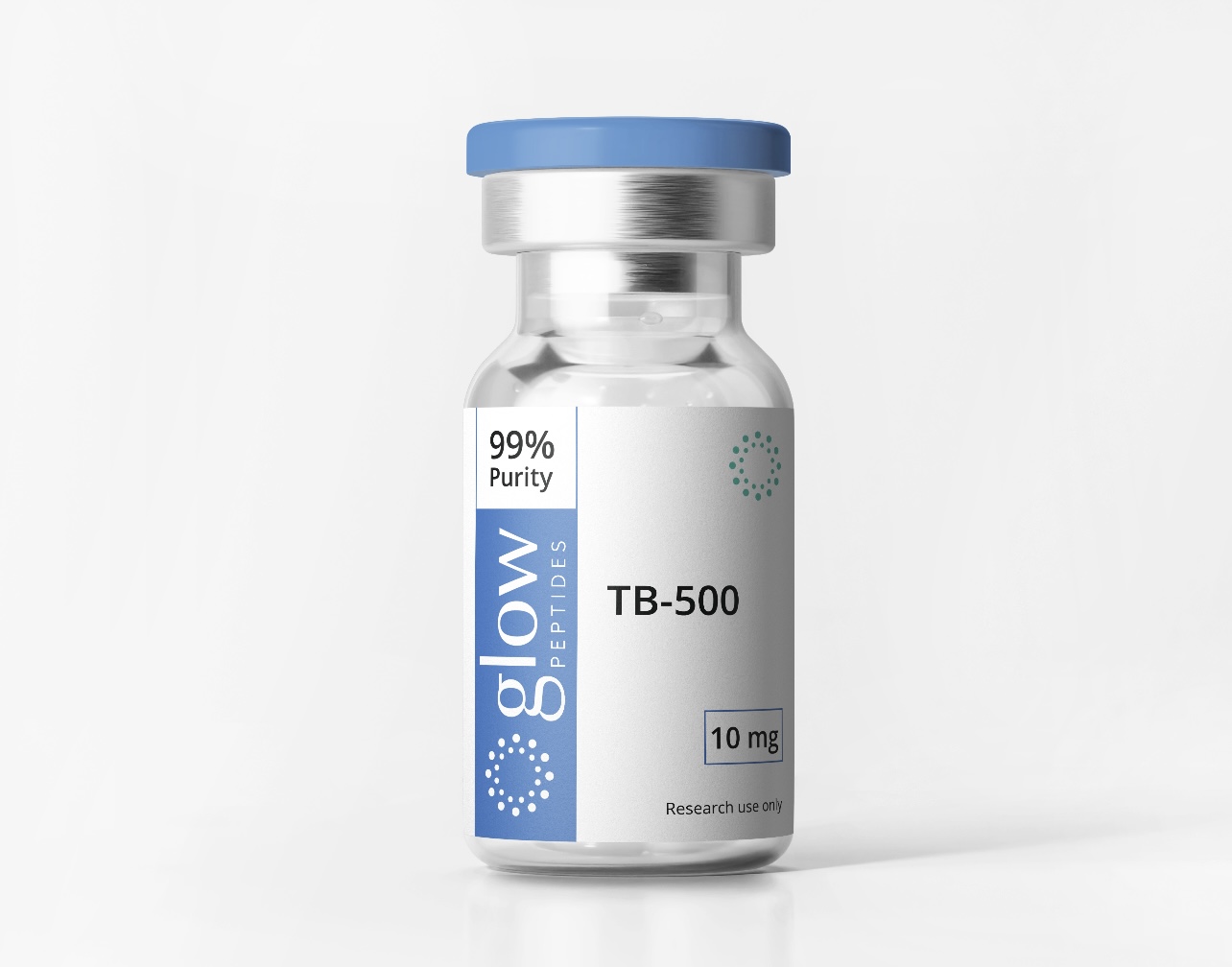
What Is TB-500? One Name, Two Records
Glow Peptides Research Team · 2026-10-07
For research use only. Not for human or veterinary use, diagnostic use, or in any therapeutic application.
TB-500 is a name with two different molecules standing behind it, and knowing that is most of what the name usefully tells you. In the public chemical record, TB-500 is a short synthetic peptide of seven residues at a mass of about 889. In parts of the market, the same name is attached to thymosin beta-4, the natural 43-residue parent protein at about 4,963, more than five times the size. This page sets out both records, shows how the fragment sits inside the parent, and explains why the lot certificate behind the TB-500 research vial is the only document that settles which molecule a given vial holds.
The short version
- Two records, one name. PubChem's record carrying the TB-500 name is CID 62707662: C38H68N10O14, about 889.0, an acetylated seven-residue peptide. Thymosin beta-4, the parent, is CID 45382195: C212H350N56O78S, about 4,963.
- The parent record does not carry the TB-500 name at all. The fragment record carries it three ways: TB500, TB-500 and TB 500.
- The fragment is the parent's residues 17 to 23, the sequence Leu-Lys-Lys-Thr-Glu-Thr-Gln, with an acetyl cap on its front.
- The gap is 5.58 times. No identity line can confuse 889 with 4,963, which makes this the easiest naming problem in this territory to check and the worst one to ignore.
- Market usage attaches the name to both conventions, so the name alone does not identify a vial. The lot certificate does.
What is TB-500, in the public record?
Ask the chemistry database rather than the market and the answer is specific. PubChem holds a record whose synonym list carries the name in all three spellings, TB500, TB-500 and TB 500: CID 62707662, molecular formula C38H68N10O14, molecular weight about 889.0, CAS registry number 885340-08-9. The record also spells out what the molecule is: Ac-Leu-Lys-Lys-Thr-Glu-Thr-Gln-OH, a chain of seven amino acid residues with an acetyl group capping the amino end. A seven-residue chain is a small peptide by any standard, under two thirds the mass of BPC-157 and about two and a half times the mass of a tripeptide.
The same database holds a separate record titled Thymosin Beta 4: CID 45382195, formula C212H350N56O78S, molecular weight about 4,963. Its synonym list runs to ten names, and none of them is TB-500. In the public record, the name belongs to the fragment, not the parent.
| The fragment, carrying the name | The parent protein | |
|---|---|---|
| PubChem record | CID 62707662 | CID 45382195, titled Thymosin Beta 4 |
| Formula | C38H68N10O14 | C212H350N56O78S |
| Mass | About 889.0 | About 4,963 |
| Chain | 7 residues, acetylated: Ac-Leu-Lys-Lys-Thr-Glu-Thr-Gln-OH | 43 residues in the mature chain |
| Carries the TB-500 name? | Yes, in three spellings | No |
The small peptide inside the full protein
The two molecules are related by position, and the position is checkable rather than folklore. UniProt, the protein sequence database, holds human thymosin beta-4 as entry P62328: a mature chain of 43 residues, an actin-binding protein by classification. Reading along that chain, the letters LKKTETQ, the exact sequence of the fragment, sit at positions 17 to 23. The synthetic fragment takes those seven residues and adds an acetyl cap that the parent does not carry at that position, which is why the fragment is written with the Ac- prefix. The cap is not decoration: acetylation closes off the free amino end and adds 42 mass units, so the capped fragment weighs 42 more than the bare seven letters would. Both details are part of the record's identity, and both are the kind of thing an identity method either resolves or does not.
| Stretch of the parent chain | What it is |
|---|---|
| Residues 1 to 16 | Parent only. Not part of the fragment |
| Residues 17 to 23: LKKTETQ | The seven letters the fragment copies, with an acetyl cap added on the synthetic version's amino end |
| Residues 24 to 43 | Parent only. Not part of the fragment |
So the honest one-line relationship is: TB-500 as the public record defines it is a capped copy of one seven-residue stretch from the middle of thymosin beta-4. It is not the protein, and the protein is not it. Dividing the two masses makes the point bluntly: 4,963 over 889.0 is 5.58. A factor of five and a half is not a rounding question, a salt question or a convention question. It is two different molecules.
Why the 5.58 gap is useful rather than just alarming
Most naming problems in this catalog's territory are subtle: a one-unit amide difference on KPV, a sixty-unit salt difference on BPC-157, a two-unit oxidation difference on NAD. This one is enormous, and that makes it the easiest to check. Any identity result reconciles with one of the two records at a glance: a figure near 889 is the fragment, a figure near 4,963 is the parent, and nothing in between is either. One look at one number on a lot certificate answers a question that the name, on its own, cannot.
One analytical property the two molecules share is worth knowing because it is counterintuitive: neither has a handle at 280 nanometers, the ultraviolet wavelength standard detectors watch. Essentially only two amino acids, tryptophan and tyrosine, absorb strongly there, and reading along both sequences, the seven-residue fragment and the full 43-residue parent chain alike contain neither amino acid. A detector parked at 280 sees nothing of either molecule, so chromatographic work on both runs at the shorter wavelengths that watch the peptide bond itself. On a certificate, that is one more reason the stated method matters alongside the figure.
Why TB-500 can mean two different molecules
If the public record were the whole story, there would be no article to write. It is not. Across the wider market, listings, summaries and documents attach the TB-500 name to both conventions: sometimes to the seven-residue fragment the record defines, sometimes to full thymosin beta-4 supplied under the shorter name. Neither usage announces itself, and a reader has no way to tell from the name which convention a given page or vial follows.
That is not an accusation aimed at anyone; it is what happens when a catchy development-style name outgrows the molecule it started on. Names in this territory are marketing conventions with no registry behind them. Registry numbers and lot documents hold still; names travel. The practical consequence is the same as for every unsettled label: the name identifies a conversation, not a molecule. The two things that identify a molecule are a database record, for the definition, and a lot certificate, for the vial in your hand.
Even the registry layer asks for one more degree of care here than usual: the parent protein appears in the public databases under more than one compound record, with different entries carrying different registry numbers. The figures this page quotes for the parent come from the record titled Thymosin Beta 4 named in the Sources, and a document citing a different registry number for the parent should be reconciled to whichever record that number actually belongs to, rather than assumed onto this one.
What this means when you read a certificate
For a compound with a contested name, the identity section of a lot certificate stops being a formality and becomes the whole point. The general discipline is unchanged, a lot number matching the vial, the laboratory named, the method beside the figure, and it is walked field by field in how to read a peptide certificate of analysis. Specific to this name, two checks do the work:
Read the identity mass against the fork. Near 889, the document describes the fragment. Near 4,963, it describes the parent. Either can be a legitimate research material; they are simply not the same one, and no purity figure transfers between them.
Check the salt convention while you are there. The fragment record also carries an acetate name, and a salt shifts the expected gross figure the same way it does for any lyophilized peptide, so the certificate's stated form is part of the identity, not an afterthought.
Published lot records for this catalog sit in the lot document directory, each linking its certificate. In this catalog the lyophilized, or freeze-dried, vial of the compound carries catalog code TB10 and is described as a synthetic thymosin beta-4 fragment. An encapsulated format sits alongside it. The specification is stated as a floor rather than a finding; the certificate for a given lot is where its identity is reported. The compound also appears co-lyophilized in blends, including the two-component pairing covered in the BPC-157 and TB-500 blend, and on a blend's documents the same fork applies to the TB-500 component's identity line.
The pattern across the catalog
Every compound here has a version of this page's question, and the answer is always the same shape: a public record for the definition, a lot certificate for the vial. TB-500 just happens to be the compound where the stakes of the naming question are a factor of five and a half.
What this page deliberately does not cover
Most of what ranks for this question is built on material that falls outside the scope of a research-use page, and none of it is written here. Saying so plainly is more useful than leaving the gap unexplained.
Glow Peptides supplies cataloged materials for laboratory research only. The materials are not drugs, supplements, cosmetics or medical devices, and they are not intended for human or veterinary use. This page gives no dosing, administration, reconstitution, duration, combination or protocol guidance, states no expected outcomes and makes no claim about what these materials do; those questions are outside what a supplier of research materials should answer. What is in scope, and what this page covers, is composition, strength, purity, analytical methods, handling, storage and documentation.
Frequently asked questions
What is TB-500?
In the public chemical record, TB-500 is a synthetic acetylated peptide of seven residues, Ac-Leu-Lys-Lys-Thr-Glu-Thr-Gln-OH, held on PubChem as CID 62707662 with the formula C38H68N10O14 and a mass of about 889.0. The seven residues copy positions 17 to 23 of thymosin beta-4, a natural 43-residue protein. In parts of the market the same name is also attached to the full parent protein, which is why the name alone does not settle what a vial contains.
Is TB-500 the same as thymosin beta-4?
Not in the public record. Thymosin beta-4 is the 43-residue parent protein, held as its own PubChem record at about 4,963, and its synonym list does not include TB-500. The record carrying the TB-500 name is the seven-residue fragment at about 889.0. Market usage blurs the two, but the records, the formulas and the masses are distinct, and the gap between them is a factor of five and a half.
Why do some pages give TB-500 a mass near 889 and others near 4,963?
Because the two figures belong to two different molecules that share the name. About 889.0 is the acetylated seven-residue fragment, the record that actually carries the TB-500 name. About 4,963 is full thymosin beta-4, the parent protein. A page quoting one figure has picked one convention, usually without saying so. On a lot document the ambiguity disappears, because the reported identity mass reconciles with only one of the two.
What sequence is TB-500?
The record carrying the name spells it Ac-Leu-Lys-Lys-Thr-Glu-Thr-Gln-OH: leucine, lysine, lysine, threonine, glutamic acid, threonine, glutamine, with an acetyl cap on the amino end. Those seven letters, LKKTETQ, sit at positions 17 to 23 of the mature 43-residue thymosin beta-4 chain held under UniProt entry P62328, which is what makes the fragment a copy of one stretch of the parent.
How do I know which molecule my vial contains?
Read the lot certificate rather than the label. The identity section reports a measured mass, and that figure reconciles with either the fragment near 889.0 or the parent near 4,963, never both. Check the stated form at the same time, since the fragment record also carries an acetate salt name and the salt shifts the expected gross figure. The name on the front of the vial cannot answer this question; the document behind the lot number can.
What does TB-500 mean on a blend label?
On a multi-component vial it names one of the components, and the same fork applies to that component's identity line on the blend's certificate: the reported mass for the TB-500 component reconciles with one of the two records. The blend context changes nothing about the naming question, it just moves the place you read the answer to the per-component identity results of the blend's own lot document.
Sources
- PubChem, National Library of Medicine, National Institutes of Health. Records read 5 October 2026: CID 62707662, with its formula, mass, CAS number 885340-08-9, the sequence synonym Ac-Leu-Lys-Lys-Thr-Glu-Thr-Gln-OH, the TB500, TB-500 and TB 500 name variants and a TB 500 acetate salt name among its 32 synonyms; and CID 45382195, titled Thymosin Beta 4, with its formula, mass and a ten-name synonym list that does not include TB-500. The parent was also confirmed to appear under at least one further PubChem compound record carrying its own registry identifiers, read the same day.
- UniProt, entry P62328, human thymosin beta-4, FASTA sequence read 5 October 2026: a mature chain of 43 residues, with the letters LKKTETQ at mature positions 17 to 23, counted directly off the retrieved sequence. The actin-binding classification is the entry's own.
- Glow Peptides live product page for TB-500, read 5 October 2026, for the catalog code TB10 and the catalog's description of the material as a synthetic thymosin beta-4 fragment. No formula or mass is quoted from any catalog page in this article; identity figures here come from the public records above, and the identity of any specific lot is a matter for that lot's certificate.
- The 5.58 ratio was computed from the two PubChem masses named above. The comparative figures used in passing, BPC-157 at about 1,419.5, the GHK-class tripeptides near 340, the one-unit KPV amide difference, the sixty-unit acetate difference and the two-unit NAD oxidation difference, come from the same PubChem records cited across this catalog's companion articles and were re-read 5 October 2026.
For research use only. Not for human or veterinary use, diagnostic use, or any therapeutic application.