Glow Peptides · Research Journal
What Is Tesamorelin? From Label to Lab Report
Glow Peptides Research Team · 2026-11-02
For research use only. Not for human or veterinary use, diagnostic use, or in any therapeutic application.
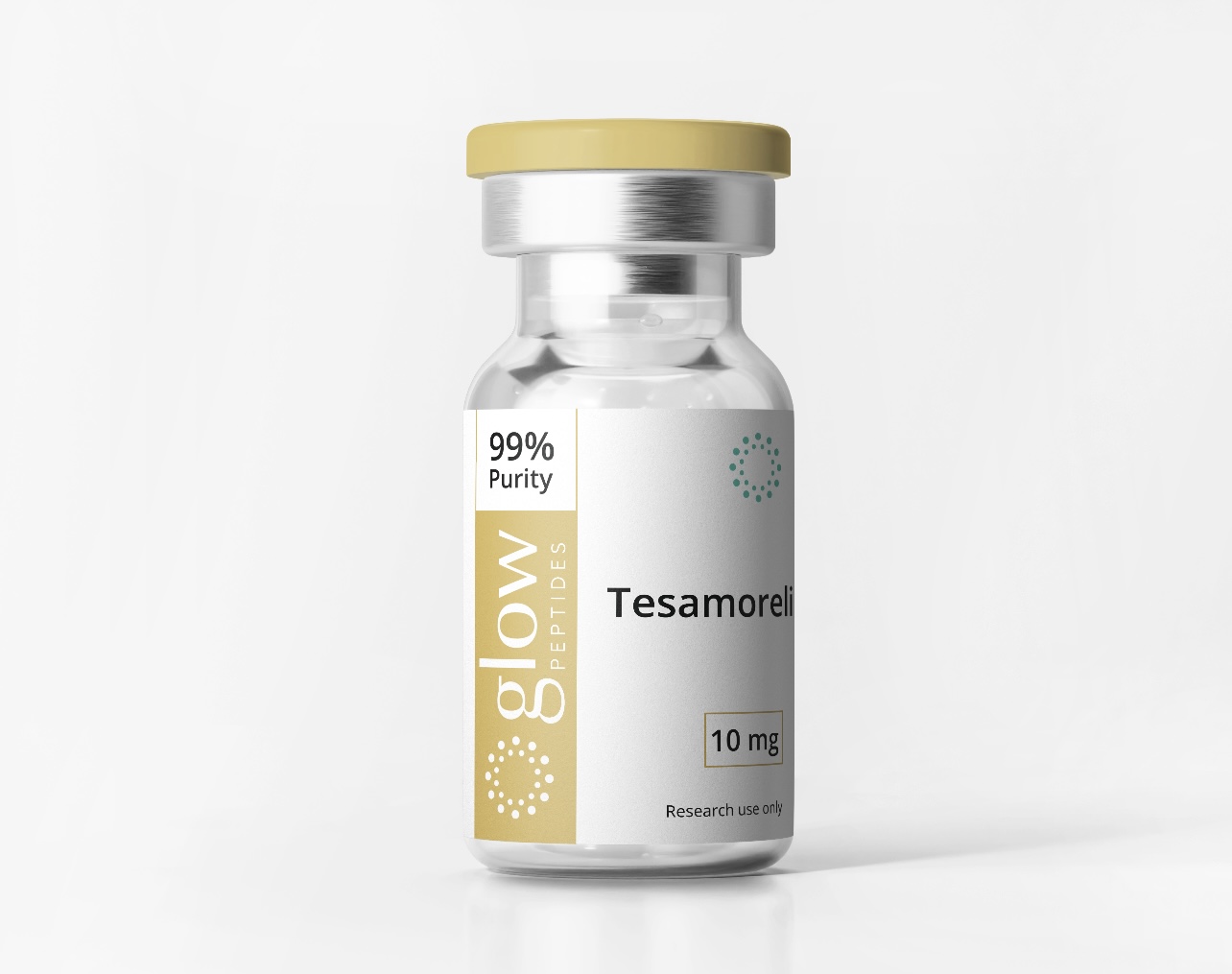
What is tesamorelin? Chemically, it is the shortest possible answer in this catalog: the natural growth hormone releasing hormone, 44 amino acid residues long, with one small chemical group attached to its front. The public record even says so in one of its listed names, (3E)-hex-3-enoylsomatoliberin. Everything else about the compound, its development code, its approved-product history and its paperwork, hangs off that one-group difference. This page reads the three lines on the label of the tesamorelin research vial, name, strength and lot, and follows each one to the record or document that backs it.
The short version
- One molecule, three names. TH9507 is the development code, tesamorelin is the nonproprietary name, and Egrifta is the brand name of the approved product. The public record is PubChem CID 16137828: C221H366N72O67S, mass about 5,136, CAS 218949-48-5.
- It is the natural hormone plus one group. The chain is the 44-residue growth hormone releasing hormone; the addition is a trans-3-hexenoyl group on the front. The record carries the synonym GHRH(1-44) for exactly this reason.
- At about 5,136 it is one of the two largest single chains in this catalog, within about 220 mass units of FOXO4-DRI at 5,358.
- The regulatory record, stated as fact: application BLA 022505, approved 10 November 2010. What the approved product is for is outside the scope of this page.
- The name never identifies a vial. The record defines the molecule; the lot certificate describes the batch. For a 44-residue chain the certificate reading has its own discipline, covered in its own article.
What is tesamorelin? The name on the label
Start with the name line the way this catalog's listing prints it: Tesamorelin · TH9507. Two of the molecule's three names are already there. TH9507 is the development code, the placeholder the compound carried through its research years, and it still travels with the molecule the way development codes do: the public record lists TH9507, TH 9507 and TH-9507 among its synonyms.
Tesamorelin is the nonproprietary name, the standardized name that chemistry databases and regulators file the compound under. The third name is not on the label and should not be: Egrifta, the brand name on the one approved application built on this molecule, which names those products and nothing else.
The public record behind the first two names is PubChem CID 16137828: molecular formula C221H366N72O67S, mass about 5,136, CAS registry number 218949-48-5. Any document about this compound, whatever name it uses, reconciles to that formula, that mass and that registry number, which is what makes the record more useful than any of the three names.
| Name | What kind of name it is | What it tells you |
|---|---|---|
| TH9507 | A development code | The research-era label, still carried as a synonym on the public record and printed on this catalog's own listing |
| Tesamorelin | The nonproprietary name | The name the record files the molecule under: CID 16137828, CAS 218949-48-5 |
| Egrifta | A brand name | The approved products containing tesamorelin, all under application BLA 022505, approved 10 November 2010. A brand names a product, never a research vial |
The practical reading order is the reverse of the fame order. The brand name belongs to one specific approved product and to nothing else.
The nonproprietary name is where the chemistry lives. The development code is the least precise of the three, because a code on a research label carries no registry of its own; it borrows its meaning from the record it points at.
Tesamorelin is one of the few compounds in this catalog whose development code grew all the way up. PT-141 made the same journey, from code to nonproprietary name to an approved product's brand, and the lesson transfers unchanged: a grown-up name chain is a convenience for readers, not a credential for a vial.
The difference between the two stories is where the code ended up. PT-141's code eclipsed its proper name in everyday search, while TH9507 faded to a synonym that mostly survives on labels and in older literature, which is why this catalog prints both names on the listing, so a reader arriving from either era of the literature can reconcile the vial to the same record.
The natural hormone, plus one group
Most synthetic peptides in this catalog relate to a natural molecule in one of two ways: they copy a piece of it, or they rebuild it with changes scattered through the chain. Tesamorelin does something simpler, and the public record compresses it into one listed chemical name: (3E)-hex-3-enoylsomatoliberin. Somatoliberin is the formal name for growth hormone releasing hormone, the natural 44-residue hormone, held in the protein database under UniProt entry P01286 as a 108-residue precursor whose mature hormone is the 44-residue chain.
Tesamorelin is that same 44-residue sequence with a trans-3-hexenoyl group, a small six-carbon unit, attached at the front. The record carries the synonym GHRH(1-44) because, group aside, that is exactly what the chain is.
So the honest one-line definition runs: the natural hormone's full sequence, plus one deliberate chemical addition. That makes tesamorelin an analog in the precise sense of the word, a designed variant of a natural molecule, rather than a fragment of one or an unrelated invention. How that one group compares against the other common analog of the same hormone, which takes the opposite approach and shortens the chain instead, is worked through number by number in tesamorelin versus sermorelin, including the arithmetic of what the group weighs.
The word analog also places tesamorelin on the catalog's family tree, because the compounds here relate to natural molecules in only a handful of ways. TB-500, as the public record carries it, is a fragment, a short copied stretch of a larger protein. FOXO4-DRI is a designed derivative, a mirrored and reversed copy of one stretch with a carrier attached.
KLOW is a blend, four separate compounds freeze-dried into one vial. Tesamorelin is the fourth kind: a full-length analog, the complete natural sequence carried whole, with one deliberate addition. Of the four relationships, it is the one that keeps the most of its parent, the full natural sequence changed by a single group, and that one group of difference is the entire reason it has its own record, its own registry number and its own regulatory history rather than the hormone's.
Why a 44-residue chain changes how you read figures
Size is the quiet story on this label. At about 5,136, tesamorelin is one of the two largest single-compound chains in this catalog, within about 220 mass units of FOXO4-DRI at about 5,358, and several times the mass of the short fragments that fill most research catalogs.
A long chain has more positions where a synthesis can go slightly wrong, which is why purity and identity figures for a molecule this size deserve a more careful read than the same figures on a five-residue fragment. That reading discipline has its own article, linked below.
In laboratory studies the compound is examined for binding to the growth hormone releasing hormone receptor, the receptor the natural hormone binds. That is receptor pharmacology, and it is where this page leaves the subject.
From code to approved name: the regulatory record
The public drug database carries one approved application for tesamorelin: BLA 022505, with original approval on 10 November 2010, the product sold under the brand name Egrifta. One detail of the record is worth a sentence for readers who collect such things: the application is now held as a biologics license application, a different category from the new drug application that covers most small molecules and some peptides; the record was converted from a new drug application on 23 March 2020 under the biologics transition, which is how a 44-residue hormone analog is classed today.
Those are the facts this page states, and deliberately all of them. What the approved product is for, who uses it, and how are questions about a medicine, and they sit outside what a research-use page covers.
The record cuts the other way too, the same way it does for every compound with an approved sibling: the existence of an approved product says nothing about any research vial. The approval attaches to one product from one manufacturing and documentation chain under one brand name.
A lyophilized research material sharing the molecule does not share the approval, and a research listing that leans on the brand name is borrowing standing it does not have. The three names in the table above exist to keep those things apart.
Reading the rest of the label
After the name, the label carries two more lines, and each one points at a document.
The strength line states a nominal content. It is a declared value for the vial as supplied, not a measurement of your specific vial, the same convention as everywhere in this catalog. The measured figures for a batch live on that batch's certificate.
The lot number is the line that does the real work. It is the only string on the label that resolves to one production run and therefore to that run's paperwork.
For this compound the certificate reading deserves its own space, because identity and purity on a 44-residue chain are harder questions than on a short fragment, and they are walked field by field, with a worked example from a real lot, in tesamorelin lot documentation: identity and purity. The general certificate discipline for any compound in the catalog is in how to read a peptide certificate of analysis.
The catalog's own figures for this compound are worth one sentence of reconciliation: the product page prints the formula and mass exactly as the public record carries them, C221H366N72O67S at 5,136, with the purity figure stated as a catalog specification rather than a measured lot result. Handling and storage for the material are covered in the tesamorelin reference guide and are deliberately not repeated here.
The pattern across the catalog
Every compound here answers to a public record for the definition and a lot certificate for the vial. Tesamorelin is the compound where the definition is one word long, and the certificate, for a chain this size, is where the careful reading happens.
What this page deliberately does not cover
Most of what ranks for this question is built on material that falls outside the scope of a research-use page, and none of it is written here. Saying so plainly is more useful than leaving the gap unexplained.
Glow Peptides supplies cataloged materials for laboratory research only. The materials are not drugs, supplements, cosmetics or medical devices, and they are not intended for human or veterinary use.
This page gives no dosing, administration, reconstitution, duration, combination or protocol guidance, states no expected outcomes and makes no claim about what these materials do; those questions are outside what a supplier of research materials should answer, and that includes every question about the approved product beyond the existence and date of its approval. What is in scope for a research-use page is composition, strength, purity, analytical methods, handling, storage and documentation; this page covers the names and the record, and points to the catalog's guides for the rest.
Frequently asked questions
Why does the label say TH9507 next to tesamorelin?
TH9507 follows the standard pattern for development codes: a short company prefix followed by a project number. Expect to meet it in three spellings, TH9507, TH 9507 and TH-9507, because different databases hyphenate codes differently; all three sit as synonyms on the same public record, CID 16137828, so the spelling differences carry no meaning. If a search in older literature returns results under the code that a search under tesamorelin misses, that is the same compound discussed before its proper name existed, not a different one.
What does somatoliberin mean?
It is the formal name for growth hormone releasing hormone, built from a naming convention worth knowing: hormones that trigger the release of another hormone take the ending -liberin, from the Latin for to free. Somato- points at somatotropin, the growth hormone, so somatoliberin reads as the releaser of growth hormone. Spotting that convention makes systematic names much less intimidating, because a long name like (3E)-hex-3-enoylsomatoliberin stops being a wall of letters and becomes two readable parts: a small chemical group, and the hormone it is attached to.
How is tesamorelin different from sermorelin?
They are two different answers to the same design question. Sermorelin keeps only the first 29 amino acids of the natural hormone and caps the end; tesamorelin keeps all 44 and adds a group to the front. Shorter chain against modified full chain, which is why the two have different formulas, different masses and entirely separate records. The full comparison, with every figure checked against the public records, is this catalog's tesamorelin versus sermorelin article.
What does BLA mean on the regulatory record?
BLA is a biologics license application, the agency's approval route for biological products; NDA is a new drug application. The practical point for a reader is that being a peptide does not decide the letters. PT-141, elsewhere in this catalog, is also a peptide with an approved product behind its name, and its record carries an NDA, a new drug application, not a BLA. So two compounds from the same catalog can sit under different application types, and the prefix is worth copying exactly when searching the public database. The letters change nothing about the research material; they are part of the record's identity, the way the application number and date are.
Why is the mass written as about 5,136 rather than an exact figure?
Because a quoted mass depends on what is being counted. The public record's mass figure for the free peptide is 5,136 to the nearest unit, and real materials are often handled as salts, which add the mass of the salt partner. That is also why two reputable sources can print figures that differ by a unit or two without either being wrong: they are usually counting the same molecule at different precision. Larger gaps usually mean a salt form is being counted.
Sources
- PubChem, National Library of Medicine, National Institutes of Health. Record read 28 October 2026: tesamorelin CID 16137828, with its formula C221H366N72O67S, mass about 5,136, CAS number 218949-48-5, the listed chemical name (3E)-hex-3-enoylsomatoliberin, and the synonyms TH9507, TH 9507, TH-9507 and GHRH(1-44). The FOXO4-DRI mass of about 5,358 used for catalog context comes from PubChem CID 167312269, cited fully in that compound's own article and re-read the same day.
- UniProt, entry P01286, somatoliberin, read 28 October 2026: a 108-residue precursor protein whose mature hormone is the 44-residue growth hormone releasing hormone chain.
- Drugs@FDA, the US Food and Drug Administration's public approval database, queried 28 October 2026 for tesamorelin: application BLA 022505, original approval dated 10 November 2010, brand name Egrifta. No statement about the product beyond those record fields is made on this page.
- Glow Peptides live product page for tesamorelin, read 28 October 2026, for the listing line Tesamorelin · TH9507, the formula and mass as printed (which match the public record), and the catalog purity specification wording; the reference guide, read the same day, for handling and storage. The identity of any specific lot is a matter for that lot's certificate.
For research use only. Not for human or veterinary use, diagnostic use, or any therapeutic application.