Glow Peptides · Research Journal
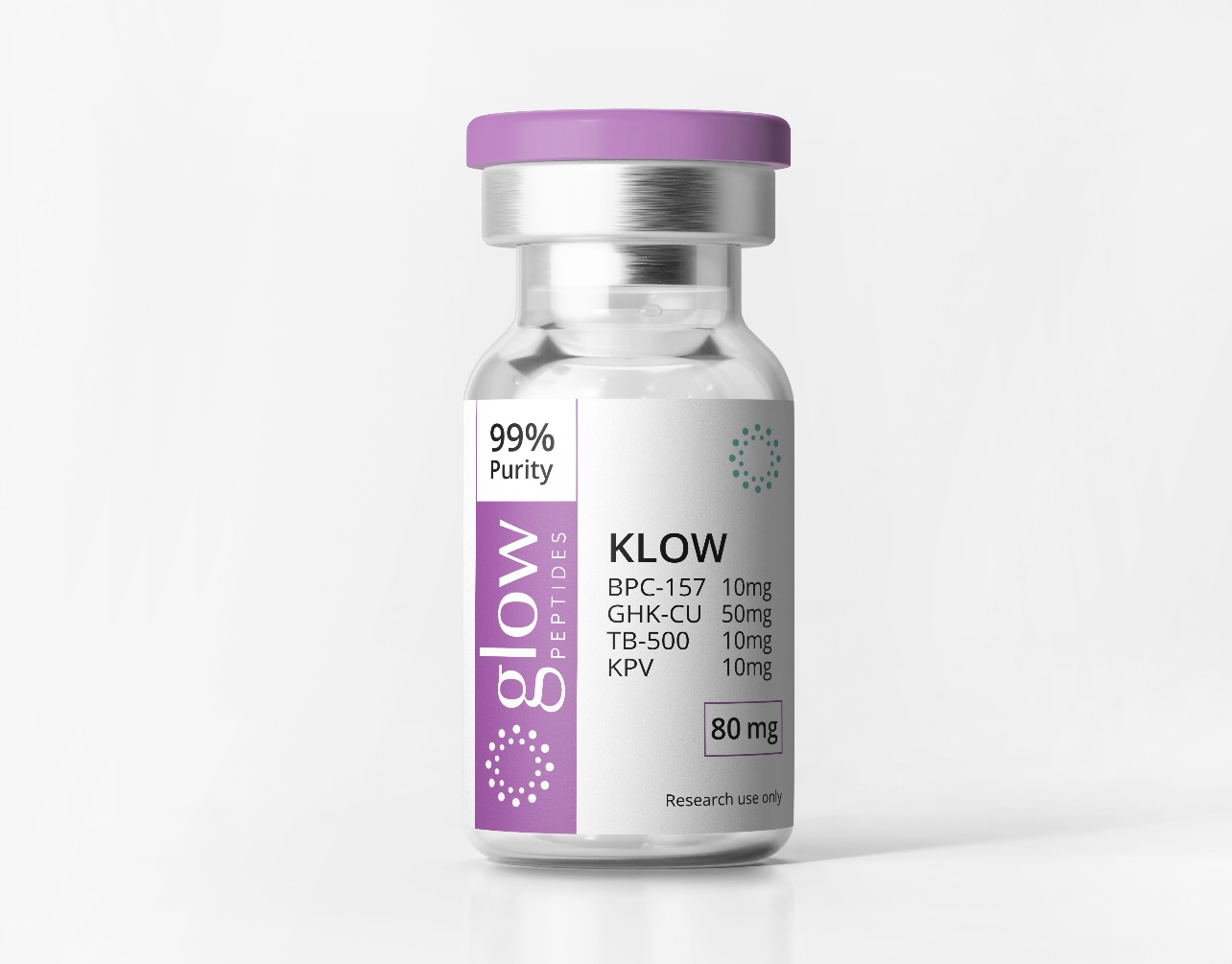
Is KLOW a Stack? One Vial, Four Peptides
Glow Peptides Research Team · 2026-11-09
For research use only. Not for human or veterinary use, diagnostic use, or in any therapeutic application.
Is KLOW a stack? The phrase KLOW stack turns up in search, and the answer depends on what the word is doing. In the market's sense, yes: stack is shorthand for more than one peptide in the picture, and KLOW holds four. On the label the word does not appear; what the vial is, in the catalog's own terms, is a blend. Four research peptides, KPV, GHK-Cu, BPC-157 and TB-500, are freeze-dried together into the KLOW four-peptide blend vial, so the four arrive as one material, under one catalog code, from one production run.
That is the fact the word stack hides, and it is not small. It decides how many lot numbers a laboratory records, how many certificates it reads, whether the proportions are adjustable, and what a single document can and cannot say about four compounds at once. This page answers the stack question for KLOW specifically: what the two words mean as formats, and what each format looks like on paper.
The short version
- KLOW is a blend; stack is the market's word for it. The four peptides are combined when the product is made, not assembled afterwards from separate vials.
- The same four compounds as separate products would mean four vials, four lot numbers, four certificates and four sets of documents to reconcile. KLOW carries one lot and one certificate.
- The ratio is fixed. A blend's proportions are set in production and are identical for every vial in a lot. A set of single vials has no built-in proportions at all.
- The four components are KPV, GHK-Cu, BPC-157 and TB-500, each with its own public record, from two tripeptides in the 340 to 403 range up to the full thymosin beta-4 chain at about 4,963.
- The label itself settles the question. It carries one product name, one set of declared component amounts and one lot number, where a set assembled from separate products would carry four labels, four lots and four sets of paperwork.
KLOW stack or KLOW blend: which word fits the vial?
The two words do different jobs. Stack is market shorthand, not a label term: it says more than one peptide is in the picture and says nothing about how they are supplied. Sometimes it means a set of separate single-compound vials grouped by the person listing them; sometimes, as with KLOW, it means one container holding several materials.
Blend is the catalog's term, and it is specific: a single product whose components are combined by the manufacturer, in this case by co-lyophilization, which means the four peptides are freeze-dried together into one solid in one sealed vial. After that step there is no point at which anyone downstream can separate, inspect or reweigh them individually.
KLOW is a blend. It answers to one product name, one catalog code, KL80, and one lot number per production run.
Neither the word stack nor the word blend appears on the vial; what the label does carry, and why stack is shorthand rather than a label term, is worked through in what a peptide stack means on the label, and this page does not repeat that lesson. The question here is narrower: KLOW contains exactly the kind of compound list the word stack usually names, so what does the blend format mean on paper, and how does it differ from the same four compounds held as separate products?
The summary runs like this. If stack is being used to mean "more than one peptide in the picture", KLOW is a stack, delivered as a single pre-mixed material.
If it is being used to mean "several compounds sourced and run through the paperwork as separate products", KLOW is not that; it is one product. Both readings turn up in search, which is why the question deserves a direct answer rather than a definition.
What a four-vial set looks like on paper
Formats are easiest to compare by the documents they generate, because the documents are where the differences stop being abstract.
Take the same four peptides as four single-compound products. Each vial arrives with its own label, its own lot number and, where published, its own certificate of analysis. That is four lots that were made at different times, possibly tested by different laboratories, with four report dates, four identity results and four purity figures, none of which refer to each other.
Whoever keeps the records has to match each certificate to its own vial, check each lot string, and file four documents in a way that keeps them attached to the right containers. None of that is a defect. It is simply what owning four products means.
Now take KLOW. One vial, one lot number, one certificate. A published lot for this product links to a single report that covers the whole preparation: its identity line names all four components, with TB-500 written under the laboratory's name for it, thymosin beta-4.
One document now has to do the work four documents did in the other format. That is the real trade. The record keeping collapses from four reconciliations to one, and in exchange, everything known about the four components inside has to come from that one report, because the material itself can no longer be read component by component at the bench.
| On paper | Four single-compound vials | One KLOW blend vial |
|---|---|---|
| Products | Four, each with its own page and code | One, catalog code KL80 |
| Lot numbers to record | Four, from four production runs | One, from one production run |
| Certificates to read | Up to four, with four dates | One, covering all four components |
| Proportions | Not defined by the products | Fixed when the lot is made |
| Replacing one component | Swap one vial | Not possible; the vial is one material |
The four peptides, at a glance
Each component keeps its own chemical identity inside the blend, and each identity lives on the public database, though not always as one record: GHK-Cu answers to several closely related records rather than one, a fork the components article walks through. The table below is deliberately brief: the full component walkthrough, including why two of the four names mislead a database search, belongs to the four components of KLOW and is not re-derived here.
| Component | PubChem CID | Formula | Mass |
|---|---|---|---|
| KPV | 125672 | C16H30N4O4 | About 342.43 |
| GHK-Cu | 71587328 and 139035031, among others | C14H23CuN6O4+ or C14H21CuN6O4- | About 402.92 or 400.90 by record |
| BPC-157 | 9941957 | C62H98N16O22 | About 1,419.5 |
| TB-500, as this catalog lists it | 45382195 | C212H350N56O78S | About 4,963 |
One row earns a sentence because it affects how any KLOW document is read. The name TB-500 is used across the market for two very different molecules, a short seven-residue fragment and the full 43-residue thymosin beta-4 chain. The catalog's single-compound TB-500 listing prints the full chain's formula at about 4,963, and the published KLOW certificate names the component thymosin beta-4 with a mass series that reconstructs to the same figure, so 4,963 is the identity mass to expect against TB-500 on this product's paperwork.
One fixed ratio against four adjustable ones
The clearest difference between the formats is not in the documents at all. It is the ratio, and it is worth stating neutrally, because it is a property of the format rather than a point for either side.
In a blend, the proportions between the components are decided once, in production, and every vial of a lot carries the same split. The label prints a nominal amount against each of the four component names and a boxed total, declared catalog values rather than measurements, and nothing a buyer does changes that split: the vial is one solid, so its ratio is as fixed as its lot number.
In a set of separate single-compound vials, the opposite is true. The products themselves define no proportions whatsoever, and a laboratory preparing analytical samples from separate materials sets whatever quantities its own written procedure calls for.
Neither property is an advantage in the abstract. A fixed ratio means the material is the same thing every time, which is exactly what a reference material should be, and it means the certificate for the lot describes the only ratio that exists. A set of separate vials has no built-in ratio; whatever split exists lives only in the user's own records, across four separate paper trails.
Which property matters is a question about the research, and it is not one a catalog page can answer. The same logic separates KLOW from its three-component sibling, whose composition sits one peptide apart; the two are set side by side in the GLOW and KLOW composition comparison.
Where the ratio question has no answer
One thing neither format writes down by itself is the measured amount of each component in a specific container. On a blend, the label's per-component amounts and its total are declared nominal values, and only the lot's own report can state what an analysis actually found for each component.
On a user-assembled set, measured per-vial content lives in four separate reports, if it is reported at all. In both formats the honest source for a measured figure is the lot document, never the label.
One certificate standing in for four
The documentation consequence deserves its own short section, because it is the part of the stack question that survives after the naming is settled.
A certificate for a single-compound vial answers one identity question and one purity question. The KLOW certificate has to answer four of each, inside one report: an identity result that reconciles each named component to its public record, and a purity reading made with all four in mind, because on a four-compound material the other three components are intended contents rather than impurities. How a given lot's report prints purity, one combined figure for the material or a figure per component, is itself something to read off the document rather than assume.
The catalog's own specification is written the same way, at least 99.2 percent for each component by HPLC, and that figure is a specification the supplier undertakes to meet, not a measurement of any particular vial. A reader checking a KLOW report is therefore doing single-vial discipline four times on one page: match the lot string, find each of the four names in the identity line, and read each figure next to its method. The general discipline, field by field, is in how to read a peptide certificate of analysis; nothing about it changes for a blend except the number of components it must account for.
The answer, in one line
KLOW is a blend, and stack is the market's shorthand for it: four peptides combined in production into one lot with one certificate, with the ratio fixed and the paperwork on a single document.
What this page deliberately does not cover
Most pages written around the word stack move straight to what to combine and what to expect from combining it. None of that appears here, and saying so plainly is more useful than leaving the gap unexplained.
Glow Peptides supplies cataloged materials for laboratory research only. The materials are not drugs, supplements, cosmetics or medical devices, and they are not intended for human or veterinary use.
This page gives no dosing, administration, reconstitution, duration, combination or protocol guidance, states no expected outcomes and makes no claim about what these materials do, together or separately; those questions are outside what a supplier of research materials should answer. What is in scope, and what this page covers, is what the blend format is, how it differs from a set of separate products, and what its documentation carries.
Frequently asked questions
Is GLOW a stack in the same sense?
The same answer applies. GLOW is a co-lyophilized blend of three peptides, BPC-157, TB-500 and GHK-Cu, under catalog code GL70: one product, one lot per run, one certificate. KLOW is that composition plus KPV, under KL80. Stack is market shorthand for both and blend is the catalog's word for both, because in each case the combining happened in production, not afterwards. The two differ in component count and stated total, not in format.
Can a KLOW certificate be checked against a single-compound certificate for the same peptide?
The identity figures can. An identity result for BPC-157 should reconcile to the same public record, near a mass of 1,419.5, whether the sample came from a single-compound vial or from the blend, and the same holds for each of the other three names. Purity is covered above and is not a like-for-like figure across the two formats, so a purity number from a single-compound report is not a check on a blend report, or the reverse.
Is Wolverine a blend in the same sense?
Yes. The catalog's BPC-157 and TB-500 combination, listed under catalog code WV20, follows the same format as GLOW and KLOW: two peptides lyophilized together into one vial, one lot number, one certificate per published lot. The component count changes across the three products, from two to three to four, but the format and its documentation logic do not.
Does a laboratory record KLOW as one material or as four?
As one. The vial enters a record system as a single catalog item with a single lot number, the same as any other product. The four components appear at the document level instead: the lot's certificate should carry an identity result for each named component, so the inventory line is one entry and the verification behind it is fourfold. Filing the lot number once, with its certificate attached, keeps all four identities traceable from a single record.
Sources
- PubChem, National Library of Medicine, National Institutes of Health. Compound records read 28 October 2026: KPV CID 125672, held under the title Msh (11-13), C16H30N4O4, mass about 342.43; two of the closely related GHK-Cu copper records, CID 139035031 at a mass of about 400.90 and CID 71587328 at about 402.92; PubChem holds further entries for the copper-bound form, which the components article on this site walks through; BPC-157 CID 9941957, C62H98N16O22, mass about 1,419.5; thymosin beta-4 CID 45382195, C212H350N56O78S, mass about 4,963, the molecule this catalog's TB-500 figures correspond to.
- Glow Peptides live product page for the KLOW vial, read 28 October 2026, for the component list (KPV, GHK-Cu, BPC-157 and TB-500), the catalog code KL80, the per-component purity specification wording of at least 99.2 percent by HPLC, and the published lot certificate linked from that page.
- Glow Peptides KLOW reference guide, read 28 October 2026, for the description of the published KLOW lot certificate: all four components named in the identity line, with TB-500 reported under the laboratory's name for it, thymosin beta-4.
For research use only. Not for human or veterinary use, diagnostic use, or any therapeutic application.