Glow Peptides · Research Journal
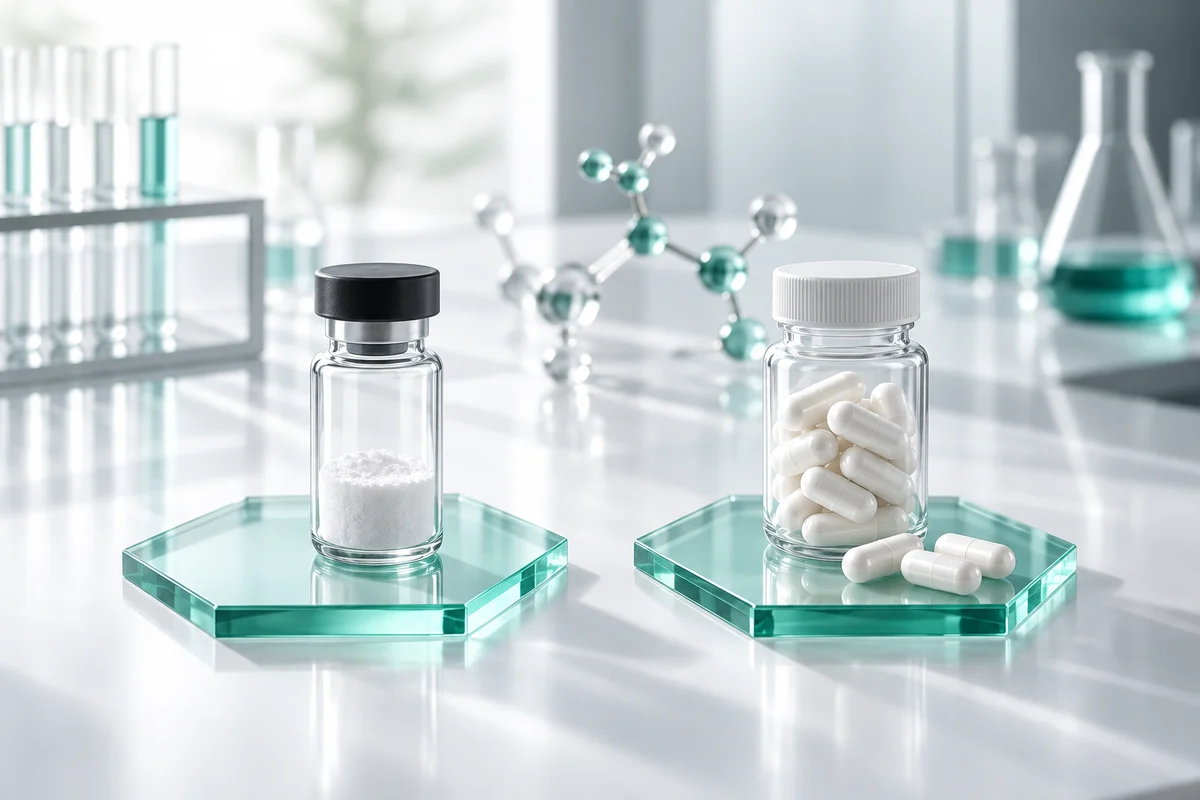
Peptide Capsules vs Lyophilized Vials: Formats Compared
Glow Peptides · 2026-09-17
For research use only. Not for human or veterinary use, diagnostic use, or in any therapeutic application.
The same research compound often appears in a catalogue twice — once as a lyophilized vial and once as a bottle of capsules — with two strength figures that look nothing like each other. A KLOW vial says 80 mg. A KLOW capsule says 500 mcg, 2 mg, 500 mcg, 500 mcg. Neither number is wrong, and comparing them directly gives an answer that is wrong by a wide margin. This guide explains what each supplied format is, how strength is expressed in each, why the two figures are not comparable, which materials Glow supplies in both, and what documentation each format carries.
The shorter reference on lyophilized vials and capsules covers the formats in a few lines if that is all you need. This page is the longer version, and it is mostly about numbers and documents rather than about the formats themselves.
One scope note before anything else. This article is about supplied format, documentation and storage conditions. It says nothing about which format anyone should choose, or about anything done with either after it leaves the shelf. All material discussed here is research-use-only.
What a lyophilized vial is
Lyophilization is freeze-drying. A peptide solution is frozen, then held under reduced pressure so that the frozen solvent sublimes — passes from solid to vapour without melting — and is drawn off. What remains is a dry solid, usually a light cake or a thin film at the base of the vial, sealed under a rubber stopper and an aluminium crimp.
Three things follow from that description, and they are the whole of what makes a vial a distinct supplied format.
The contents are dry. Water is the main agent of peptide degradation in storage, and removing it is the reason the format exists at all. The contents are also sealed under the stopper at the time of filling, which means the seal is part of the product rather than packaging around it. And the quantity in the vial is fixed at filling: a vial is one unit containing one stated amount, not a container of countable sub-units.
The visible cake is worth a word, because it generates a lot of correspondence. Cake appearance varies between materials and between batches — full cakes, shrunken cakes, thin films, and occasionally a residue so slight it is hard to see against the glass. The amount of peptide in a 10 mg vial is genuinely small, and a small mass of dry peptide does not look like much. Appearance is one of the attributes an analytical record can speak to; the eye is not a good instrument for it.
What a capsule is
A capsule is a measured quantity of material enclosed in a shell, supplied as a bottle of a fixed count. Glow's capsule bottles contain 30 capsules. The material inside is a peptide or compound combined with whatever carrier or excipient the fill requires to produce a uniform, fillable powder at that scale.
The defining difference from a vial is the unit. A vial is one unit with one number on it. A bottle of capsules is thirty units, each carrying its own stated figure, which means every strength statement about a capsule product has to specify whether it is talking about one capsule or the whole bottle. This is the single most common source of confusion between the two formats, and the arithmetic section below is devoted to it.
The second difference is that a capsule contains more than the peptide. A 500 mcg fill is half a milligram of material in a shell sized for a great deal more, so a carrier is a physical necessity rather than a shortcut. The peptide figure on a capsule listing describes the peptide content of that capsule, not the mass of the capsule.
| Attribute | Lyophilized vial | Capsule bottle |
|---|---|---|
| Physical state | Dry solid, freeze-dried in place | Powder fill enclosed in a shell |
| Unit supplied | One sealed vial | 30 capsules per bottle |
| Strength figure refers to | The whole vial | One capsule |
| Typical unit of the figure | Milligrams | Micrograms or milligrams |
| Contains carrier material | No, beyond process residues | Yes, by necessity at this scale |
| Seal | Stopper and crimp, applied at filling | Bottle closure |
| Lot documentation | Per released lot, published | Per released lot, published |
How strength is expressed in each format
This is the section the rest of the article exists for. The two formats state strength in structurally different ways, and reading one as though it were the other is not a small error — it is usually an error of two orders of magnitude or more.
A vial's figure is a package total
The number on a vial describes what is in that vial. A 10 mg BPC-157 vial contains 10 mg. On a blend vial the figure is a total summed across all constituents: the 80 mg on KLOW is the sum across BPC-157, TB-500, GHK-Cu and KPV, not the content of any one of them. The composition reference on what is in the KLOW blend works through that figure in detail.
A vial figure is not a concentration. A 3 mL blend vial stating 80 mg is stating vial contents, not a strength per millilitre. And in neither format is a strength figure a quantity to act on — it is a description of what is supplied.
A capsule's figure is a per-unit figure
The number on a capsule listing describes one capsule. To get a bottle total you multiply by 30. That step is left to the reader on most catalogues, including this one, which is why so many format comparisons go wrong at the first line.
The unit itself is the second trap. Capsule figures are frequently stated in micrograms because the per-unit quantities are small, and vial figures are almost always in milligrams. 500 mcg is 0.5 mg. A reader skimming "500" on one page and "10" on another, without registering that one is micrograms and the other milligrams, will conclude the capsule is the stronger unit by fifty times when it is in fact weaker by twenty.
The arithmetic, worked
Take KLOW, because it is the most-asked example and the hardest of the pair.
The vial is published at 80 mg total peptide across one 3 mL vial. The capsule is published per constituent: BPC-157 500 mcg, GHK-Cu 2 mg, TB-500 500 mcg, KPV 500 mcg. Those four figures sum to 3.5 mg of peptide per capsule. Across a 30-capsule bottle that is 105 mg of total peptide content.
So there are three numbers in play — 80, 3.5 and 105 — and only two of them can be set beside each other at all. 80 mg per vial against 3.5 mg per capsule is a comparison between a package and a single unit, and it is meaningless. 80 mg per vial against 105 mg per bottle is at least a comparison of two packages, but it still tells you only what each package contains in total, not how the constituents are distributed within it. The vial publishes one summed figure; the capsule publishes four separate ones. They are not the same kind of statement, and no arithmetic converts one into the other.
| Material | Vial figure (per vial) | Per capsule | Per 30-capsule bottle |
|---|---|---|---|
| BPC-157 | 10 mg | 500 mcg | 15 mg |
| TB-500 | 10 mg | 500 mcg | 15 mg |
| GHK-Cu | 50 mg | 2 mg | 60 mg |
| KPV | 10 mg | 500 mcg | 15 mg |
| Semax | 10 mg | 500 mcg | 15 mg |
| Selank | 10 mg | 500 mcg | 15 mg |
| GLOW blend | 70 mg total | 500 mcg + 2 mg + 500 mcg = 3 mg | 90 mg |
| KLOW blend | 80 mg total | 500 mcg + 2 mg + 500 mcg + 500 mcg = 3.5 mg | 105 mg |
Two cautions about that table. The bottle-total column is arithmetic performed here for illustration, not a published specification — the published figure is the per-capsule one. And a bottle total sitting near a vial figure does not make the two packages equivalent in any respect beyond the arithmetic shown.
Which materials Glow supplies in both formats
Ten compounds are listed in both a vial and a capsule form: the GLOW blend, the KLOW blend, GHK-Cu, BPC-157, TB-500, NAD+, KPV, AOD-9604, Semax and Selank. For these, a vial lot and a capsule lot are separate released batches with separate lot numbers and separate certificates, even where the underlying compound is the same.
Other materials appear in one format only. At the time of writing, MK-677, SLU-PP-332, tesofensine, methylene blue and 5-Amino-1MQ are listed as capsules; MOTS-C, PT-141, MT-II, tesamorelin, glutathione, FOXO4-DRI and the Wolverine blend are listed as vials. The catalogue is the authority on what is currently listed, and the format is stated on each product page.
- Listed in both formats. GLOW blend, KLOW blend, GHK-Cu, BPC-157, TB-500, NAD+, KPV, AOD-9604, Semax, Selank.
- Listed as capsules. MK-677, SLU-PP-332, tesofensine, methylene blue, 5-Amino-1MQ.
- Listed as vials. MOTS-C, PT-141, MT-II, tesamorelin, glutathione, FOXO4-DRI, Wolverine.
Storage conditions, and what differs
Both formats are stable solids, and the conditions that matter to a solid peptide preparation are the same three in either case: temperature, light and seal integrity. What differs is how much margin each format has and where its vulnerability sits.
Temperature. Cold storage slows chemical degradation in both formats. The general principle is uncontroversial: lower is slower. What each specific material tolerates is a property of that material, and the product page for the item is where any stated condition belongs — not a general article.
Light. Some peptides and several non-peptide compounds are light-sensitive, and amber glass or an opaque bottle exists for that reason rather than for appearance. Keeping either format in its own container, out of direct light, is the whole of the practice.
Seal. This is where the two formats genuinely diverge. A vial's stopper-and-crimp seal is applied at filling and is intact until it is broken; an unbroken vial is a sealed system and its moisture exposure is whatever was left after lyophilization. A capsule bottle is opened and closed repeatedly by design, so ambient humidity reaches the contents on every opening. Neither observation makes one format better. They are different exposure profiles, and the handling that follows from each is different.
One limit applies to both, and it is worth repeating because a certificate is sometimes read as though it covered it. An analytical record describes the material as analysed on the date of analysis. Conditions after that point are outside what any certificate can speak to.
What documentation each format carries
The documentation is the same in kind for both formats, which is the more useful half of the answer.
Every released lot — vial or capsule — is analysed by an independent laboratory, Freedom Diagnostics, named on the certificates themselves. Purity is measured by reverse-phase HPLC and identity by mass spectrometry. The published specification is a floor of ≥99.2% purity, meaning the minimum every released lot must clear rather than a typical or average value. Where a lot's report includes additional attributes such as endotoxin, those results appear on that lot's certificate and apply to that lot.
Every released lot's certificate is published at the quality and COA directory, with no account and no request required, and the QR code on a vial opens the record for its own lot rather than a product-level document.
The point that matters across formats: a capsule lot and a vial lot of the same compound are different batches with different certificates. Holding a certificate for the 10 mg KPV vial tells you nothing about a bottle of KPV capsules, and vice versa. The lot number on the package you are holding is the only thing that resolves to a document about that package. The field-by-field walkthrough is in the article on certificates of analysis.
One compound, two formats, two records
AOD-9604 makes the point cleanly because Glow lists it in both formats, and each has its own released lot and its own certificate.
| Lot | Material | Format | Record |
|---|---|---|---|
| 260410-HP-AD10-02 | AOD-9604 | Vial | View certificate |
| 2605--SXH-AOD8502-01 | AOD-9604 capsules | Capsule | View certificate |
| 2605-SXH-KL35-01 | KLOW blend capsules | Capsule | View certificate |
Open the first two and note that they are two separate documents describing two separate batches of the same named compound. That is the correct arrangement. A single certificate offered as covering both formats would be describing material that was never analysed together.
Reading a capsule listing accurately
Four questions answer almost everything a capsule listing can be asked, and they are the same four regardless of the compound.
- Is this figure per capsule or per bottle? Per capsule, on this catalogue and on most. Multiply by the count for a bottle total, and do not assume the count — it is 30 here, and it is not 30 everywhere.
- Micrograms or milligrams? A thousandfold difference sitting in a three-letter suffix. 500 mcg is 0.5 mg.
- Is this a blend? A blend capsule states a figure per constituent. Summing them gives peptide content per capsule; there is no single headline number to read.
- Does the figure describe the peptide or the capsule? The peptide. A capsule's total mass includes carrier material, and that mass is not the strength figure.
Red flags across both formats
- A strength figure with no denominator. "80 mg" or "500 mcg" with no statement of per-what is the most common way a listing misleads without saying anything false.
- A capsule product with no capsule count. Without the count there is no bottle total, and the per-unit figure cannot be placed in any context.
- A single certificate presented as covering both formats. Different formats are different batches. Certificates describe batches.
- A blend stating one purity figure rather than a per-component specification. A blend is not one substance, and a single purity number for a mixture is not a result you can interpret.
- No lot number on the vial or bottle. If the package carries no batch code, no published record can be matched to it.
- Storage guidance that varies by page for the same material. A condition stated one way on the product page and another way on the label is a documentation problem before it is anything else.
- Purity claimed without a method. A percentage is only comparable when the method behind it is stated, in either format.
Frequently asked questions
What is the difference between peptide capsules and lyophilized vials?
They are two supplied formats. A lyophilized vial holds a freeze-dried solid, sealed under a stopper at filling, with one strength figure describing the whole vial. A capsule bottle holds 30 individually filled units, each stating its own figure, with carrier material alongside the peptide. Both carry per-lot documentation from an independent laboratory. The practical difference for a reader is how strength is stated: a package total in one case, a per-unit figure in the other.
Why does a KLOW vial say 80 mg and a KLOW capsule say 500 mcg?
Because the two figures count different things. The 80 mg is the total peptide content across one entire 3 mL vial, summed over all four constituents. The capsule figures are stated per constituent per capsule: BPC-157 500 mcg, GHK-Cu 2 mg, TB-500 500 mcg, KPV 500 mcg, which sum to 3.5 mg of peptide per capsule. Across a 30-capsule bottle that is 105 mg. A package total and a per-unit figure are not comparable numbers.
Which Glow compounds come in both capsules and vials?
Ten are listed in both formats: the GLOW blend, the KLOW blend, GHK-Cu, BPC-157, TB-500, NAD+, KPV, AOD-9604, Semax and Selank. Others are listed in one format only — MK-677, SLU-PP-332, tesofensine, methylene blue and 5-Amino-1MQ as capsules, and MOTS-C, PT-141, MT-II, tesamorelin, glutathione, FOXO4-DRI and Wolverine as vials. The catalogue is the current authority, and each product page states its own format.
Do capsules and vials of the same compound share a certificate of analysis?
No. They are separate released batches with separate lot numbers and separate certificates, even when the named compound is identical. AOD-9604 is a clear example: the vial lot and the capsule lot each resolve to their own published record. A supplier offering one document as covering both formats is describing material that was never analysed together, which is the same failure as offering one certificate for an entire product line.
How should each format be stored?
The conditions that matter are the same three for both: temperature, light and seal integrity. Cold slows chemical change in solids, light-sensitive materials belong in their own opaque or amber container, and moisture is the main variable a seal is protecting against. The formats differ in seal behaviour rather than in principle — a vial is sealed at filling and stays sealed, while a capsule bottle is opened repeatedly by design. Any condition specific to a material is stated on its product page.